My Father Left Me Off the Family Vacation—Then Tried to Borrow Against My Mother’s Trust
My father spent nearly $11,000 taking my stepmother and stepsister to Europe, then told me the trip was “for the family we built together” and left me behind to watch the house.
I’m Flora Bennett, 24, and I live in Charleston, South Carolina. My mother, Helena, died when I was eight. My father remarried two years later, and from that point on, I learned to make myself useful enough that nobody could accuse me of being difficult.
I worked evenings at an independent bookstore while finishing my historic-preservation degree. I bought most of my own clothes. I paid my father $450 every month because Rachel, my stepmother, said adult children shouldn’t expect free housing.
Meanwhile, my 20-year-old stepsister Haley had the largest bedroom, private tuition, a newer car, and apparently a two-week trip to Paris, Rome, and Barcelona.
For eight months, I listened to them plan it.
I wasn’t invited.
Three days before they left, I finally said I could buy my own ticket.
My father, Thomas, barely looked up from the itinerary.
“It isn’t about the ticket,” he said. “This is time for the three of us.”
Rachel gave me the sympathetic smile she used whenever she wanted cruelty to sound civilized.
“You have work anyway.”
I didn’t.
I had already arranged two weeks off because some stupid part of me thought Dad might change his mind.
He didn’t.
On departure morning, Rachel handed me a handwritten list.
Water the plants.
Put the trash out.
Bring in the mail.
No guests.
Don’t use Thomas’s office.
Haley wheeled a new cream suitcase through the foyer while Dad checked everyone’s passports.
Everyone’s except mine.
Then he put the spare house key on the console table and said, “Keep the place in decent shape.”
That was it.
No hug.
No “wish you were coming.”
They climbed into an SUV and left me standing in the doorway of the Charleston house where I’d lived since I was five.
I spent the first hour angry.
The second hour embarrassed that I was still angry.
By noon, I had convinced myself to stop behaving like a rejected teenager and use the quiet house to finish a research paper.
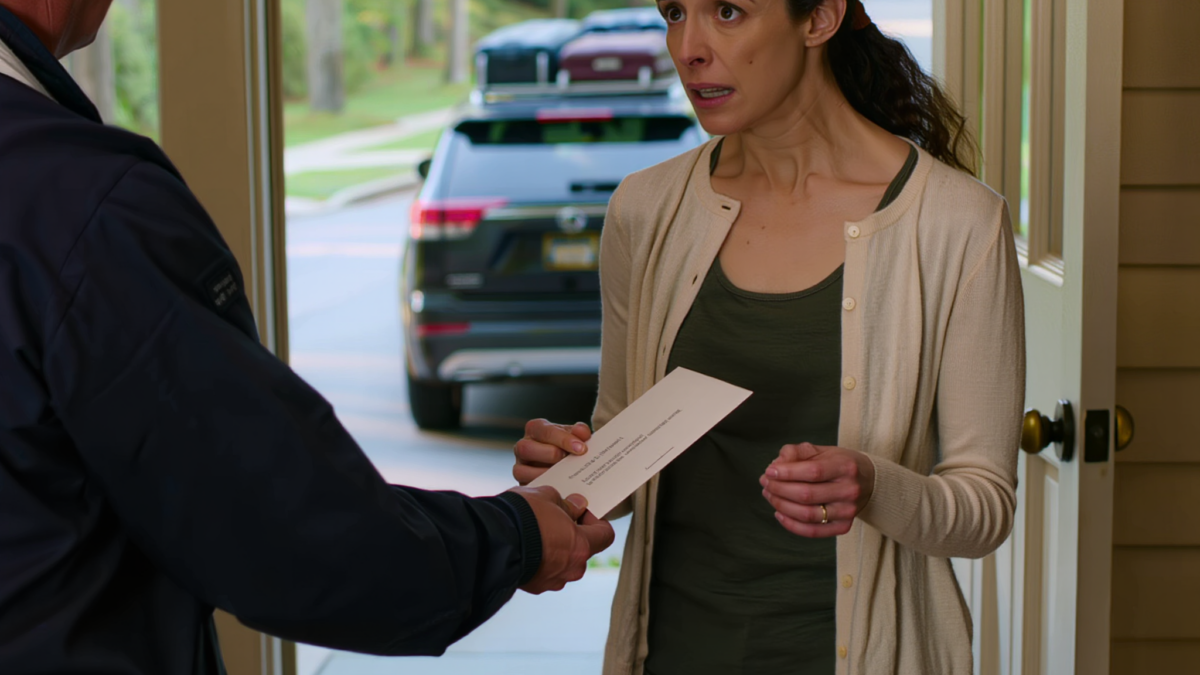
Then the doorbell rang.
A courier stood outside holding a rigid white envelope.
“Flora Helena Bennett?”
“Yes.”
“I need your signature.”
The return address belonged to Palmetto Coastal Bank.
Across the front, beneath my name, were the words:
BENEFICIARY ACKNOWLEDGMENT REQUIRED.
I almost told him he had the wrong person.
I didn’t have a trust account at Palmetto Coastal.
I had checking, savings, student loans, and about $4,300 I’d managed not to spend.
That was it.
I signed.
Inside was a notice regarding a proposed $186,000 loan secured by 127 Magnolia Street.
My address.
The borrower was not my father.
It was something called the Helena Bennett Family Trust.
I read the name twice.
Then I found the section labeled BENEFICIARY.
Flora Helena Bennett.
My hands started shaking.
The packet said the trust owned the house and that I was its sole remainder beneficiary.
My father was listed as trustee.
The loan was scheduled to close twelve days later—three days before my family returned from Europe.
The bank wanted my acknowledgment because the trust was scheduled to terminate when I turned twenty-five.
I would be twenty-five in eight months.
I called the number on the letter.
The banker verified my identity and confirmed the application was real.
Then she said, “Your trustee indicated you were aware of the transaction.”
“I’m not.”
There was a pause.
She told me the loan proceeds were supposed to go into the trust’s operating account for “property improvements and beneficiary support.”
I looked around the house.
The roof had been replaced the year before.
The kitchen had been remodeled eighteen months earlier.
Nothing needed $186,000.
Then the banker said something that made me sit down.
“This isn’t your first beneficiary acknowledgment, Ms. Bennett. We have signed annual disclosures from prior years.”
“I’ve never signed one.”
She went quiet again.
A minute later, she emailed me the most recent copy.
At the bottom was my name.
Flora H. Bennett.
And underneath it was a signature that looked enough like mine to fool someone who had never watched me write it.
I enlarged the signature on my laptop until it filled the screen. The first letter was wrong. I make my capital F in one continuous stroke. Whoever signed this stopped halfway through.
I called Palmetto Coastal again and told them I disputed every acknowledgment bearing my name. The banker immediately placed the $186,000 loan on hold. Then she sent me the trust’s mailing address. It wasn’t mine. It was my father’s insurance office downtown.
I searched county property records. The house wasn’t the only asset held by the Helena Bennett Family Trust. Two small rental condos near downtown Charleston were titled to it too. I had never heard of either property.
Then I found the name of the property-management company and called. A woman named Marisol Alvarez asked for my date of birth before answering anything.
When I gave it to her, she sounded confused.
“I’ve been sending your annual rent summaries to Mr. Bennett for six years,” she said.
“What rent summaries?”
There was a pause.
“The trust receives between $3,400 and $3,900 a month before expenses.”
I stopped breathing for a second.
My father had spent years telling me the household could barely afford my groceries.
I paid him $450 a month to sleep in the smallest bedroom.
Marisol emailed the most recent annual statement.
At the bottom was a line labeled BENEFICIARY SUPPORT REIMBURSEMENT.
My father had charged the trust $1,150 every month for housing and supporting me.
Then I saw another line.
EDUCATION DISTRIBUTION — $18,600.
The student named beside it wasn’t me.
It was Haley.
For several minutes, I just sat at the kitchen table.
The house was so quiet that I could hear the refrigerator cycle on and off.
I had imagined discovering some terrible family secret would feel explosive.
It didn’t.
It felt administrative.
Rows.
Dates.
Dollar amounts.
My name placed beside expenses I had never received.
Haley’s name where mine should have been.
I opened my banking app.
For the last three years, I had transferred $450 to my father on the first of every month.
Sometimes he reminded me a day early.
Adult life costs money, Flora.
Everyone contributes.
Thirty-six months.
$16,200.
At the same time, he had charged my mother’s trust $1,150 a month for my housing and support.
Another $41,400.
He had been collecting money for supporting me from both sides.
And I was the one who had spent nights shelving books because I thought I needed the extra income to pay him.
I called Marisol again.
“Can you send me older statements?”
“I need authorization.”
“I’m the beneficiary.”
“I understand, but Thomas is the trustee.”
That word suddenly sounded less like a title and more like a weapon.
“What can you give me legally?”
She hesitated.
“I can send anything already designated for beneficiary delivery. Those should have been going to you annually.”
“Should have?”
“Yes.”
“Have you ever sent them to me?”
“I send them to the address your trustee provides.”
“His office.”
“Yes.”
“Do the statements show where distributions go?”
“Some of them.”
“Send whatever you can.”
Twenty minutes later, five PDFs arrived.
I printed them because I needed paper in front of me.
The pattern was worse than the first year suggested.
2019: $12,400 labeled beneficiary education.
I had been nineteen and paying tuition with grants, federal loans, and bookstore wages.
The actual payment listed on the trust ledger went to St. Catherine Design Institute in Savannah.
Haley attended St. Catherine.
2020: $9,800 beneficiary education.
St. Catherine again.
2021: $14,250.
2022: $17,100.
2023: $18,600.
More than $72,000.
I had $31,000 in student loans.
My mother’s trust had apparently spent enough on “my education” to cover those loans twice.
Just not on me.
There were household reimbursements too.
Roof work.
Insurance.
Property tax.
Those at least made sense if the trust owned the house.
Then I found charges that didn’t.
$6,740: FAMILY WELLNESS TRAVEL.
$3,980: BENEFICIARY CULTURAL ENRICHMENT.
$8,250: EDUCATIONAL TRAVEL DEPOSIT.
The dates matched the months Dad and Rachel had started planning Europe.
I checked Rachel’s social media.
She had posted a photograph from the airport that morning.
Three passports.
Three champagne glasses.
Caption: Finally using that unexpected blessing exactly the way Uncle James would have wanted.
The “unexpected inheritance” Dad claimed had funded the trip.
I searched probate records for his uncle.
There was an estate.
I couldn’t see everything online, but I could see enough.
James Bennett had died leaving a modest estate primarily to his surviving partner and two charitable organizations.
Dad was not listed among the primary beneficiaries.
Maybe he had received something small.
Maybe not.
But by then I understood the more important point.
The trust ledger had already paid travel expenses.
My mother’s money was helping finance the vacation I had been told wasn’t for me.
I took photographs of every page.
Then I emailed copies to myself.
Then I stopped.
For the first time that day, I realized I was alone in a house controlled by someone whose financial records I had just started questioning.
Dad was in Europe.
That gave me time.
But it also meant I had no idea what he could access remotely.
I packed my laptop, passport, birth certificate, two changes of clothes, my mother’s few pieces of jewelry, and the printed trust statements.
I carried everything to my car.
Then I called my closest friend from school, Lena Brooks.
Lena lived with her aunt in West Ashley.
I told her I needed somewhere to stay for a few nights.
She did not ask why before saying yes.
That mattered.
On the drive there, Palmetto Coastal called.
The banker’s name was Simone Harris.
She told me the lender’s legal department had placed the loan into fraud review because I disputed the acknowledgment signatures.
“No funds will be released until we verify authority,” she said.
“Can my father undo that?”
“Not without resolving the beneficiary dispute.”
I gripped the steering wheel.
“Please note that I do not consent to any new debt secured by the trust property.”
“I already documented it.”
“What happens now?”
“You should speak with independent counsel.”
Independent.
The word stayed with me.
Everyone I knew connected to the house had always come through my father.
The accountant.
The insurance agent.
The property manager.
Even the maintenance company.
I needed someone who had never worked for Thomas Bennett.
At Lena’s kitchen table, I searched my mother’s full name plus “estate Charleston attorney.”
One name kept appearing in old public records.
Margaret Ellis.
Ellis & Wren Probate Law.
The office was still open.
I called at 4:12 p.m.
The receptionist asked what the matter concerned.
“The Helena Bennett Family Trust.”
She put me on hold.
A different woman answered.
“Flora?”
I froze.
“Yes.”
“This is Margaret Ellis.”
“You know who I am?”
“I drafted your mother’s estate plan.”
My throat tightened.
I had expected a lawyer.
I had not expected someone who knew my mother.
Margaret asked if I could come in the next morning.
I said yes.
Then she added, “Bring identification. And Flora?”
“Yes?”
“Please don’t sign anything your father sends you tonight.”
I barely slept.
Dad texted around midnight Charleston time.
Bank says there’s some confusion with the Magnolia loan. Did you call them?
I stared at the message.
Then another appeared.
It’s routine trust management. Nothing you need to worry about.
The same language he had used my whole life.
Nothing you need to worry about.
When Mom died.
When he remarried.
When he moved Rachel’s furniture into the house.
When Haley took the larger upstairs bedroom.
When I asked why money was always tight.
When I asked why I couldn’t see college financial documents.
Nothing you need to worry about.
I didn’t answer.
Margaret Ellis’s office occupied the second floor of a narrow historic building on Broad Street.
She was sixty-two, with silver hair cut at her jaw and the kind of direct gaze that made lying seem pointless.
She looked at my identification first.
Then she looked at me.
“You have Helena’s eyes.”
I wasn’t prepared for that.
I looked down at my hands.
Margaret did not push.
She placed a file on the table.
“Tell me what Thomas has told you about the trust.”
“Nothing.”
Her expression changed.
“Nothing?”
“I learned the name yesterday.”
She sat back.
For several seconds, she said nothing.
Then she opened the file.
My mother had created the Helena Bennett Family Trust two months after her diagnosis became terminal.
The trust owned the Magnolia Street house, two rental condominiums, and an investment account funded by property my grandparents had left her.
Thomas was named trustee because I was eight.
The arrangement was not unusual.
What mattered were the restrictions.
He could use trust income for taxes, insurance, repairs, and reasonable costs associated with my health, education, maintenance, and support.
He could not use principal for himself.
He could not make gifts to other family members.
He could not classify someone else’s tuition as my education.
He was required to keep records.
Starting when I turned eighteen, he was required to send me an annual accounting.
At twenty-five, the trust terminated and the remaining assets transferred to me outright.
I stared at Margaret.
“He was supposed to tell me at eighteen?”
“Yes.”
“He didn’t.”
“I know that now.”
“Why didn’t you contact me?”
“I tried.”
She pulled out correspondence.
Letters to Thomas.
Emails.
Certified notices.
The first letter had been sent two months before my eighteenth birthday.
Please provide Flora’s current email and phone number so we may conduct the beneficiary orientation required under Helena’s instructions.
Thomas replied that I was emotionally fragile after starting college and asked for a delay.
Six months later, Margaret wrote again.
He said I was overwhelmed.
A year later, he said I had asked him to continue handling everything.
“I never asked that.”
Margaret nodded.
“I know.”
Then she showed me an acknowledgment supposedly signed by me at nineteen.
Same bad F.
Another at twenty.
Another at twenty-one.
Four years of beneficiary statements.
Four signatures.
None mine.
I felt nauseous.
“I should have done more,” Margaret said.
Her voice was steady, but I could hear regret underneath it.
“Why didn’t you?”
“Because Thomas was the acting trustee, you were an adult living at the trust property, and we received documents purporting to show that you had been informed. I questioned it. Not enough.”
That answer was not satisfying.
It was, however, honest.
I preferred it to sympathy.
“What is the trust worth?”
Margaret handed me a current summary from the custodian.
The Magnolia house had been appraised the previous year at $612,000.
The condos were worth approximately $238,000 together.
The investment account held $104,600.
There was some debt attached to one condo.
Net trust value: about $878,000.
I laughed.
Not because anything was funny.
Because I had argued with Rachel over a $74 textbook the previous semester.
She told me to find a used copy.
I had eaten instant noodles for four nights because I didn’t want to ask Dad for money.
Nearly nine hundred thousand dollars sat inside a structure built to protect me.
And I didn’t even know its name.
Margaret let me absorb the number.
Then I asked the question that mattered more.
“How much should be there?”
“We need a forensic accounting.”
“What does that mean?”
“We reconstruct trust income, legitimate expenses, distributions, reimbursements, and asset performance. Then we compare what happened against what the trust permitted.”
“Can we stop him before he borrows against the house?”
“Yes.”
“How?”
“You can petition the probate court to suspend his trustee powers while the accounting is conducted.”
I immediately said, “Do it.”
Margaret did not reach for a form.
“Understand the consequence first.”
I waited.
“If the court suspends Thomas, an independent fiduciary will control trust accounts. Household expenses being paid by the trust may stop until reviewed. That could affect him and Rachel while they’re traveling. It will also almost certainly end any chance of handling this quietly.”
“They had eighteen years to handle it quietly.”
“You’re angry.”
“Yes.”
“Anger is allowed. I’m asking whether you’re making a legal decision or an emotional one.”
I thought about that.
Then I looked at the forged acknowledgments.
“My father is trying to put $186,000 of new debt on property he manages for me while I don’t even know the trust exists.”
Margaret nodded.
“That’s a legal reason.”
“I want him suspended.”
She reached for the petition.
That was my first real decision.
Not changing locks.
Not throwing suitcases onto the lawn.
Not shouting through a window.
I signed a sworn statement saying I had never received the annual accountings, never signed the acknowledgments, never consented to the pending loan, and never authorized trust funds to pay Haley’s education.
Signing it cost me something.
Once filed, this would no longer be a private wound I could minimize later.
It would become a record.
My father would know I had chosen evidence over protecting him.
I signed anyway.
The probate judge issued a temporary order two days later.
Thomas’s authority to borrow, transfer, or make non-routine distributions was suspended.
A professional fiduciary named Andrea Collins was appointed temporary special trustee.
Palmetto Coastal canceled the loan closing.
The trust investment account was restricted pending review.
Then something happened in Rome.
My phone rang at 4:38 a.m.
Rachel.
I silenced it.
She called again.
Then Dad.
Then Haley.
At 5:03, Dad texted.
What the hell did you do?
I did not answer.
The next message explained.
Their travel card had been declined at the Rome hotel.
I later learned it was a card linked to the trust’s operating account.
I had never known the card existed.
The independent trustee froze discretionary spending after seeing charges for airfare, luxury hotels, restaurant bills, and private tours coded as beneficiary cultural enrichment.
My father had other money.
They were not stranded.
But suddenly he had to use it.
He called Margaret before he called me again.
That was progress.
The forensic accounting began while they were still in Europe.
Andrea Collins requested seven years of records from banks, property managers, tax preparers, contractors, schools, and Dad’s insurance office.
Marisol Alvarez gave her every rent ledger.
She also produced emails.
One from 2020 stood out.
Please continue sweeping excess rental proceeds to household operating. Do not copy Flora on financials. She becomes anxious about money and I’m managing this for her benefit.
I read it three times.
I did become anxious about money.
Because Dad told me constantly that we didn’t have enough.
He created the fear, then used the fear as the reason to hide the thing that would have disproved it.
Another email involved my monthly $450 payments.
Marisol had asked whether Flora’s contribution should offset the trust’s support reimbursement.
Dad replied:
No. Her payment is household discipline, not reimbursement.
Household discipline.
I had worked twenty hours a week while taking classes because my father believed charging me rent taught responsibility.
At the same time, he billed the trust $1,150 every month for providing the housing I was paying him to receive.
That phrase became the first thing that made Andrea Collins openly angry.
Not visibly angry.
Accountant angry.
She underlined it twice.
The education payments were worse.
The trust agreement specifically allowed distributions for my tuition, books, training, and professional development.
I had never received them.
Instead, Thomas had instructed the custodian to pay Haley’s private-school tuition using distribution codes that identified me as the supported beneficiary.
He apparently assumed no one would question the school name.
He was wrong.
Andrea did.
The total paid toward Haley’s education from trust funds was $76,350.
Rachel’s defense, through an attorney, was that Haley had lived in the same household and that “family educational stability” indirectly benefited me.
Margaret read that sentence aloud once.
Then she removed her glasses.
“I’ve practiced trust law for thirty-four years,” she said. “That is a new one.”
The Europe trip had cost the trust $10,840 before the spending freeze.
None of it had been authorized by me.
None of it had anything to do with my education.
The hotels were booked for three people.
My name did not appear anywhere.
The same trust that supposedly funded my “cultural enrichment” had paid for a trip from which I was explicitly excluded.
Then Andrea found the renovations.
Some were legitimate.
The roof really had been replaced.
The HVAC work was real.
Property taxes were paid.
Insurance was current.
My father had not stolen everything.
That distinction mattered.
But several reimbursements were inflated.
A $6,200 kitchen repair had been charged to the trust as $14,900.
A contractor invoice for $3,750 became a $9,400 reimbursement.
A landscaping project on Magnolia Street included a $5,600 charge that actually covered work at a lake cabin Rachel’s brother owned.
There were more.
Small enough to disappear individually.
Large enough to matter together.
By the time the preliminary accounting was complete, Andrea estimated approximately $168,000 in questionable or clearly unauthorized distributions over seven years.
That number did not include lost investment growth.
It also did not include the $450 monthly payments I made from my own account.
Margaret asked if I wanted to include those in the civil claim.
“Yes.”
“Even though some of that money arguably covered groceries or utilities?”
“He was already reimbursing himself for my support.”
“Good answer.”
Not emotional.
Documented.
The family returned to Charleston four days early.
I did not meet them at Magnolia Street.
I wasn’t there.
I had moved my clothes, books, laptop, mother’s jewelry, and a box of childhood photographs to Lena’s aunt’s house.
My father texted when he discovered my room mostly empty.
Where are you?
Then:
You went through my financial records?
Then:
You had no right.
I almost replied to that one.
Almost.
Instead, I forwarded it to Margaret.
The following afternoon, Thomas appeared at Ellis & Wren without an appointment.
Margaret’s receptionist called me after security asked him to leave.
I felt guilty.
That surprised me.
After everything I knew, some part of me still pictured him as Dad arriving angry because his daughter had done something wrong.
The feeling lasted several minutes.
Then I remembered the forged F.
The mediation happened three weeks later.
Thomas sat across a conference table from me with his attorney.
Rachel sat beside him.
Haley was not there.
Dad looked older than he had before Europe.
Not ruined.
Not broken.
Just tired.
For most of my childhood, his irritation had been enough to make me apologize before I knew what I had done.
That day, he stared at me and I did not shrink.
“This has gotten ridiculous,” he said.
Margaret lifted a hand.
His attorney touched his sleeve.
Dad continued anyway.
“I managed those properties for sixteen years. I paid taxes. I dealt with tenants. I fixed roofs. I kept that house standing.”
“With trust money,” I said.
“With work.”
“I’m not saying you did nothing.”
He stopped.
I think he expected me to accuse him of stealing every dollar.
That would have been easier for him to dismiss.
I slid Andrea’s preliminary accounting across the table.
“I’m saying you used assets you were legally required to manage for me, hid them from me, forged acknowledgments in my name, charged the trust to support me while charging me rent, paid Haley’s tuition from my education distributions, and tried to borrow another one hundred eighty-six thousand dollars before the trust transferred to me.”
Rachel spoke for the first time.
“We never thought of Haley as taking from you.”
“That’s because you never told me there was anything to take.”
“She is your sister.”
“Then why wasn’t I family enough to go to Europe?”
Rachel looked away.
Dad leaned forward.
“You have no idea what it cost to raise you after your mother died.”
That sentence landed exactly where he intended.
For a moment, I was eight.
Hospital hallway.
Black dress.
My father holding my hand.
Everyone telling me I was lucky I still had him.
Then I looked at the accounting again.
“I know what the trust paid.”
His face changed.
It was not the answer he expected.
“You think money replaces raising a child?”
“No. I think raising your child doesn’t give you ownership of her inheritance.”
Silence.
His attorney asked for a break.
We took one.
In the restroom, I locked myself in a stall and cried so quietly no one outside could hear.
That embarrassed me until Margaret found me afterward.
“You can be correct and still grieve,” she said.
“I keep wanting him to say there’s an explanation.”
“There are explanations.”
“That make it okay?”
“No.”
That was the difference.
The mediation did not settle.
Dad wanted me to wait eight months until the trust terminated naturally.
He offered to cancel the loan, stop using trust funds for Haley, and provide future statements.
In exchange, I would withdraw the removal petition and agree not to pursue prior reimbursements.
Eight months earlier, I might have accepted just to keep him from being angry.
I said no.
The probate court hearing was held six weeks later.
There were no crowds.
No reporters.
No dramatic confession.
Andrea testified about the accounting.
Marisol testified about rental statements.
Margaret provided the original trust documents and her unanswered beneficiary notices.
The bank supplied the disputed acknowledgments.
Dad testified too.
He said he believed he had broad discretion as trustee.
He said family expenses benefited the household in which I lived.
He said the education payments for Haley were an error in classification.
He said the signatures on the beneficiary acknowledgments had been prepared by staff.
My attorney asked whether I had personally signed them.
“No.”
“Did you authorize anyone to sign them for you?”
Dad paused.
He said he believed I had delegated financial matters to him.
Margaret’s associate placed my expired minor-beneficiary forms beside the later acknowledgments.
No adult delegation existed.
That mattered.
The judge did not accuse my father of being evil.
She did something more important.
She removed him as trustee.
The written order found that he had failed to provide required disclosures, commingled beneficiary support with household expenses, approved distributions benefiting people other than me, and attempted to encumber trust property while material questions about prior administration remained unresolved.
Andrea Collins became permanent trustee until my twenty-fifth birthday.
The court ordered a final accounting and authorized recovery of improper payments.
Dad was also required to reimburse a portion of legal and accounting fees from his own assets rather than from the trust.
When the judge finished, my father did not look at me.
Rachel cried.
I didn’t.
Not then.
Outside the courthouse, Margaret asked if I felt better.
“No.”
“Good.”
I stared at her.
She smiled slightly.
“People expect legal clarity to feel like emotional closure. They are not the same thing.”
She was right.
The immediate consequence was practical.
Trust spending stopped.
The Magnolia house remained trust property, but Thomas and Rachel could no longer treat its accounts like a household wallet.
Andrea established a legitimate monthly occupancy arrangement.
Because they were living in property owned for my benefit, they had to pay fair but reduced rent while the case remained open.
Dad hated that.
For years, I had paid him to live in the trust’s house.
Now he was paying the trust.
I did not set the amount.
Andrea did.
That made it better.
The lake-cabin landscaping reimbursement was reversed.
The education payments to St. Catherine became part of the recovery claim.
The travel charges were reclassified as trustee personal expenditures.
Some items were contested.
Some were negotiated.
Nothing was as neat as the first spreadsheet suggested.
That was another thing I learned.
Financial abuse can be clear without every dollar being simple.
Haley contacted me about two months after the hearing.
Her first message said:
Can we talk without Mom and Dad?
I ignored it for a day.
Then I agreed to meet at a coffee shop near campus.
She arrived without makeup, wearing jeans and a university sweatshirt.
For once, she looked twenty instead of like Rachel’s polished extension.
She sat across from me and said, “I didn’t know.”
“About what?”
“The trust.”
“Any of it?”
“I knew your mom left you something. Dad always said it was small and locked up until you were twenty-five.”
“Did you know your tuition came from it?”
“No.”
I watched her face.
I believed that part.
Then she added, “I knew they treated you differently.”
That mattered too.
“You never said anything.”
“I was a kid.”
“You’re twenty.”
“I know.”
Neither of us spoke.
Haley stared at her coffee.
“I liked being the favorite,” she said.
It was the first brutally honest thing I had ever heard from her.
“I knew when Mom bought me things and told you there wasn’t money that it was unfair. I didn’t ask where the money came from. I didn’t want to.”
I felt something in me loosen.
Not forgiveness.
Recognition.
“You don’t owe me an apology for being sixteen,” I said. “You do owe me honesty now.”
She nodded.
“Dad says you’re trying to take the house.”
“The trust owns the house.”
“He says he made it a home.”
“He did. That doesn’t make it his.”
“What happens to us?”
“I don’t know yet.”
That answer frightened her.
It frightened me too.
For the first time, I had control approaching, and I did not know what I wanted to do with it.
Haley started working part-time that semester.
Rachel told relatives I had cut her off from tuition.
I hadn’t.
The trust had.
Because her tuition was never supposed to come from it.
Haley took a federal student loan and her parents covered part of the rest.
She did not drop out.
She did not become homeless.
She simply entered the financial world I had been living in since eighteen.
That distinction cured me of some guilt.
The final accounting was completed four months before my birthday.
After credits for legitimate maintenance, taxes, insurance, and permitted support, Andrea calculated $142,700 in unauthorized distributions and reimbursements.
With agreed lost earnings and part of my personal rent payments included, the civil recovery demand reached $171,300.
My father did not have that amount sitting in cash.
Settlement took another two months.
He agreed to repay $96,000 immediately from a brokerage account and retirement distribution.
The remaining amount became a secured five-year repayment obligation.
Rachel surrendered claims to several reimbursements she had previously argued were household expenses.
No one went to prison.
No police dragged anyone away.
The signature issue was referred to the appropriate authorities through counsel, but I did not build my life around whether criminal charges followed.
The thing I needed was already happening.
The assets were being protected.
The records were corrected.
My father no longer controlled them.
Two weeks before my twenty-fifth birthday, Dad asked to meet alone.
I said no.
He asked again.
I agreed only if Margaret’s office hosted it.
He came without Rachel.
For the first time in my life, he looked nervous around me.
We sat in a smaller conference room.
No lawyers at the table, though Margaret was nearby.
Dad placed his hands together.
“I know you think I hated you.”
“I don’t know what you felt.”
“I didn’t hate you.”
“Okay.”
He looked frustrated by the answer.
“When Helena died, I had a child, properties, tenants, bills, and a business that wasn’t doing well. Then I met Rachel. Life kept moving.”
“I know.”
“I used trust income to keep the household stable.”
“You also used it for Haley.”
“She became my daughter too.”
“I never said she shouldn’t have had anything.”
“You act like I chose her instead of you.”
“You did sometimes.”
He looked away.
I continued.
“What I can’t understand is why you let me believe I was costing you money.”
He rubbed his forehead.
“I wanted you to learn to work.”
“I worked.”
“I didn’t want you growing up entitled because there was property waiting.”
“You could have taught me responsibility without lying.”
“I thought knowing about nearly a million dollars at eighteen would ruin you.”
“So you used it instead?”
His face tightened.
That was the closest we came to the real issue.
He had convinced himself that controlling the money meant controlling the danger.
Then the control became convenient.
And convenience became entitlement.
“You should have told me,” I said.
“I know.”
It was the first sentence of accountability he had given me.
Not enough.
But real.
Then he added, “I should never have let those acknowledgments go through in your name.”
“Did you sign them?”
He looked at me.
“I signed some.”
There it was.
No courtroom breakdown.
No dramatic confession.
Just six words in a quiet office.
“What about the others?”
“Rachel’s assistant handled paperwork.”
“Did Rachel know?”
“She knew you weren’t getting statements.”
I sat back.
For years, I had imagined that if I ever got the truth, I would feel powerful.
Mostly I felt tired.
“Why the Europe trip?”
Dad gave a sad laugh.
“Rachel wanted one big family trip before Haley transferred schools.”
“Family.”
He knew.
“I was angry when you asked to come.”
“Why?”
“Because you always reminded me that there was another part of my life before Rachel.”
The sentence hurt more than the money.
I think he realized that after he said it.
He closed his eyes.
“I’m sorry.”
I stood.
Not because I wanted to punish him.
Because the meeting was finished.
“I believe you’re sorry now,” I said. “That doesn’t make me ready to be your daughter the way I was before.”
I left.
On my twenty-fifth birthday, the Helena Bennett Family Trust terminated according to its terms.
The remaining assets transferred to me.
The process took paperwork, tax planning, deeds, and more signatures than any birthday should require.
But by the end of the month, the Magnolia house, the two condos, and the investment account were under my direct ownership.
Everyone expected me to move into the master bedroom and reclaim the house.
I didn’t.
I had spent too many years believing possession of that building would finally prove I belonged.
By then, I understood something better.
I did not want to build my adult life inside rooms where I had learned to disappear.
I gave Dad and Rachel six months to find another place.
Not because a court required that much.
Because I chose it.
They paid rent during that period.
No special favors.
No humiliation.
A written lease.
A security deposit.
Normal rules.
Haley moved into a campus apartment with two roommates before they left.
When the six months ended, Dad and Rachel rented a townhouse outside Charleston.
I did not stand at the door when they packed.
I did not change the locks while they were at dinner.
I did not watch from a window.
A property manager handled the final inspection.
The house was empty when I returned.
I walked through every room alone.
The master bedroom.
Haley’s old room.
Dad’s office.
My small bedroom at the end of the hall.
The walls were bare.
Without furniture, the hierarchy disappeared.
Rooms were just rooms.
I sat on the floor of my old bedroom.
For a while, I thought about the eighteen-year-old version of me counting bookstore tips so I could pay my father rent.
I wanted to tell her something.
Not that she was secretly rich.
Money was not the point.
I wanted to tell her she was not expensive.
She was not inconvenient.
She was not being generously tolerated.
She had been a child whose security had already been planned for by a mother who knew she might not survive to provide it herself.
The adults around her had changed the story.
The story had never been true.
I sold Magnolia Street the following spring.
That surprised almost everyone.
Haley asked why.
Dad did not ask.
I think he understood.
A family with two young children bought it.
The mother loved the old staircase.
The father wanted space for a workshop.
Their daughter, maybe seven, chose my old bedroom because the afternoon sun hit that window first.
I almost laughed.
At closing, I signed the deed myself.
No trustee.
No forged acknowledgment.
No one else’s permission.
I kept one rental condo as an investment and sold the other to reduce concentration in real estate.
I paid off my student loans.
That was one of the strangest checks I ever wrote.
The money that should have helped fund my education finally finished paying for it.
I completed my degree the next semester.
I accepted a full-time position with a Charleston preservation firm that restored historic schools, neighborhood theaters, and small civic buildings.
I could have stopped working.
I didn’t want to.
For the first time, work was something I chose rather than proof that I deserved space.
I rented a small apartment near Hampton Park.
Two bedrooms.
Nothing grand.
One room became my office.
The other was mine.
I painted it deep blue.
The color I had wanted when I was sixteen.
The entire job cost less than two hundred dollars.
I laughed when I saw the receipt.
Rachel had once told me repainting was an expense the family couldn’t justify.
Some memories become funny only after they lose authority over you.
Haley and I developed something that might eventually become a real sister relationship.
Slowly.
She apologized without asking me to say it was okay.
That helped.
She got a job at a gallery.
She began paying part of her own tuition.
Once, she called because her car needed an $800 repair.
I waited for the familiar request.
It never came.
She just complained about the price.
Then she said, “I picked up two extra weekend shifts.”
I smiled after we hung up.
Not because she had suffered.
Because she had solved her own problem.
Dad wrote me a check every quarter under the repayment agreement.
The first few came with notes.
I’m sorry.
I hope you’ll call.
I miss you.
Eventually the notes stopped.
The checks continued.
That was better.
Rachel and I had no relationship.
She sent one long email accusing me of reducing fifteen years of family life to spreadsheets and legal documents.
I did not answer.
The spreadsheets were not the whole relationship.
They were simply the part she could no longer explain away.
A year after the trust ended, Margaret gave me a sealed envelope.
It had been stored with the original estate file.
My mother had written my name on it.
Not instructions.
Not asset lists.
Just Flora.
I took it home before opening it.
The letter was shorter than I expected.
Mom wrote that she hoped I grew into someone curious and kind.
She wrote that property could create freedom but never belonging.
She wrote that I should never confuse financial independence with emotional isolation.
The last paragraph said:
I cannot choose every person who will enter your life after I’m gone. I can only leave you enough security that fear never has to make those choices for you.
I read that line several times.
For years, fear had made nearly every choice.
Fear of Dad’s anger.
Fear of being ungrateful.
Fear of losing the only family I had left.
Fear of rent.
Fear of tuition.
Fear of being the difficult daughter.
The money mattered because it removed some of those fears.
But the documents did something else.
They showed me how many fears had been manufactured.
That was the part I never gave back.
Two years after the Europe trip, Haley sent me a photograph from Barcelona.
She had saved for the trip herself.
She was standing in front of a narrow street lined with balconies, smiling beside two friends.
Her message said:
Not a “family trip.” Just mine.
I replied:
Looks better that way.
She sent a laughing emoji.
Then:
I wish we’d handled everything differently back then.
I thought about it before answering.
So do I.
That was enough.
I still travel.
The first trip I took after the case was not Europe.
It was a four-day drive through North Carolina to visit old textile towns for a preservation project.
I paid for my own hotel.
I chose every stop.
No one decided whether I belonged.
The freedom was almost boring.
That is one of the best things about it.
People sometimes imagine reclaiming your life feels dramatic.
Mine mostly feels quiet.
A key that only I authorized.
A bank statement delivered to my address.
A room painted the color I chose.
A paycheck I do not have to hand over to prove I am responsible.
A phone call I can decline without panicking.
A family dinner I attend because I want to be there.
I used to think being excluded from Europe was the moment my family finally rejected me.
Now I think it was the moment their version of the family stopped working on me.
They left.
A letter arrived.
And for the first time, the paperwork told me a story more truthful than the people around me had.
I was never the burden living in someone else’s house.
I was a child whose mother had tried to leave her security.
My father was supposed to guard it.
Instead, he decided I was safer not knowing.
Then safer became easier.
And easier became profitable.
I cannot change those years.
I can decide what they mean.
They do not mean I was foolish.
Children are supposed to trust their parents.
They do not mean every good memory was fake.
Some were real.
They do not mean I need to hate my father forever.
Anger and access are different things.
I can stop being angry someday and still never give him control over my life again.
That has become my definition of a boundary.
Not punishment.
Not revenge.
A fact.
This is mine.
That is yours.
You do not cross the line without my permission.
The first certified envelope from Palmetto Coastal is still in a file cabinet in my apartment.
Sometimes I think about throwing it away.
I probably will eventually.
For now, I keep it beside my mother’s letter and the final trustee accounting.
One document showed me how badly the system around me had failed.
The other reminded me why the system existed at all.
Between them is the life I have now.
Not inherited.
Not stolen.
Not borrowed.
Mine.







