At My Brother’s Wedding, My Parents Said My Lake House Would Secure His Loan

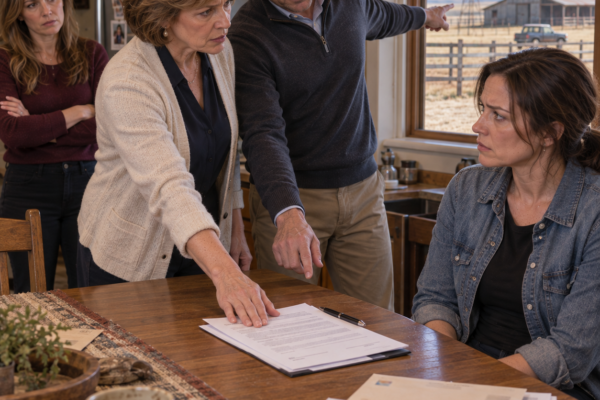
My mother slid a silver pen across the linen table at my brother’s wedding reception and said, “Sign the lake-house collateral papers before you leave. Dylan’s lender needs them Monday.”
I stared at her.
“Dylan’s lender needs my house?”
Janice lowered her voice, but not enough to make the conversation private.
“It’s temporary. Six months, maybe less.”
The house she meant was a two-bedroom cottage I owned near Port Washington, Wisconsin.
I bought it three years earlier after a decade of consulting work, missed weekends, and more hotel rooms than I wanted to remember. It wasn’t a mansion. It had old cedar siding, a narrow deck, and a view of Lake Michigan that made my brain finally stop running when I sat outside with coffee.
It was also mine.
My brother Dylan was getting married ten feet away.
His new wife, Brooke, was laughing with bridesmaids near the dance floor.
Apparently their wedding day also included a financing deadline nobody had mentioned to me.
My father, Robert, joined us.
“It’s additional collateral, Carrie. Nothing more.”
“For what?”
“The house they’re buying.”
I looked at Dylan.
He had spent the previous year rebuilding his credit after a restaurant partnership failed. I knew he and Brooke wanted a house after the wedding.
I did not know their plan involved mine.
Janice pushed the folder closer.
“The private lender is advancing two hundred ten thousand. Your cottage just gives them security while Dylan gets everything settled.”
“What does ‘everything’ mean?”
Robert sighed.
“Don’t turn this into a work meeting.”
I was thirty-six and worked in cybersecurity compliance for a regional insurance company. In my family, asking what a document actually did was regularly described as “turning things into work.”
Five years earlier, the same pattern had already cost more than I liked admitting. My parents had emptied most of their emergency savings helping Dylan keep his restaurant partnership alive. When the business finally folded, they could no longer qualify for the mortgage on the house they wanted after downsizing. I bought a small bungalow in Wauwatosa and let them live there for what we all called “a year or two.” They were still there, rent-free.
I never used that history as a weapon.
I also never imagined they would treat it as evidence that my property was a family reserve account.
At the wedding, I had already spent the evening listening to relatives joke that Dylan was finally becoming “the responsible one.” Nobody mentioned who had covered my parents’ property taxes, insurance, and major repairs while he rebuilt his credit.
I opened the packet.
The first page called me a third-party collateral owner.
The next said I would grant a mortgage against the cottage until the bridge loan was repaid.
My signature line was blank.
Good.
Then I reached the appraisal.
Estimated value: $438,000.
Inspection date: Tuesday.
I had spent Tuesday in Milwaukee.
Nobody had asked to inspect the cottage.
I flipped through six interior photographs.
Living room.
Kitchen.
Upstairs bedroom.
The sliding door facing the lake.
Photos taken from inside my house.
My chest went cold.
“Who let the appraiser in?”
Neither of my parents answered.
Dylan had finally noticed the three of us standing together.
He walked over, still wearing his tuxedo jacket.
“Can we not do this tonight?”
I looked at him.
“You had my house appraised without telling me.”
His face tightened.
“It was just valuation work.”
“Who gave them access?”
“Carrie.”
“Who?”
Janice touched my wrist.
“Your father still has an emergency key.”
I pulled my hand away.
That key existed because Robert had once driven up during a frozen-pipe scare while I was traveling.
Not so he could admit lenders into my home.
Brooke approached slowly.
“What’s going on?”
Dylan answered before I could.
“Nothing. Family paperwork.”
She looked at the folder.
“Is that the cabin guarantee?”
Guarantee.
Not surprise.
I looked at her.
“You knew about this?”
Brooke’s smile disappeared.
“Dylan said you offered to help with the bridge loan.”
Every sound in the ballroom seemed to move farther away.
I looked back at my brother.
“I never offered my house.”
He swallowed.
Then my mother said the sentence that made the whole thing worse.
“Well, we knew you would once you understood how much he needed it.”
I didn’t sign anything. The next morning, I called the lender using the number on the appraisal packet. I told the closing officer I owned the cottage and had never agreed to pledge it. Her tone changed immediately. She said the loan had not funded and could not close without my notarized collateral documents.
Then I asked who told them I had agreed. She would only say the file contained a representation that “family consent had been obtained in principle.” I asked about the appraisal. That she could explain. Their appraiser had been met at the cottage Tuesday afternoon by Robert Mercer. My father.
He identified himself as the property owner’s father and said I had authorized access. I opened my porch-camera archive. Tuesday, 2:14 p.m. There was my father unlocking the front door for a man carrying a tablet and laser measure. At 2:46, they came back outside. Before leaving, Robert tested the lock twice and put my emergency key in his pocket.
I saved the clip. Then the lender emailed me a copy of the preliminary collateral schedule. The cottage wasn’t the only strange thing in it. Under “Use of Proceeds,” the first line was not Dylan and Brooke’s down payment. It was a $54,000 reimbursement to Robert and Janice Mercer.
I had no idea my parents were supposed to receive money from my brother’s loan.
The $54,000 reimbursement sat on the page like a second argument nobody had bothered to make out loud.
I called Dana Kim before breakfast.
Dana had handled the closing when I bought the cottage and later helped me set up a simple estate plan. She was a real-estate attorney, which meant she cared about recorded documents more than family explanations.
That morning, I was grateful for it.
I sent her the appraisal, the collateral packet, the camera clip, and the preliminary use-of-proceeds schedule.
She called back an hour later.
“First, the good news. There is no recorded mortgage against the cottage.”
I exhaled.
“Second, the loan cannot close against your property unless you sign the required mortgage and collateral documents.”
“Good.”
“Third, your family has already done enough that I want everything preserved.”
“What does that mean?”
“It means stop debating them.”
That was harder than it sounded.
By noon, my phone contained nine messages from Janice, four from Robert, and six from Dylan.
My mother’s messages moved through every familiar stage.
Please call me.
You misunderstood.
Nobody was taking your house.
We were trying to help Dylan start his marriage without carrying the consequences of one bad business year forever.
Then:
I cannot believe you embarrassed us by contacting the lender directly.
That one was almost impressive.
My father was less emotional.
He wrote:
Let’s sit down after the wedding weekend and go through the numbers. The $54k is explainable.
Dylan sent only one sentence at first.
Brooke is furious because you made this sound like fraud.
I stared at it.
Then I answered the only message I sent that day.
I told the lender I did not consent to my property being used as collateral. Everything else is your explanation to give.
Dana sent formal written notice to the lender before lunch stating that I had not authorized any mortgage, guarantee, appraisal access, or collateral pledge involving the cottage. She also requested that all communications and supporting materials relating to my property be preserved.
Then she ordered a title report.
Nothing had been recorded.
No lien.
No deed transfer.
No mysterious ownership filing.
I was still the sole owner.
That mattered.
The situation was bad enough without turning it into a fantasy where my family had somehow stolen a house through one form.
What they had done was simpler.
They had built an entire financial plan around the expectation that I would eventually sign.
I changed the cottage locks that afternoon.
Not because I thought Robert would race back there.
Because the emergency key no longer felt like an emergency key.
It felt like access I had granted for one purpose and watched get converted into another.
The locksmith asked whether I wanted five copies.
“Two.”
“Family?”
“One for me. One for my attorney’s file.”
He looked at me like that answer carried a story.
He was right.
The bungalow my parents lived in was a separate problem.
Five years earlier, Dylan had opened a restaurant with a college friend.
The place had good reviews and terrible cash flow.
When the partnership started missing vendor payments, Robert and Janice used most of their liquid savings to keep it going.
Then they guaranteed a short-term business note.
When the restaurant closed, the guarantee followed them home.
They sold their old house before the lender could become part of every conversation and moved into a rental.
I had been thirty-one, newly promoted, and making more money than anyone in my family understood.
I bought a small two-bedroom bungalow in Wauwatosa for $318,000.
My parents moved in.
No rent.
They covered utilities.
I covered the mortgage, taxes, insurance, and major repairs.
The plan was eighteen months while they rebuilt savings.
Then two years.
Then “until things settle.”
Five years later, my mother had a vegetable garden behind a house she referred to as ours whenever a repair bill appeared and theirs whenever I mentioned paperwork.
I had never resented helping them enough to end the arrangement.
What I resented now was realizing the arrangement had taught everyone the wrong lesson.
I thought I had given my parents housing.
They seemed to have learned that my assets existed wherever the family needed them.
Dana asked whether I wanted to change anything about the bungalow immediately.
“No.”
“Why not?”
“Because they’re angry, not dangerous.”
“That wasn’t my question.”
I rubbed my forehead.
“I don’t want this to become retaliation.”
“Good.”
She waited.
“What do you want it to become?”
I thought about Robert unlocking my cottage for an appraiser.
“Documented.”
“That I can help with.”
We drafted a written occupancy agreement.
Six months.
Below-market rent of $900 a month beginning January 1.
They would keep utilities in their names.
No subletting.
No business storage for Dylan.
No changes to locks without written permission.
No access to any other property I owned without separate consent.
At the end of six months, we would either sign a normal lease or they would make other housing arrangements.
I did not send it yet.
Dana told me to wait until we understood the loan.
That was becoming the theme of my week.
Understand first.
Act second.
It was not nearly as satisfying as anger.
It was much more useful.
Brooke called me Monday morning.
I almost let it go to voicemail.
Then I answered.
“Hi.”
She sounded exhausted.
“Carrie, I need to ask you something, and I need you not to protect Dylan when you answer.”
That got my attention.
“Okay.”
“Did you ever tell him you would use the cottage to help us get the house?”
“No.”
Not “not exactly.”
Not “we discussed helping.”
No.
Brooke was quiet.
“He told me you had offered the cabin as temporary security because you knew his credit was still recovering.”
“I never offered that.”
“He said your parents were handling the paperwork with you because you were busy.”
“They were handling paperwork. Just not with my permission.”
Another silence.
Then she said, “I’m sorry.”
“You don’t owe me the first apology.”
“I’ve been looking at houses for three months because I thought the financing was settled.”
That sentence helped me understand her role.
At the reception, Brooke had looked surprised by the argument, not by the existence of the loan. Dylan had told her the loan was legitimate because I had already agreed.
She had believed her husband.
That was not unreasonable.
“What did Dylan tell you the $210,000 was for?” I asked.
“Down payment and bridge financing until his credit improves.”
“Anything about your in-laws being reimbursed fifty-four thousand?”
“No.”
“Anything about old restaurant debt?”
“No.”
Her breath changed.
“What old restaurant debt?”
I told her what I knew, which wasn’t much.
Then I stopped.
“I think you should ask Dylan.”
“I will.”
An hour later, Dylan called.
This time I answered.
“What did you tell Brooke?”
“The truth.”
“You had no right to drag business debt into my marriage.”
I almost laughed.
“The business debt is in the loan you wanted secured by my cottage.”
“That is not the same thing.”
“Then explain the difference.”
He was quiet for a second.
“The lender wanted everything cleaned up at closing.”
“What is everything?”
“Vendor settlements.”
“How much?”
“Carrie.”
“How much?”
“Forty-two thousand.”
I wrote it down.
“And the fifty-four to Mom and Dad?”
“They floated money for me.”
“For what?”
“Some of the same obligations.”
“Why is their reimbursement in the bridge loan?”
“Because they should not have to lose retirement money over a business that failed.”
I leaned back in my chair.
There it was.
A sentence that sounded reasonable until you finished tracing where the replacement money was supposed to come from.
My house.
“So instead I should risk my property.”
“It is collateral, not a gift.”
“That is risk.”
“The loan term is short.”
“That is still risk.”
“You always do this.”
“What?”
“You hear one bad possibility and act like it is guaranteed.”
“I work in compliance. I hear a contract and read what it allows.”
He exhaled hard.
“The cottage has equity. Nobody expects the loan to default.”
“Then secure it with something you own.”
That stopped him.
He said, “I don’t have anything with enough equity.”
“I know.”
It was crueler than I intended.
I regretted the tone immediately.
Not the point.
Dylan’s restaurant failure had not made him stupid or worthless.
He had tried something.
It failed.
What made this different was what he had done afterward.
He had turned my stability into replacement collateral.
“You could have asked me,” I said.
“I knew you’d overthink it.”
“That is not a reason to skip consent.”
“You would have said no before understanding the full picture.”
“Correct.”
He made a sound of disbelief.
“You hear yourself?”
“Yes.”
That ended the call.
By Tuesday, Dana had received more of the lender file.
The private lender was a regional investment group that specialized in short-duration real-estate and business bridge loans.
The structure was more complicated than my parents had described at the wedding.
Borrowers: Robert and Janice Mercer.
Co-borrower: Dylan Mercer.
Loan amount: $210,000.
Term: twelve months.
Interest rate: high enough that I read it twice.
Collateral: my Port Washington cottage, subject to my execution of a third-party mortgage and limited guaranty.
The proposed uses of proceeds were listed clearly.
$54,000 reimbursement to Robert and Janice for advances previously made on Dylan’s behalf.
$42,000 to settle remaining vendor and equipment claims from the restaurant.
$89,000 reserved toward Dylan and Brooke’s home purchase and closing requirements.
The remainder covered fees, interest reserves, and transaction costs.
This was not a simple down-payment loan.
It was a cleanup package.
My cottage was supposed to absorb the risk of decisions made by three other adults.
Dana read the schedule beside me.
“Did anyone ever send you this?”
“No.”
“Did anyone ever send you the promissory note?”
“No.”
“Did anyone explain the rate?”
“No.”
“Did anyone tell you Robert and Janice are actual borrowers?”
“No.”
She closed the file.
“Then stop calling this a family favor in your head.”
“I’m not.”
“You are a little.”
I looked at her.
She was right.
I still had the instinct to soften the language because the people involved had once driven me to school, sat through hospital waiting rooms, and mailed birthday cards.
Family history makes accurate nouns feel disloyal.
Loan.
Collateral.
Borrower.
Consent.
Risk.
None of those words cared who had made Thanksgiving dinner when I was twelve.
The family group chat found me before the next document did.
My aunt Carol wrote first.
I heard there was some confusion about Dylan’s house financing. Can everyone please remember this is supposed to be a happy week?
My cousin Mark added a thumbs-up.
Then Janice wrote:
Carrie is understandably cautious because she deals with risk all day. We are giving her time to see that nobody is asking her to give anything away.
I read that sentence twice.
Then I typed:
A lender asked me to mortgage my cottage for a $210,000 loan I did not request, after an appraisal I did not authorize. That is not confusion.
I attached nothing.
I did not mention Dylan’s business debt.
I did not mention the $54,000 repayment to my parents.
I wanted to see whether anybody would correct my mother’s version without being forced.
Nobody did.
Twenty minutes later, Robert called.
“You didn’t need to put the amount in the family chat.”
“Mom put the issue in the family chat.”
“She was trying to calm people down.”
“By describing it inaccurately.”
“You know what she meant.”
That phrase had done a remarkable amount of work in my family.
You know what she meant.
You know how Dylan is.
You know your father hates conflict.
You know Mom worries.
Translated, it usually meant:
Please absorb the difference between what happened and the version that creates the least trouble.
“I know what the loan says,” I answered.
Robert was quiet.
Then he said, “I’ll bring the cabin key back.”
“Dana already had the locks changed.”
The hurt in his silence surprised me.
“You changed them?”
“Yes.”
“I would never go back there without asking.”
“You already did.”
That ended the call.
The next day, a padded envelope arrived at Dana’s office.
Inside was the old brass cottage key.
No note.
I held it in my palm.
My father had always been the parent I trusted more with practical things.
He taught me how to change a tire.
He drove across town when my first apartment flooded.
When I bought the cottage, he spent two weekends helping replace rotten deck boards and refused to let me pay him.
The security footage did not erase those memories.
The memories did not erase the footage.
I was learning to hold both.
Dana finally told me to send the bungalow occupancy agreement.
I emailed it to my parents with a short note.
I am not asking you to move immediately. The informal arrangement needs to become written. This agreement gives us six months to decide what happens next.
Janice called before I finished my coffee.
“Nine hundred dollars?”
“It’s below half the market rent.”
“We are your parents.”
“Yes.”
“We lost our house helping your brother.”
“I know.”
“And now you are charging us because we tried to help him again.”
“No. I’m documenting an arrangement that should have been documented years ago.”
“Do you hear yourself?”
Apparently everybody in my family had discovered that question at once.
“Yes.”
She began crying.
Real crying.
That made it harder.
“I thought we had one child we could depend on.”
I closed my eyes.
That sentence contained my entire childhood in eleven words.
Dylan was the child who needed chances.
I was the child who could be depended on.
One role received forgiveness.
The other received invoices.
“I’m still your daughter,” I said.
“You don’t act like it.”
“What would acting like it require?”
She didn’t answer directly.
“You have two houses.”
There it was.
“Mom.”
“Your father and I have nothing in our names now.”
“You live in a house I bought.”
“And apparently that can disappear whenever you’re angry.”
“It hasn’t disappeared.”
“You’re threatening us with a lease.”
“A lease is not a threat.”
“It is when family never needed one before.”
Maybe that was true.
Maybe the absence of paperwork had always been part of what made my help feel like love.
But the absence of paperwork had also become the space where my family rewrote expectations.
“I’m not discussing the cottage or the bungalow without Dana now.”
Janice’s crying stopped faster than I expected.
“You brought a lawyer into this family.”
“No. The loan brought a lawyer into my property.”
She hung up.
I sat at my desk for ten minutes after the call without opening my laptop.
At work, I spent my days telling executives that controls were not insults.
Authentication was not mistrust.
Dual approval was not an accusation.
Documentation was what allowed reasonable people to work together when memories, incentives, and pressure changed.
At home, I had somehow believed love made those principles unnecessary.
Brooke texted that afternoon.
Dylan finally showed me the use-of-proceeds sheet.
Then:
I did not know.
I believed her.
She asked if I had a few minutes to talk.
We met at a coffee shop near my office.
She arrived without makeup and looked younger than she had at the wedding.
“I’m not leaving him,” she said before sitting down.
“I didn’t ask you to.”
“I know. I just don’t want this conversation to become that.”
“Okay.”
She wrapped both hands around her coffee.
“I’m angry.”
“You should probably be angry at him, not me.”
“I am.”
Then she told me something I had not known.
Dylan had described the bridge financing as a temporary family loan that would be repaid after he sold his remaining interest in restaurant equipment and after his credit improved enough to refinance.
He had not told Brooke that my parents were borrowers.
He had not told her about the $42,000 in old claims.
He had not told her my parents were being reimbursed.
And he definitely had not told her the cottage was the only real estate securing the loan.
“He said you had offered it because you hardly ever use it in winter.”
I laughed once.
“I use it whenever I want.”
“I know that now.”
Brooke looked embarrassed.
“I picked paint colors.”
“For the cottage?”
“No. God, no. For the house we were buying.”
That distinction mattered.
She had not been dreaming about taking my property.
She had been dreaming about a house she believed they could finance legitimately.
“I’m sorry,” she said.
I nodded.
Then she asked, “If you don’t sign, what happens?”
“I don’t know.”
That was true.
For the first time, nobody in the conversation treated my answer as the mechanism that had to save everybody else.
Dana received the lender correspondence on Thursday.
The lender had been cooperative once it understood I disputed the property pledge. Its position was simple: the loan had always been conditional on my independently signed documents. No money had funded. No mortgage had been recorded. The firm wanted the file cleaned up as much as I did.
That file included twenty-seven emails.
Most were boring.
Income verification.
Appraisal scheduling.
Requests for tax returns.
Questions about Dylan’s old business liabilities.
Then I reached an email from Janice.
Subject: Third-party collateral timing.
The lender’s closing officer had written:
We still need direct confirmation from Ms. Mercer that she is willing to pledge the Port Washington property. We cannot rely solely on family representations.
My mother replied:
Carrie understands she is helping Dylan. She is cautious about documents and will want to review everything, but she always comes through for family once she sees there is no other practical option. We are planning to have her sign after the wedding when everyone is together.
The email was dated eleven days before the wedding.
I stopped.
Dana kept reading.
A later message from the lender said:
Please do not incur nonrefundable obligations based on anticipated collateral approval. The loan remains conditional.
Janice answered:
Understood. We are already committed on several items, but Carrie will not let us lose money over paperwork.
I felt the room get very still.
“What items?” I asked.
Dana turned another page.
The next email was from Robert.
He attached proof of a $54,000 withdrawal from a retirement account and wrote that the funds had been advanced to resolve Dylan’s vendor claims so the bridge loan could close cleanly.
The loan proceeds were supposed to reimburse them.
They had spent the money first.
Then they told the lender I would prevent the loss.
Another attachment showed $22,000 in wedding and housing deposits charged across two credit cards in Robert and Janice’s names.
Not all of it was directly tied to the home purchase.
Some was wedding expense.
Some was a refundable reservation deposit for the new house.
Some was not refundable.
My parents had overextended themselves across multiple promises and treated my cottage as the asset that would make the whole structure hold.
I looked at Dana.
“They did this before I knew there was a loan.”
“Yes.”
“They were warned not to.”
“Yes.”
“And Mom said I’d sign because I wouldn’t let them lose money.”
“Yes.”
There was one more email.
Dylan to the lender, copied to my parents.
Carrie is conservative but she has substantial equity and no dependents. She will understand that using idle property for temporary collateral is the logical choice.
Idle property.
I read that phrase twice.
My cottage had become idle because I was single.
My savings had become available because I had no children.
My ability to say no had become temporary because other people had committed money first.
That was the Main Reveal for me.
The plan had never been to ask for a favor and accept my answer.
The plan was to create enough sunk cost, urgency, family audience, and emotional consequence that refusal would become socially expensive.
They had built the pressure before they ever showed me the papers.
The wedding was not unlucky timing.
The wedding was leverage.
Dana watched me read.
“What are you thinking?”
“I want to sell everything.”
She waited.
“The cottage. The bungalow. I want nothing they can point at.”
“Do you actually want to sell?”
I hated that question immediately.
“I want them unable to touch it.”
“That is different.”
I stood and walked to the window.
Milwaukee traffic moved below us.
People changed lanes.
A bus stopped.
Nobody knew my mother had turned my brother’s wedding into a closing strategy.
“I don’t know what I want.”
“Then don’t transfer permanent property because you are having a temporary emotional response.”
That sentence probably saved me from making a decision I would have regretted.
I sat back down.
“What can I do now?”
“Refuse the collateral. Formally.”
“Done.”
“Secure access.”
“Done.”
“Decide whether you want your parents to remain in the bungalow under the written terms.”
“I don’t know.”
“You have six months to decide.”
“And Dylan?”
“Dylan handles Dylan.”
That sounded almost cruel.
It also sounded like the boundary my family had spent years avoiding.
The lender terminated the proposed bridge transaction the next day after receiving my formal refusal.
Not because I ordered it to.
Because without the cottage, the underwriting did not work.
Dylan and Brooke’s home purchase was no longer financeable under that structure.
They still had options.
They could rent.
They could look smaller.
They could improve Dylan’s credit.
They could wait.
All the options everybody had somehow decided were less acceptable than my signature.
Janice called Dana rather than me after the lender issued the notice.
According to Dana, my mother said the family needed “one final conversation before irreversible damage was done.”
Dana asked what damage was still reversible.
Janice did not have a clean answer.
We agreed to meet Monday evening at Dana’s office.
No wedding guests.
No family group chat.
No dining-room performance.
Just the five adults whose signatures and money had actually become part of the problem.
Janice.
Robert.
Dylan.
Brooke.
Me.
Dana would be there because by then I had learned something basic.
If people are planning around your signature, bring somebody whose job is to notice where the paper goes.
Monday evening, Dylan arrived first.
He looked like he had not slept well.
Brooke came separately.
That told me something, but I did not ask.
My parents arrived together.
Janice did not look at me when she sat down.
Robert did.
“Carrie.”
“Dad.”
Dana placed a copy of the proposed loan package in the middle of the conference table.
“No one is here to negotiate Carrie’s cottage,” she said. “That issue is closed. She will not pledge it.”
Janice immediately leaned forward.
“Then why are we here?”
“Because you asked for a final conversation.”
My mother looked at me.
“I asked because I hoped my daughter might listen to the full situation before destroying her brother’s future.”
Brooke’s head turned.
I stayed quiet.
Dana did too.
Silence is useful when people are accustomed to someone rescuing them from their own sentence.
Janice continued.
“Your father and I used retirement money because Dylan needed to clear old obligations before he could move on. We did that because he is our son.”
“I understand.”
“And the bridge loan would have put that money back.”
“Using my cottage.”
“Temporarily.”
Robert said quietly, “Janice.”
She ignored him.
“You have almost three hundred thousand dollars in equity there.”
“Irrelevant.”
“It is not irrelevant when family is drowning.”
Brooke interrupted.
“Were you being reimbursed before the house down payment?”
Everyone looked at her.
Janice’s expression shifted.
“The lender structured the proceeds.”
“That’s not what I asked.”
Brooke had learned something from this family quickly.
Dylan said, “Brooke, we already went through this.”
“No, you explained why you thought it made sense. I’m asking if your parents were getting their fifty-four thousand back before the money went toward our house.”
Dana slid the use-of-proceeds schedule toward her.
Brooke read it.
Then looked at Dylan.
“You told me the loan was for the house.”
“It was mostly for the house.”
“Forty-two thousand goes to restaurant debt.”
“To clean up my credit.”
“And fifty-four goes back to your parents.”
“Because they fronted money for me.”
Brooke looked at me.
“I’m sorry.”
Dylan pushed his chair back slightly.
“Can everybody stop apologizing to Carrie like I tried to rob a bank?”
“No one said that,” I answered.
“You’re treating me like a criminal.”
“I’m treating you like a borrower who promised my property to a lender before asking me.”
“I never signed your name.”
“No. You just told everyone I would sign mine.”
His face hardened.
“You would have helped if Mom hadn’t handled it badly.”
That sentence was useful because it removed one of the excuses I had still been making for him.
This was not only Janice.
I opened the email packet.
“Did you write this?”
I slid his email across the table.
Carrie is conservative but she has substantial equity and no dependents. She will understand that using idle property for temporary collateral is the logical choice.
He read it.
“So?”
Brooke closed her eyes.
I said, “You reduced my life to available equity.”
“That is not what I meant.”
“What did you mean by ‘no dependents’?”
He did not answer.
“What does whether I have children have to do with your debt?”
“You have more flexibility.”
“There it is.”
Janice started crying.
Robert reached toward her.
She pushed his hand away.
“I cannot believe this is what our family has become.”
I looked at her.
“Mom, the lender told you not to commit money until I approved the collateral.”
She stopped crying long enough to look at me.
“You saw those emails?”
“Yes.”
Robert’s face changed.
He had not known exactly what I had.
I continued.
“You wrote that I would sign once I saw there was no other practical option.”
“I know my daughter.”
“No. You knew how often guilt had worked before.”
“That is cruel.”
“It is accurate.”
Dana did not interrupt.
Neither did Brooke.
I placed the bungalow agreement on the table.
“This is separate from Dylan’s loan.”
My father read the first page.
“Nine hundred a month.”
“Starting January first.”
Janice stared at me.
“You are charging us rent because we tried to help your brother.”
“No.”
“Then why now?”
“Because Dad used an emergency key to let an appraiser into another property I own. Because all of you treated my assets like family inventory. The informal arrangement is over.”
Robert looked down.
“I should not have used the key.”
“No.”
“I thought you had already agreed.”
“Who told you that?”
He glanced at Janice.
That answer was visible.
My mother stiffened.
“Do not put this all on me.”
“I’m not,” I said. “Dad opened the door. Dylan sent the lender information. You made the representation. Everybody gets their own part.”
For once, no one could hide inside the family plural.
Brooke spoke quietly.
“I’m not moving forward with the house purchase.”
Dylan turned toward her.
“What?”
“Not this one.”
“Brooke.”
“We can rent another year.”
“We already paid deposits.”
“Then we lose whatever the contract says we lose.”
“You’re serious?”
“Yes.”
He stared at her.
She continued.
“I am not starting our marriage with a house financed by your sister’s collateral, your parents’ retirement, and debt you did not fully explain to me.”
Dylan looked at me as though I had done that.
I almost defended myself.
Then I didn’t.
His marriage was not my system to repair.
Robert signed the acknowledgment that he had returned the old cottage key and would not enter any property I owned without permission.
Janice refused to sign the bungalow agreement that night.
Dana told her she did not need to.
The current permission to occupy would remain temporarily while formal notice requirements were handled.
That sounded colder than I wanted.
It was also why lawyers existed.
The meeting ended without a perfect speech.
Dylan left angry.
Brooke left alone.
My parents stood in the hallway for several minutes speaking quietly.
Then Robert came back into the room.
“Carrie.”
I looked up.
“I’m sorry.”
Janice was waiting near the elevator.
He glanced toward her.
Then back at me.
“I knew you hadn’t personally told me to let the appraiser in.”
That admission hurt more than “I thought you agreed.”
“Why did you do it?”
He looked tired.
“Because your mother said if we could keep everything moving, you’d eventually say yes.”
“And you believed her.”
“I wanted to.”
There was nothing useful to add.
He nodded once and left.
Dana closed the conference-room door.
“You okay?”
“No.”
“Good answer.”
I laughed despite myself.
Then I cried for about five minutes in a chair designed for corporate depositions.
Dana handed me tissues without pretending the evening had been a victory.
It wasn’t.
My cottage was protected.
My family was not.
The immediate consequences were less dramatic than anyone predicted.
Dylan and Brooke walked away from the house purchase under the financing contingency. They lost several thousand dollars in inspection, design-upgrade, and application costs, but they did not lose a six-figure deposit or become homeless.
They rented a townhouse for another year.
Dylan closed the remaining obligations from the restaurant through a negotiated payment plan instead of one bridge loan.
He also took an operations job with a regional hospitality group.
At first, Janice described that as him “giving up on entrepreneurship.”
Six months later, even Dylan admitted predictable income felt better than constantly explaining late payments.
Brooke stayed married to him.
I learned that secondhand because neither of them made their marriage my business after the meeting.
That was probably healthier.
My parents signed the bungalow agreement three weeks later.
Robert signed first.
Janice waited until the day before the deadline.
For six months, they paid the $900 monthly rent on time.
The amount covered most of the property taxes, insurance, and a portion of maintenance. I still carried the mortgage.
The purpose was never profit.
It was to make the arrangement visible.
Something changed once money moved according to a document rather than habit.
My mother stopped referring to the bungalow as “our house” when she wanted a repair.
She started saying “the house” or “your house.”
I did not enjoy that correction as much as I expected.
It sounded sad.
At the end of the six months, I offered them a normal one-year lease at $1,450, still below market.
They declined.
Janice said she could not live comfortably in a property where she felt “like a tenant.”
I almost pointed out that she was a tenant.
Instead, I said, “Okay.”
They found a two-bedroom apartment near my aunt Carol.
Smaller.
Affordable.
Robert liked that the building handled snow removal.
Janice hated the kitchen.
Some things survived every family crisis.
Once they moved, I hired a property manager and rented the bungalow at market rate to a nurse and her teenage son.
The first month the rent hit my account, I stared at it longer than necessary.
Not because of the money.
Because for five years that property had been a relationship disguised as housing.
Now it was simply a property.
I could finally see the difference.
The cottage stayed mine.
Dana asked twice whether I still wanted to sell it.
Both times I said no.
The first winter after the wedding, I drove there during a snowstorm that was not quite bad enough to justify canceling the trip.
The cedar siding looked terrible against the gray lake.
One gutter had come loose.
The deck needed staining again in spring.
It was not an investment brochure.
It was a small house that required work.
Mine.
I sat by the window with coffee and thought about the phrase Dylan had used.
Idle property.
There was nothing idle about the peace I got there.
That was another thing my family had measured badly.
Not every asset is waiting to become more productive.
Not every room needs to be assigned to the person with the loudest emergency.
Not every stable person exists to collateralize someone else’s instability.
My father came to the cottage once the following summer.
Only because I invited him.
He brought tools.
Of course he did.
We replaced two boards on the deck.
For three hours, we talked about wood rot, weather, and whether I had bought the wrong screws.
Near the end, he sat on the step and said, “I should have asked you.”
“Yes.”
“I kept telling myself I was helping all my kids.”
“You were.”
He looked at me.
“That doesn’t make it okay.”
“No.”
He nodded.
We did not hug.
We finished the railing.
That was enough for that day.
Janice took longer.
Ten months after the wedding, she mailed me a letter.
The first page defended everything.
Dylan had been under pressure.
They were scared about retirement.
She believed the loan would be repaid.
She thought my cottage was safe.
I almost stopped reading.
Then the second page changed.
She wrote:
I told myself your caution was selfish because I needed your caution to get out of the way. The lender warned us not to commit money before you agreed. I did it anyway because I believed your love would force you to rescue us from that decision.
I read that sentence three times.
Then:
I am sorry for treating your reliability as permission.
That was the sentence I kept.
I answered with four words.
I received your letter.
We speak now.
Not every week.
Not about money unless it is truly necessary.
Dylan apologized seven months later.
His version was less polished.
“I thought because you had more, it cost you less.”
That was probably the most accurate thing anyone said.
He and Brooke eventually bought a smaller house outside Milwaukee with conventional financing.
No family collateral.
No private bridge note.
No third-party mortgage.
When he told me, I said congratulations.
I did not offer money.
He did not ask.
That felt like progress.
Fourteen months after the wedding, I hosted a small dinner at the cottage.
Dana came.
My friend Elise from work came with her husband.
Robert came alone because Janice said she was not ready.
That was fine.
We ate chili because the wind had turned colder than expected.
Nobody discussed property values.
Nobody asked what the cottage could secure.
At one point, Robert went to bring in firewood and paused beside the back door.
“Do you want me to lock this after I come in?”
The question was so ordinary that it almost undid me.
“Yes,” I said.
He did.
Later, after everyone left, I checked the door once before bed.
Not because I was afraid someone would enter.
Habit.
Then I walked upstairs.
The cottage had never been proof that I was more successful than Dylan.
It had never been a reward for being single.
It was not family inventory.
It was a place I bought and chose to keep.
That sounds obvious.
It took my family a wedding, a lender, an appraisal, and one very expensive misunderstanding of consent to finally learn it.
It took me almost as long to learn something else.
Being the person who can handle more does not mean you owe everyone more access.
The strongest boundary I set that year was not selling the cottage or charging rent.
It was refusing to let other people’s commitments become my emergency.
They made the promises.
I finally let them carry them.