My Family Skipped My Husband’s Funeral—Then Came Back Asking Me to Sign Over His Ranch
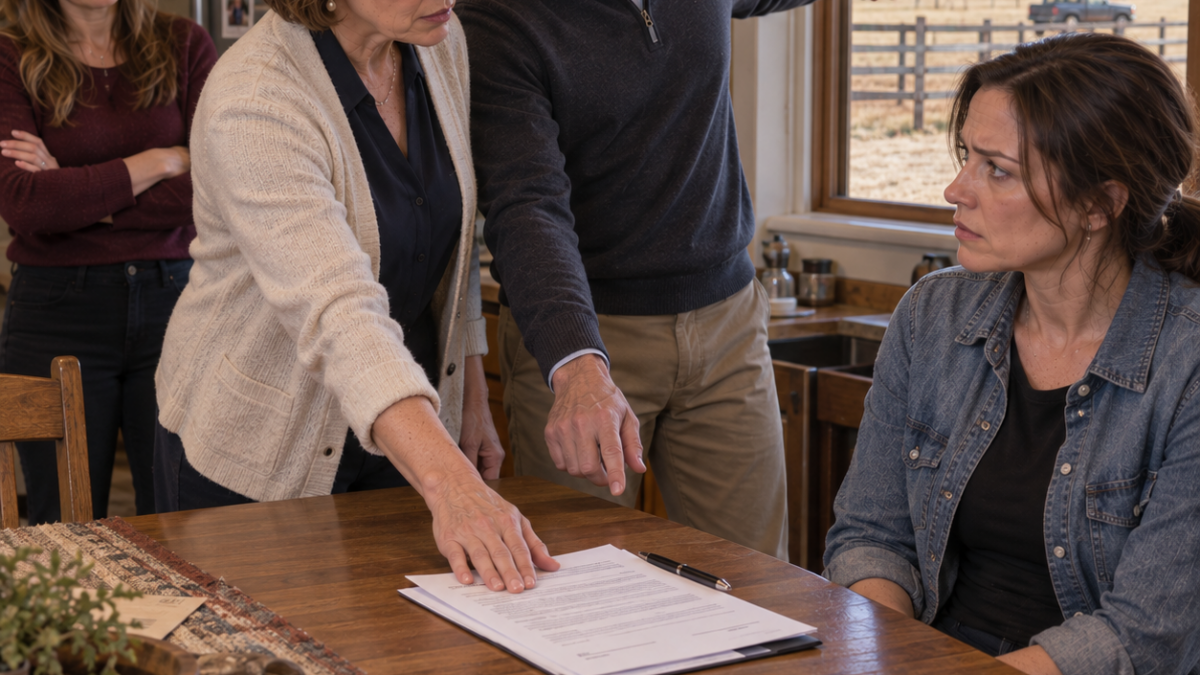
Three months after my husband’s funeral, my mother pushed a power-of-attorney form across my kitchen table and said, “Sign it. Travis knows how to handle land deals.”
My husband, Eli, had been dead for ninety-four days.
My mother hadn’t come to his funeral.
Neither had my sister Brooke or her husband, Travis.
Now all three of them were sitting in the ranch house Eli and I had spent nine years repairing, talking about selling it before I had even packed away his boots.
“I’m not signing anything.”
Mom’s mouth tightened.
“Hannah, nobody is trying to take anything from you.”
Travis leaned forward.
He was a commercial land broker in Denver and wore the same expensive quarter-zip sweater he wore whenever he wanted people in rural Colorado to understand that he worked with bigger money than they did.
“You’re sitting on seven hundred twenty acres, cattle equipment you don’t need, and a house that needs work,” he said. “You can turn all of that into cash and stop struggling.”
“I’m not struggling.”
Mom gave me a look.
“You’re a widow running a ranch by yourself.”
“I also have a job.”
“You manage an animal clinic.”
“I’ve managed its books and staff for eleven years.”
“That isn’t the same as understanding land.”
There it was.
The family version of me.
Competent enough to help when somebody needed paperwork, money, or a favor.
Never competent enough to make the important decision myself.
Eli had heard that tone for nine years.
My mother never forgave me for marrying a cattle rancher who drove a fourteen-year-old pickup and wore patched work jackets.
When I called her from the hospital the morning Eli died from a sudden aortic rupture, her first response was not, “Are you okay?”
She said, “Hannah, I warned you this life was going to leave you with bills and dirt.”
She did not come to the funeral.
Brooke texted that her daughter had a dance competition they had already paid for.
My younger brother Ryan said he was sorry but didn’t want to “get in the middle” because Mom was upset with me.
The people who buried Eli were our neighbors, the veterinarian I worked for, two ranch hands who had known him since high school, and an electrician he used to work with before he came home to run the ranch.
Now Mom was asking me for control over the property.
Travis tapped the power-of-attorney form.
“This is limited. It just lets me speak to buyers and review offers.”
“I can speak to buyers.”
“You don’t know that market.”
“What market?”
He paused.
“The energy market. Agricultural land. Whatever interest is out there.”
I stared at him.
I had never mentioned energy.
Mom jumped in.
“People are talking, Hannah. Survey trucks. County filings. Something called Prairie Current.”
My eyes moved back to Travis.
Prairie Current Energy.
I knew the name because an envelope from them had arrived two weeks earlier addressed to Eli.
I had not opened it.
I had placed it with the rest of his property documents because I still couldn’t bring myself to process every piece of mail that arrived with his name on it.
“How do you know Prairie Current?”
Travis leaned back.
“I work in land.”
“That isn’t an answer.”
Brooke sighed.
“Can we not turn everything into an interrogation?”
“You came into my house with a power of attorney.”
“Because we’re trying to help.”
Mom pushed the document closer.
“You always make people prove they care about you.”
I looked at her.
“No. I make people explain what they want me to sign.”
Nobody spoke.
I slid the form back across the table.
“If you came to see me, stay for dinner. If you came to get authority over the ranch, you can leave.”
They left.
Twenty minutes later, I went into Eli’s small office off the mudroom.
The unopened Prairie Current envelope was still on his desk.
I opened it.
Inside was a recorded-document notice from the county clerk.
MEMORANDUM OF WIND ENERGY OPTION AND EASEMENT.
Landowner: Elijah Pierce.
Property: 720 acres.
Then I saw another name.
HIGH PLAINS LAND COOPERATIVE LLC.
I had never heard of it.
At the bottom of the page was a handwritten note in Eli’s blocky handwriting.
Martin has the full file.
And beneath that:
Do not sign anything for Travis.
Martin Hale had been Eli’s attorney for almost fifteen years. I called him the next morning. When I read the note aloud, he went quiet.
“Hannah, can you come in?”
I drove to his office in Limon with the Prairie Current notice in my purse.
Martin put a thick blue file on the desk.
He explained that Eli and four neighboring families had formed High Plains Land Cooperative two years earlier to negotiate energy leases as one block instead of five desperate landowners negotiating separately.
The project was not final.
Permits, transmission studies, and financing still had to clear.
But the contracts were real.
“So why didn’t he tell me?”
“He planned to when Prairie Current cleared the interconnection study.”
Martin opened another section.
“Eli was worried someone would try to buy the land before you understood what you had.”
“Someone?”
Martin slid a letter toward me.
It was dated eleven months before Eli died.
The letter offered $1.05 million for our entire ranch, including all existing and future energy-development rights.
Buyer:
Front Range Land Partners LLC.
Broker:
Travis Dalton.
My brother-in-law.
I looked at Martin.
“He tried to buy our ranch?”
“He tried to broker the sale.”
“Did Eli know Travis was behind it?”
Martin turned over the page.
Eli had written one sentence across the back.
Travis knows what Prairie Current is planning.
Don’t let him pretend otherwise.
I sat there for a long time.
Then I asked the question that had been bothering me since Mom said Prairie Current at my kitchen table.
“How much is the ranch actually worth?”
Martin leaned back.
“That depends on what you mean by worth.”
“I mean what made my brother-in-law offer a million dollars for land he spent nine years calling a dust bowl.”
“That’s a better question.”
He opened another folder.
Before I married Eli, I knew almost nothing about ranch economics.
I knew enough to understand cattle ate money with remarkable efficiency.
I knew a late freeze could destroy what looked promising in April.
I knew hay prices always seemed highest when you needed the most hay.
But I had grown up in suburban Denver.
My mother taught piano.
My father worked in commercial insurance until he died six years ago.
Brooke became a dental-office administrator, married Travis, and moved into a six-bedroom house in Highlands Ranch.
Ryan worked in logistics.
I was the daughter who moved east and married “the rancher.”
Mom used that phrase for years as though rancher were a diagnosis.
Eli was not poor.
He was not rich either.
The ranch had been in his family for three generations.
Seven hundred twenty acres of dry pasture and wheat ground.
A modest cattle operation.
A house built in 1968 with kitchen cabinets Eli insisted were “still functional” even though two doors had to be lifted before they would close.
We had a mortgage.
Equipment loans.
Some good years.
Some tight ones.
Eli wore the same boots until the leather split.
We vacationed twice in nine years.
Once to Santa Fe.
Once to South Dakota because Eli wanted to see Mount Rushmore and I wanted to prove we were capable of leaving Colorado for more than forty-eight hours.
Mom treated every practical choice as proof I had married beneath myself.
At Thanksgiving one year she asked whether Eli ever planned to “graduate from cattle.”
He said, “I’ve been trying. They keep failing the entrance exam.”
I laughed.
Mom did not.
What she never bothered learning was that Eli had spent seven years working as a substation technician before his father suffered a stroke.
He knew transmission systems.
He knew electrical infrastructure.
He knew exactly what the big steel lines three miles north of our ranch meant when renewable developers started studying the region.
I did not.
Not because he hid his intelligence.
Because wind-development projects take years, most of them die, and Eli apparently refused to build our financial plans around something that might never happen.
Martin pointed to a map.
Five ranches formed an irregular block covering just over 4,200 acres.
Ours was on the northeast corner.
The other owners were Ruth and Charlie Benton, Miguel and Rosa Alvarez, brothers Kent and Roy Halpern, and Jim Sutter.
I knew every one of them.
Ruth had brought two casseroles after Eli died.
Miguel had repaired a broken water line at midnight because I could not get a contractor.
Jim had helped carry Eli’s casket.
“You’re telling me all of them knew?”
“They knew about the cooperative.”
“And nobody told me?”
“Eli asked them not to discuss the project outside the group until the grid study cleared.”
I felt embarrassed.
Martin must have seen it.
“Hannah, don’t take that as everybody conspiring around you.”
“My husband formed a company with four neighbors.”
“A negotiating cooperative.”
“And I didn’t know.”
“Yes.”
“That’s not nothing.”
“No.”
I appreciated that he did not try to soften it.
I loved Eli.
I also resented him in that moment.
Both feelings fit.
Martin explained the structure.
The neighbors had not sold their ranches.
They had pooled negotiating rights.
If Prairie Current built the wind project, each landowner would receive payments based on acreage used, turbines placed, roads, underground collection lines, and other infrastructure.
Our property mattered for another reason.
The closest practical connection to the existing transmission corridor crossed the north side of our ranch.
Prairie Current wanted roughly forty acres near that boundary for a substation and battery-storage facility.
“That’s the part Travis cared about,” Martin said.
“How much?”
“The preliminary term sheet included a $1.35 million site payment if the project reaches construction.”
I stared at him.
“For forty acres?”
“For the substation easement, battery site, access, transmission corridor, and related restrictions.”
“And then?”
“Annual lease payments if the project operates.”
“How much?”
“For your parcel, current projection is roughly two hundred forty to two hundred eighty thousand per year, escalating under the lease.”
I stopped hearing for a second.
Not because I was mentally shopping.
Because my mother’s sentence came back.
Bills and dirt.
Seven hundred twenty acres of dirt.
Eli had known it might become something else.
“Is that guaranteed?”
“No.”
That answer helped.
“Permitting can fail. Interconnection costs can kill the project. Financing can collapse. Turbine layout can change. Prairie Current could walk away during the option period under certain provisions.”
“So I’m not secretly rich.”
Martin smiled.
“You own a ranch with unusually valuable project potential.”
That I could understand.
He showed me the current option payments.
Small compared with the projected project.
Enough to cover legal fees and cooperative administration.
Eli had placed every payment into a separate account.
He had not spent a dollar.
The account passed to me.
Then Martin showed me the Front Range offer.
$1.05 million for the ranch.
House.
Barns.
Equipment excluding livestock.
Surface rights.
All renewable-energy options, easements, and development rights.
Travis’s proposed buyer would have taken everything.
“What was the ranch worth without Prairie Current?”
“Recent appraisal was about $1.4 million including improvements.”
I looked at him.
“So his buyer offered below normal market.”
“Yes.”
“With the energy rights included.”
“Yes.”
“And he knew about the project.”
Martin nodded.
“That is what Eli believed.”
“Why?”
“Because Travis used Prairie Current’s project code in an email before the county memorandum became public.”
That was specific.
“Where would he get it?”
“We don’t know.”
Travis worked land deals throughout eastern Colorado.
Someone could have talked.
A surveyor.
A landman.
An investor.
Nothing about knowing the code was illegal.
But it proved his surprise in my kitchen was theater.
I asked what Eli had done when he received the offer.
“Rejected it.”
“That’s all?”
“Not quite.”
Martin handed me an email.
Eli to Travis:
If you want to visit as Hannah’s family, you know where the house is.
If you want to buy my ranch for less than appraised value while taking rights you already know may be worth more than the dirt, don’t waste the gas.
That sounded exactly like Eli.
Travis responded that Eli was emotionally attached and failed to understand liquidity.
Eli never answered.
Martin closed the folder.
“There’s another email you should see, but I want you prepared for it.”
“From Travis?”
“Yes.”
“When?”
“Eight days after Eli died.”
I felt my stomach tighten.
Martin printed it.
Travis had emailed a land-acquisition manager he apparently knew at Prairie Current.
He wrote that Eli had passed unexpectedly.
He said the property would “likely be sold during estate cleanup.”
He described me as a surviving spouse “without operational ranch background.”
Then:
Family can likely facilitate authority if direct acquisition becomes preferable to lease structure.
I read that sentence twice.
“He contacted them before he contacted me.”
“Yes.”
“How did Prairie Current respond?”
“They told him all communications had to go through the recorded landowner or legal successor and the cooperative’s attorney.”
“Did they tell you?”
“Eli’s death triggered their legal review. They forwarded it to me once I entered the estate.”
My grief changed shape.
I had been angry at my mother for arriving with paperwork.
Now I understood that the paperwork was not her idea.
Travis had been building the sale before they came through my door.
The next afternoon, I drove to the Benton place.
Ruth answered wearing gardening gloves.
She saw my face and said, “You found out.”
Apparently everyone in eastern Colorado had become incapable of greeting me normally.
“Can we talk?”
We sat at her kitchen table.
Charlie came in from the shop halfway through.
I asked the question I had avoided at Martin’s office.
“Why did Eli keep this from me?”
Ruth took off her gloves.
“He didn’t want to.”
“That’s not the same as not doing it.”
“No.”
Good.
No excuses.
She told me how it started.
Three years earlier, a developer had approached the Halperns individually.
Low offer.
Long lease.
Terms heavily favoring the company.
Eli read it because Roy Halpern knew his utility background.
Eli told them not to sign until they had counsel.
Then he started talking to neighbors.
If the developer needed contiguous acreage, the landowners had more leverage together than separately.
Martin helped form the cooperative.
They hired an independent energy attorney in Denver.
Then Prairie Current entered.
“When did Travis show up?”
Ruth’s mouth tightened.
“Last summer.”
“He came here?”
“Twice.”
That was new.
“He told Charlie we should consider selling outright while land values were strong.”
Charlie sat down.
“He kept saying projects fall through and cash doesn’t.”
“What did Eli say?”
Charlie smiled.
“Something about cash falling through pretty fast if you sell the wrong thing.”
Also Eli.
Travis approached three of the five families.
All refused.
Then he approached Eli through Front Range.
“So he knew the cooperative existed.”
“Oh, yes.”
Ruth reached into a drawer.
She handed me an old business card.
Travis Dalton.
Senior Land Advisor.
On the back, in Travis’s handwriting:
If Eli changes his mind, call before Prairie locks you up long term.
I put the card on the table.
“Why didn’t anybody tell me?”
Ruth looked uncomfortable.
“Because Eli asked us not to.”
I waited.
“He said if the project died, he didn’t want you spending three years worrying about money that never existed.”
“I can handle uncertainty.”
“I know.”
“Did he?”
Ruth sighed.
“I think he thought protecting you meant carrying the uncertainty himself.”
That sounded like my husband.
And it sounded like one of the things about him that had always driven me crazy.
Eli believed burdens were physical objects.
If he could carry more, I should carry less.
It was loving.
It was also arrogant.
I drove home angry at a dead man.
Grief is strange that way.
You can miss someone so much your ribs hurt and still want to argue with them.
I stood in his workshop and said out loud, “You should have told me.”
The room did not answer.
His welding gloves hung from a nail.
His thermos was still on the shelf.
I cried for the first time in weeks.
Not because of Prairie Current.
Because I would never get to have the argument.
Three days later, Brooke called.
“Mom says you’re accusing Travis of trying to steal the ranch.”
“I haven’t spoken to Mom.”
“So that’s not true?”
“What part?”
She became impatient.
“Hannah.”
“Travis offered Eli less than appraised value for the ranch while knowing about the energy project.”
“That’s business.”
“He approached the developer eight days after Eli died and told them the family could probably arrange authority to sell.”
Silence.
“Where did you hear that?”
“I read the email.”
Another silence.
Then, “Travis wouldn’t do that without a reason.”
I almost admired the speed of the defense.
“What reason makes it better?”
“He probably thought you’d want options.”
“He didn’t ask me.”
“He knew you were grieving.”
“So he tried to make decisions before I stopped grieving?”
“That’s not what I said.”
“No. It’s what he did.”
Brooke lowered her voice.
“Mom is terrified you’re going to make some huge decision because you feel like keeping Eli’s ranch proves something.”
“This isn’t about proving anything.”
“You hated ranch work.”
“I hate breaking ice from stock tanks at six in the morning. That’s different.”
“You have your clinic job. Sell the ranch. Take the money. Come back toward Denver.”
Back.
Interesting word.
I had lived on the ranch nine years.
Mom’s house had not been home since I was nineteen.
“Brooke, did you know Travis tried to buy it last year?”
“No.”
“Ask him.”
She hung up.
Travis called twenty minutes later.
His tone was different from my kitchen.
No charm.
No fake concern.
“You’re making me sound predatory.”
“You wrote the offer.”
“I represented a buyer.”
“You contacted Prairie after Eli died.”
“Because there was a live transaction.”
“There was no sale transaction.”
“There could have been.”
“With whose authorization?”
He paused.
“This is what I mean. You don’t understand how land positioning works.”
I actually smiled.
“Then explain it.”
“A broker identifies opportunity before the market gets there.”
“By telling the developer my family could get authority over my property?”
“That line is being taken out of context.”
“What context?”
“You were grieving. The estate was unsettled. Everybody knew you weren’t going to run cattle forever.”
“You knew that?”
“Come on, Hannah.”
“No. Tell me.”
He exhaled.
“You work at a vet clinic.”
“I work at an animal hospital. I manage twenty-two employees, payroll, vendor contracts, compliance, and a two-million-dollar operating budget.”
“That’s not ranch management.”
“Correct.”
“And Eli did everything.”
“No.”
“He did the meaningful parts.”
That landed.
He knew it did.
I heard the silence stretch.
Then he said, “That came out wrong.”
“No, it didn’t.”
I ended the call.
The next morning I hired a ranch manager.
That sounds petty in sequence.
It wasn’t.
His name was Ben Alvarez, Miguel and Rosa’s nephew.
He had managed a cow-calf operation near Burlington for twelve years and wanted to move closer to family.
We agreed on salary, housing, responsibilities, and a six-month review.
Hiring him cost money.
It also cost pride.
I had spent three months trying to prove I could do everything Eli did.
I couldn’t.
Not while working four days a week.
Not while learning the cooperative.
Not while grieving.
That did not mean the ranch had to be sold.
It meant I needed help.
That decision was the first one that felt like mine rather than a reaction to my family.
The Prairie Current meeting happened two weeks later.
Five landowners.
Martin.
Our energy attorney.
Two Prairie Current representatives.
Me.
Travis was not invited.
He arrived anyway.
Brooke drove him.
Mom came in her own car.
Ryan appeared ten minutes later and stood near the back like someone attending a meeting he expected to regret.
We were meeting in the county extension conference room because it was large enough for everybody actually involved.
Travis walked toward the table with a portfolio.
Martin stopped him.
“This is a cooperative meeting.”
“I represent family interests.”
“No, you don’t.”
Mom said, “I’m Hannah’s mother.”
Martin turned to her.
“That does not make you a party to her property contracts.”
Travis smiled tightly.
“We’re not here to interfere.”
The Prairie Current land manager, Melissa Ward, looked at him.
“We have correspondence suggesting otherwise.”
Brooke turned toward Travis.
“What correspondence?”
There it was.
The first crack.
Travis looked at Melissa.
“That email has been badly characterized.”
Melissa opened her laptop.
“Would you like me to read it?”
He stopped talking.
We let them sit in the back because I wanted no later argument that anyone had been excluded from information.
That was my choice.
Martin asked me twice.
I said yes twice.
The meeting started.
Prairie Current had completed the interconnection feasibility stage.
That did not mean construction was guaranteed.
Environmental studies remained.
County permits.
Financing.
Equipment procurement.
But a major technical obstacle had cleared.
They wanted to extend the option and move into advanced development.
Melissa explained the expected layout.
Thirty-four turbines across the full cooperative area.
Nine likely on our ranch, depending on final engineering.
Underground collection lines.
Access roads.
The substation and battery-storage site on the north forty.
She went through payments.
Option extension.
Construction disturbance payments.
Road use.
Turbine rent.
Substation lease.
Escalators.
Decommissioning security.
I asked questions until my notebook had six pages.
Nobody told me I was overthinking it.
Nobody sighed because I wanted details.
The energy attorney asked more than I did.
That felt good.
Then we reached ownership.
Melissa explained that Prairie Current had received several third-party inquiries asking whether the Pierce tract might be sold instead of leased.
“One was associated with Front Range Land Partners.”
Brooke looked at Travis.
He stared at the table.
Melissa continued.
“Another inquiry came directly from Mr. Dalton after Mr. Pierce’s death.”
Mom whispered, “Travis?”
He lifted his hands.
“I was trying to understand the market.”
Melissa looked at him.
“You represented that the surviving spouse was unlikely to maintain agricultural operations and that family authority could potentially be arranged.”
Brooke’s face changed.
“You told me you only made one phone call.”
“It was one email.”
“You said you were checking whether the rumor was true.”
“I was.”
“You told them we could arrange authority?”
“I said potentially.”
Mom looked between them.
She had arrived believing Travis was the expert rescuing her foolish daughter.
Now the expert was explaining vocabulary.
Ryan spoke from the wall.
“How much did you make if she sold?”
Travis turned.
“This has nothing to do with you.”
Ryan shrugged.
“Neither does Hannah’s ranch, apparently, but we’re all here.”
I almost laughed.
Melissa answered because Travis did not.
“We were not party to his brokerage agreement.”
Martin opened the Front Range offer.
“The proposed acquisition agreement included a buyer-paid brokerage fee of four percent.”
Brooke did the math first.
“Forty-two thousand.”
Travis said, “That’s standard.”
Martin continued.
“The buyer also intended to market the energy-positioned tract to infrastructure investors after acquisition.”
“How do you know that?” Travis asked.
Martin looked at him.
“Because your buyer sent Eli a revised proposal containing the investor-distribution schedule by mistake.”
That was new even to me.
Martin placed it on the table.
Front Range’s plan was simple.
Buy our ranch for $1.05 million.
Hold through Prairie Current’s interconnection decision.
Then either negotiate a direct sale to an infrastructure fund or keep the lease economics.
Their internal target valuation after site control:
Between $6.8 million and $8.4 million.
The room became silent.
Mom looked physically confused.
“Eight million?”
Martin raised a finger.
“Target valuation. Not guaranteed cash value.”
That distinction mattered.
I was glad he made it.
Brooke stared at her husband.
“You knew?”
Travis’s face tightened.
“I knew there was upside.”
“You told us Hannah was sitting on a ranch that barely paid for itself.”
“The ranch operation barely does.”
“That isn’t what I asked.”
Travis pushed his chair back.
“Everybody in this room is acting like I committed a crime by trying to make a deal.”
I spoke.
“No.”
He looked at me.
“You tried to make a deal with Eli. He said no.”
“Yes.”
“Then he died.”
His expression hardened.
“You contacted the developer before you called me.”
Nothing.
“You came to my house with a power of attorney.”
“Hannah—”
“You told my mother I couldn’t handle land.”
“I said you weren’t experienced.”
“You told Prairie Current the family could probably arrange authority.”
“I was trying to protect value.”
“For who?”
That was the question.
He had no answer that helped him.
Brooke stood.
“I’m going outside.”
Travis reached for her arm without touching her.
“Brooke.”
She stepped away.
“No.”
Mom followed.
Ryan stayed.
Travis looked around the room.
Then he picked up his portfolio.
“This meeting is obviously hostile.”
Martin said, “It’s a contract meeting.”
Travis left.
The door closed.
Melissa waited a moment.
Then she said, “We can continue another day.”
“No,” I said.
My voice surprised me.
“I want to continue.”
That was my decision.
Not to punish Travis.
Not to prove Mom wrong.
Not because Eli had wanted the project.
I still had to decide whether I wanted thirty years of turbines, roads, and a substation on land where I could currently see almost nothing but grass.
The lease had costs.
Real ones.
Construction disruption.
Reduced flexibility on parts of the property.
Visual change.
Noise at certain distances.
A long contractual relationship with a corporation that might someday be sold to another corporation.
I wanted every one of those costs understood.
So we kept going.
I did not sign that day.
That mattered too.
I took the proposed extension home.
I paid another attorney, independent from Martin and the cooperative, to review my individual land provisions.
I talked to Ben about ranch operations.
I talked to an accountant about taxes.
I talked to neighboring landowners whose projects had already been built.
I visited a wind farm seventy miles north and stood beneath a turbine long enough to hear what “quiet” actually meant instead of relying on a brochure.
Eli had done years of work.
I still needed the decision to become mine.
Three weeks later, I signed.
Not a sale.
An extended option and lease framework.
The cooperative remained intact.
The ranch remained mine.
If Prairie Current reached construction, the north forty would host the substation and battery facility.
The turbine and infrastructure payments would begin according to the final layout.
The contract included decommissioning security, road restoration requirements, crop and grazing protections, and annual escalators our attorney had negotiated.
The upfront site payment would not arrive until construction notice.
I could live with that.
I called Mom afterward.
She answered on the first ring.
“You signed.”
It was not a question.
“Yes.”
“So you’re tied to them for thirty years.”
“If the project gets built.”
“You should have sold.”
“I know you think that.”
“You could walk away with millions.”
“Maybe.”
“Then why wouldn’t you?”
I looked through the window at the south pasture.
“Because I don’t want to.”
“That’s not a reason.”
“It’s the only reason I need.”
She became quiet.
Then:
“Your father would never have let you make a decision this emotional.”
Dad had been dead six years.
I was suddenly tired of him being used as a ventriloquist dummy in arguments he never got to hear.
“Dad isn’t here.”
“Hannah.”
“And Eli isn’t here.”
Her voice softened.
“I know.”
“No, Mom. That’s the part I don’t think you understand.”
She went silent.
“I called you when my husband died.”
“I remember.”
“You told me I had chosen bills and dirt.”
Her breathing changed.
“I was upset.”
“You didn’t come to his funeral.”
“Brooke had—”
“I know about the dance competition.”
“Hannah, please.”
“I am not discussing the ranch with you anymore.”
“I’m your mother.”
“Yes.”
“That should mean something.”
“It does.”
I took a breath.
“It does not mean power of attorney.”
She hung up.
We did not speak for five months.
Prairie Current reached construction notice the following spring.
The project still changed twice before that.
Two turbines disappeared from our final layout because of an eagle study.
A service road moved.
The battery footprint got smaller.
The final expected annual payment on our property became closer to $218,000 rather than the early high estimate.
Still life-changing.
But by then I understood something I hadn’t understood at Martin’s desk.
Large numbers become ordinary once they turn into taxes, insurance, reserve requirements, repairs, and long-term planning.
The $1.35 million substation-site payment arrived in escrow after final conditions cleared.
I did not buy a new house.
I paid off the remaining ranch mortgage.
I paid off one equipment note.
I created a drought reserve.
I replaced the well system we had been patching for six years.
I funded retirement accounts I had ignored while Eli and I were prioritizing the ranch.
Then I sat with Martin and the cooperative members and created something Eli had mentioned in an old notebook.
A rural electrical-trades scholarship.
Two students a year.
Nothing enormous.
Enough for tools, community-college tuition, and certification costs for young people going into line work, electrical maintenance, or renewable-energy technology.
We named it for Eli.
I almost didn’t.
Naming things after dead people had started feeling like another way to perform grief.
Then I remembered how proud he had been of his apprenticeship years.
So I said yes.
Brooke called after the announcement appeared in the local paper.
By then she and Travis were still married, but living separately.
I never asked for details.
She volunteered some.
His brokerage had opened a compliance review after Prairie Current documented that he had represented potential family authority he did not possess.
His firm did not lose its license.
He did.
Not his state license.
His affiliation with that brokerage.
They terminated his contract.
Another company hired him six months later.
Consequences in real life are rarely cinematic.
People lose jobs and get others.
Relationships break and sometimes remain legally intact.
Embarrassment fades.
Brooke said, “I’m sorry.”
I was silent.
“For the funeral first.”
That mattered.
“I should have been there.”
“Yes.”
“I used Ellie’s dance competition because I didn’t want to deal with Mom.”
“Yes.”
“And Travis said going would make it look like we were taking your side.”
I closed my eyes.
“There weren’t sides. Eli died.”
“I know.”
“You understand that now?”
“Yes.”
I believed her.
Forgiveness was slower.
Ryan came sooner.
He drove out one Saturday carrying beer and a new socket set he absolutely did not need to buy me.
“I stayed neutral,” he said while we stood by the shop.
“Yes.”
“That was cowardly.”
“Yes.”
“You could make this easier.”
“I could.”
He smiled.
“So?”
“No.”
He nodded.
“Fair.”
Then he spent six hours helping Ben repair corral panels.
That was the beginning.
Not a dramatic family reunion.
Work.
Calls.
Birthdays remembered.
Showing up.
The things that had always mattered more to Eli than speeches.
Mom took longer.
Almost a year after the kitchen-table power of attorney, she drove out alone.
No Brooke.
No Travis.
No papers.
I saw her car from the clinic manager’s office because she had called ahead and I told her to meet me at the ranch after work.
When I arrived, she was sitting on the porch.
The first turbine foundations were visible far north of the house.
Concrete rings.
Cranes.
Nothing beautiful.
Nothing catastrophic.
Just construction.
Mom stood.
“I brought dinner.”
She held up a casserole dish.
I almost laughed at the absurd normality of it.
“What kind?”
“Chicken.”
“Broccoli?”
“Yes.”
“You remember I hate cooked broccoli.”
She looked at the dish.
“I forgot.”
“That seems on brand.”
To my surprise, she laughed.
Then she cried.
I did not immediately hug her.
That was honest too.
We sat on the porch.
She apologized for what she said when Eli died.
Not “if it hurt.”
Not “I was emotional.”
She repeated the sentence.
Bills and dirt.
Then:
“It was cruel.”
“Yes.”
“I didn’t like the life you chose because I didn’t understand it.”
“You didn’t try.”
“No.”
That was the first conversation we had ever had where she did not defend the gap between us by blaming my choices.
She looked toward the pasture.
“I thought Travis was helping.”
“I know.”
“I wanted to believe him because his plan sounded simple.”
“Sell.”
“Yes.”
“Simple for who?”
She nodded.
“I know.”
We did not fix everything that night.
She did not suddenly love ranch life.
I did not suddenly trust her with financial decisions.
She came back twice that summer.
Then again for the scholarship dinner.
That was enough to call progress.
Construction changed the ranch.
There is no honest version of the story where millions of dollars in energy infrastructure appear and everything stays picturesque.
Road crews came.
Dust came.
Survey flags everywhere.
Ben complained about gates being left wrong.
I complained to Prairie Current.
They fixed it.
One turbine foundation interfered with a cattle lane.
We moved the lane and billed according to the contract.
The substation rose on the north forty in neat gray steel.
The battery site looked less dramatic than everyone imagined—rows of industrial enclosures behind fencing.
When the first turbine tower went up, I stood beside Ruth Benton and watched the crane lift a section into the sky.
She said, “Eli would have been unbearable today.”
I laughed.
“He would’ve explained every bolt.”
“For three hours.”
“At least.”
The tower settled into place.
For a minute neither of us spoke.
Then Ruth touched my shoulder.
“You okay?”
“No.”
She waited.
“I wish he could see it.”
“I know.”
That was all.
Grief had become less violent by then.
Not smaller.
More integrated.
It no longer entered rooms before I did.
I still had Eli’s work jacket on the mudroom hook.
I had finally moved his boots.
It took fourteen months.
Nobody clapped.
Nobody knew.
I put them in the shop because throwing them away felt wrong and keeping them beside the door felt worse.
One evening, almost two years after his death, I found another of his notebooks while clearing a cabinet.
Most of it was cattle records.
Pasture rotation.
Water measurements.
Then a page labeled:
If Prairie works.
Underneath:
Pay house.
Well.
North fence.
Hannah retirement.
Ben? manager eventually?
Scholarship maybe.
That was all.
No secret master plan.
No speech.
A list.
I sat on the shop floor and laughed until I cried.
He had planned to hire Ben.
He had planned the scholarship.
He had planned my retirement before I had bothered to plan it myself.
Then I reached the last line.
Tell Hannah before signing final.
I stared at it.
“You missed that one,” I said.
That made me angry again for about ten minutes.
Then strangely relieved.
He had intended to tell me.
He wasn’t planning some permanent secret life of contracts.
He ran out of time.
That did not erase my right to be angry.
It did make the story less lonely.
The first full year of project payments arrived the following winter.
I knew the number.
Of course I did.
I no longer avoided the statements.
The ranch operating account became healthy in a way it had never been during our marriage.
We still ran cattle.
Fewer than before.
Ben shifted grazing around infrastructure.
We leased additional pasture from Miguel.
I stayed at the animal hospital.
That confused Mom.
“You don’t need the job.”
“I like the job.”
“You’re working because you want to?”
“Yes.”
She stared at me.
Apparently this was the most radical financial decision I had made.
Work had never been only about survival.
I liked being useful.
I liked the clinic.
I liked solving scheduling disasters that did not involve my family.
Money gave me the ability to choose work rather than escape it.
That felt richer than quitting.
Travis and I have spoken twice since the cooperative meeting.
The first was at Brooke’s daughter’s high-school graduation.
He said hello.
I said hello.
The second was at Dad’s memorial anniversary gathering Mom insisted on having.
He approached me in the kitchen.
“I owe you an apology.”
I waited.
He looked older.
Less polished.
“Front Range was a bad deal.”
“Yes.”
“I thought Eli was being stubborn.”
“He was.”
That almost made him smile.
“I also thought I could create an outcome everybody would eventually be grateful for.”
“You mean you thought you could make money.”
“Yes.”
I appreciated the answer.
“And after Eli died?”
He looked down.
“That was worse.”
“Yes.”
“I saw a window.”
There it was.
The cleanest thing he ever said.
A window.
My husband died.
My brother-in-law saw timing.
“I’m sorry.”
“I believe you.”
He looked surprised.
“That doesn’t mean I trust you.”
“I know.”
We went back to the family gathering.
That was enough.
The ranch still looks like dirt from the highway.
That part makes me smile.
Drivers see grass, fences, cattle, turbine towers now.
They do not see option agreements.
Transmission studies.
Cooperative minutes.
Escalation clauses.
Drought reserves.
They do not see Eli refusing a million-dollar offer because he understood the buyer knew more than he was admitting.
They definitely do not see me in the kitchen with a power-of-attorney form sliding toward my hand.
Sometimes I still think about how close I came to signing something simply because everyone at the table spoke with confidence.
Mom sounded certain.
Travis sounded expert.
Brooke sounded reasonable.
I was the grieving widow.
They were the people with a plan.
Confidence is not authority.
That may be the most expensive lesson I never had to pay for.
On the second anniversary of Eli’s death, I took the morning off.
No memorial service.
No family gathering.
Ben handled the ranch.
I drove to the north pasture and parked near the service road.
The turbines were moving slowly.
Not dramatic.
Just steady rotation in a Colorado wind that had been blowing across that ground long before any of us arrived.
I brought Eli’s thermos.
It leaks now.
I used it anyway.
I sat on the tailgate.
From there I could see the substation.
The cattle.
The old house roof.
The hills beyond the Bentons’ place.
I thought about the last year Eli was alive.
How many mornings he must have driven those roads carrying information I did not have.
Project code.
Lease maps.
Travis’s offer.
Interconnection studies.
Maybe excitement.
Maybe fear.
I wish he had told me.
I will probably always wish that.
But I no longer confuse wishing he had done something differently with believing everything he did was wrong.
He had been trying to hold uncertainty until it became solid.
Then he died before he could put it down.
So I inherited more than land.
I inherited unfinished decisions.
Those were harder than money.
I finished them the best way I could.
Slowly.
With independent advice.
Without giving anyone else power of attorney over a life they did not have to live.
When I got home that afternoon, Mom had left a voicemail.
Not about the ranch.
Not about money.
She wanted to know whether I wanted to come to Brooke’s for dinner Sunday.
I called back.
“Yes.”
Then I added, “I’m bringing dessert.”
She laughed.
“Store-bought?”
“Absolutely.”
Normal conversation.
Still new enough to notice.
That night, I walked through the mudroom and stopped at Eli’s old jacket.
I ran two fingers over the cuff.
Then I kept walking.
My mother once said Eli had left me with bills and dirt.
She was wrong about the bills.
She was wrong about the dirt too.
But not because the dirt turned out to be valuable.
That is the part I think my family misunderstood longest.
If Prairie Current had walked away, the ranch would still have been the place where Eli and I ate dinner on the porch, fought about money, repaired fences, buried a dog, hosted neighbors, and built a marriage.
The project changed the balance sheet.
It did not retroactively give the life value.
That was already there.
Eli knew it.
Eventually, I did too.







