My Mother Asked Me to Guarantee Her $1.1 Million Loan—Then the Bank Mentioned My Earlier Signature
Eleven years after my mother told me I was no longer part of her family, she showed up at my Denver house with a $1.1 million loan guaranty and told me I had until noon the next day to sign it.
My daughter Lucy was doing math homework at the kitchen table.
My seven-year-old son, Theo, was building something out of magnetic tiles on the floor.
Neither child had ever met the woman standing inside our front door.
My mother, Vivian Pierce, looked past both of them.
“Can we discuss this privately?”
No hello to the grandchildren.
No apology.
No acknowledgment that the last time she had spoken to me face-to-face, I was twenty-five years old and newly engaged to a paramedic she considered beneath us.
Just a leather document case tucked under one arm.
I looked at my husband, Ethan.
He gave me the same quiet expression he had given me eleven years earlier when my family refused to attend our wedding.
My choice.
I led Vivian into the dining room.
She sat without taking off her coat.
“The hotel is facing a temporary liquidity issue,” she said.
My family owned the Pierce House, a seventy-eight-room historic hotel in Savannah that had been in my father’s family for three generations.
When I was growing up, my mother treated that building like proof that our last name meant something.
Everything revolved around preserving the Pierce name.
The right schools.
The right friends.
The right clubs.
Apparently the right husband.
Ethan had been none of those things.
At twenty-six, he was working twelve-hour shifts as a paramedic while finishing a degree in health systems management.
My mother called him “an ambulance driver” the first time she met him.
When I announced our engagement, she told me that if I married him, I should not expect the family to finance my mistakes.
I married him anyway.
For eleven years, they kept their word.
No birthday calls.
No Christmas invitations.
Nothing when Lucy was born.
Nothing when Theo was born.
Nothing when Ethan and I built DispatchGrid, the emergency-response software company that eventually grew out of an idea he had during an overnight ambulance shift.
Last year, an outside investment firm valued our company at roughly $62 million.
Apparently that number traveled all the way to Savannah.
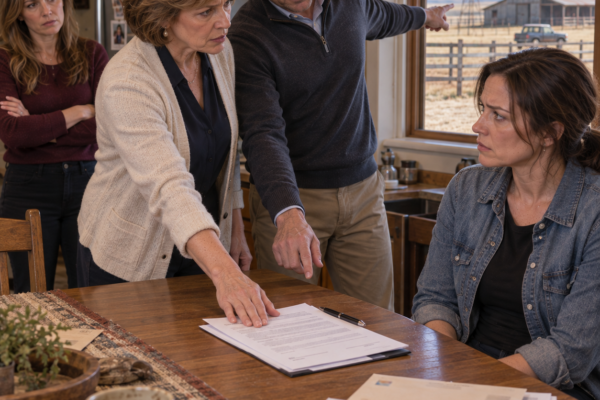
Vivian opened the document case.
“The Pierce House needs bridge financing while we restructure some obligations.”
She placed a loan agreement in front of me.
The amount was $1,100,000.
I turned to the guaranty page.
My name was already typed underneath the signature line.
NATALIE PIERCE COLE.
“I’m not signing this.”
“You haven’t even read it.”
“I don’t need a million dollars’ worth of reading to know I’m not personally guaranteeing your hotel.”
Her mouth tightened.
“Your father has been ill.”
That stopped me.
“What happened?”
“He had a stroke in February.”
It was June.
Four months.
Nobody had told me.
“Is he okay?”
“He’s recovering.”
“Where?”
“That isn’t the issue we’re discussing.”
I stared at her.
“My father had a stroke four months ago, and you came here because you need my signature?”
Her voice sharpened.
“The hotel employs sixty-three people, Natalie. Your father spent his entire adult life protecting it.”
“And you waited eleven years to remember my phone number.”
“The past is the past.”
“No. The past is why you don’t get to walk into my house asking for $1.1 million.”
She leaned forward.
“You have done extremely well. Nobody is denying that.”
The way she said it made our success sound like an inconvenient clerical error.
“This isn’t a gift,” she continued. “It’s a guaranty. The property secures the loan.”
“Then the property can guarantee itself.”
“The bank wants additional support.”
“Why me?”
“Because you’re family.”
I almost laughed.
Instead, I turned the packet over.
A financial schedule had been clipped to the back.
Most of it listed hotel debt, vendor balances, property taxes, and operating expenses.
Then I saw a section labeled EXISTING SPONSOR SUPPORT.
There were three lines.
Charles Pierce.
Vivian Pierce.
And me.
Next to my name was an amount.
$284,000.
Date: October 17 of the previous year.
I looked up.
“What is this?”
Vivian’s eyes moved to the page.
For the first time since arriving, she hesitated.
“It was temporary support.”
“I didn’t provide temporary support.”
“It was handled internally.”
“My name is next to $284,000.”
She reached for the packet.
I pulled it back.
“Natalie.”
“What exactly happened on October seventeenth?”
“You’re misunderstanding an accounting entry.”
“Then explain it.”
Her voice went cold.
“I did not fly across the country to be interrogated in your dining room.”
“You flew across the country because a bank wants my signature.”
We looked at each other for several seconds.
Then Vivian stood.
“You have until noon tomorrow. If you refuse, there may not be a Pierce House by the end of the summer.”
She picked up her handbag and walked toward the front hall.
She did not look at Lucy.
She did not look at Theo.
Ethan opened the front door for her without saying a word.
Only after her rental car disappeared down our street did I realize she had left the financial schedule on my dining table.
I called the lender whose name appeared at the top.
A commercial banking officer named Daniel Cho answered.
I gave him the loan number.
Then I asked one question.
“Why does your file say I already provided $284,000 of sponsor support?”
He was silent long enough that I knew the answer was not going to be simple.
Finally he said, “Mrs. Cole, according to our records, you signed the support letter yourself.”
I told Daniel I had never signed any support letter. He asked me to verify my email address.
The address in his file looked almost right.
My real business email ended in @dispatchgrid.com.
The one attached to the loan file ended in @dispatch-grid.com.
One hyphen.
Different domain.
Daniel stopped talking for several seconds.
Then he emailed me the support letter.
The signature looked like mine.
Not similar.
Mine.
I recognized it immediately because it had been copied from an old university scholarship form I had signed before Ethan and I were married.
The letter stated that I had personally committed up to $300,000 to support temporary operating needs at the Pierce House.
The bank had advanced $284,000 against that representation the previous October.
I asked where the money went.
Daniel said the original request described emergency hotel repairs and payroll.
Then his tone changed.
“There’s something else you should know.”
The bank’s later review showed that $176,000 of the advance had been transferred within forty-eight hours to a company called BPC Events LLC.
I knew the initials before he said another word.
Brooke Pierce Carter.
My younger sister.
The sister who had not spoken to me in eleven years had received most of a loan the bank believed I had personally guaranteed.
And according to the document Daniel sent next, Brooke had signed the certification stating that my signature was authentic.
I ended the call and sat at the dining table without moving.
Ethan read the papers standing beside me.
He did not say, “I told you so.”
That mattered.
For eleven years, he had every reason to say it.
Instead he asked, “What do you want to do?”
“I don’t know yet.”
That answer surprised me.
I was angry enough to call Vivian immediately.
I was also scared enough not to.
The fake email address bothered me almost more than the signature.
Someone had not simply copied my name onto a piece of paper.
Someone had created a domain designed to look like our company.
That required planning.
I forwarded everything to our general counsel at DispatchGrid and asked her to preserve the fake-domain information in case it had been used anywhere else.
Then I called a Denver attorney named Renee Park.
Renee handled commercial fraud and closely held business disputes.
She had helped DispatchGrid with a vendor case two years earlier.
Her first instruction was simple.
“Do not call your mother.”
“I want to hear her explain it.”
“You already heard her explanation. She called it an accounting entry.”
“She doesn’t know I spoke with the bank.”
“Good. Keep it that way for one night.”
Renee asked for the documents.
Thirty minutes later, she called back.
“This is not a family loan dispute.”
“I know.”
“No, Natalie. I need you to separate those things now. Your mother asking you to guarantee new debt is one issue. Somebody using your identity to obtain prior credit is another.”
“What happens next?”
“The bank has its own fraud process. We preserve evidence. We identify who created the fake domain. We find out whether the signature was reused anywhere else.”
“What about the hotel?”
“You are not the hotel.”
I remember staring at our dining room wall when she said that.
You are not the hotel.
Growing up, those two ideas had never been separate.
Every Pierce family argument eventually returned to the hotel.
Protect the hotel.
Represent the hotel.
Do not embarrass the hotel.
Do not date somebody who looks wrong in the hotel dining room.
Do not choose a career that takes you away from the hotel.
The building had more emotional status than most people in our family.
Renee continued.
“You may care what happens to it. That doesn’t mean you assume its liabilities.”
I slept badly.
Around two in the morning, I went downstairs and found Ethan in the kitchen.
He had opened his laptop.
“What are you doing?”
“Nothing illegal.”
“That sentence is always reassuring.”
He turned the screen toward me.
He had been searching public filings for BPC Events LLC.
Brooke started the company three years earlier.
It described itself as a luxury event-production studio serving weddings, corporate retreats, and private estates.
There were glossy photos online.
Champagne walls.
Custom florals.
Destination events.
Brooke had apparently built exactly the kind of business our mother respected.
The filings showed something less glamorous.
Two tax liens.
One civil judgment from a lighting vendor.
A recently terminated office lease.
Ethan pointed to the dates.
“The biggest lien was filed three weeks before the Pierce House got that $284,000 advance.”
I sat beside him.
“You think the hotel borrowed to rescue Brooke.”
“I think we let the documents tell us.”
That was one of the reasons I married him.
Ethan had spent his twenties making decisions in ambulances with incomplete information.
He rarely confused a suspicion with a fact.
The next morning, Daniel Cho called before eight.
The bank had frozen the new loan application.
Their fraud unit wanted a recorded statement from me.
I gave one with Renee present.
Daniel explained that the prior $284,000 was structured as an emergency working-capital advance.
The hotel’s operating account had been under pressure after a weak winter season and rising insurance costs.
That part was real.
But the application represented that three family sponsors had committed liquidity if needed.
My father.
My mother.
Me.
Brooke was not listed as a sponsor because she had no significant assets.
The bank funded the advance partly because my supposed support materially strengthened the file.
I asked who submitted my documents.
Daniel said Vivian signed the application package.
Brooke delivered supporting materials.
The fake email address confirmed the commitment.
“Who communicated through that address?”
“We’re preserving the logs now.”
“And the signature?”
“It was attached as a PDF.”
No secure electronic signature.
No live verification.
A copied image.
That was good for proving I had not signed it.
It was also disturbing that it had worked.
Renee asked why the bank was now considering another $1.1 million loan after concerns about the earlier advance.
Daniel said the new loan would refinance the emergency advance, pay delinquent property taxes, catch up critical vendors, and provide ninety days of operating liquidity.
“What about BPC Events?” Renee asked.
Another pause.
“The hotel represented that transfer as repayment of a related-party receivable.”
I actually laughed.
“Brooke owed the hotel money?”
“According to their records.”
That made no sense.
If Brooke owed the hotel money, why would the hotel send Brooke $176,000?
Daniel agreed that the direction of the transfer appeared inconsistent.
The bank had started asking questions.
That was one reason they wanted stronger guarantors.
Vivian did not just need my money.
She needed my balance sheet to make the hotel look lendable.
By noon, the deadline she had given me passed.
I signed nothing.
At 12:17, she texted.
Have you made your decision?
I showed Renee.
She said, “You can answer one sentence.”
So I did.
I will not sign the guaranty. Future communication about the bank documents should go through my attorney.
Vivian called immediately.
I let it ring.
Brooke called next.
Her name had not appeared on my phone in eleven years.
I watched it until voicemail picked up.
Then a message arrived.
You have no idea what you’re doing.
I almost responded.
Ethan stopped me.
“Let her explain it to your lawyer.”
Instead, I took Lucy to soccer practice.
That afternoon, sitting on metal bleachers with other parents, I remembered another set of bleachers.
High school.
Brooke was fifteen.
I was seventeen.
She had been crying because our mother refused to let her quit competitive dance halfway through a season.
I had sat beside her behind the gym and told her I would help her talk to Dad.
Back then, we had been close in the specific way sisters can be close when one of them spends half her life absorbing the impact meant for the other.
I was the easier child.
Brooke was louder.
Mom fought with Brooke constantly, then bought her things to restore peace.
I learned not to ask.
By college, that dynamic had hardened.
Brooke received a new car.
I got help with tuition but worked summers for everything else.
If Brooke made an expensive mistake, it became a family emergency.
If I made a mistake, it became character development.
Then I met Ethan.
He was twenty-seven and working nights for Denver EMS while taking classes during the day.
We met because my apartment building had a gas leak and several residents were evaluated outside.
I was fine.
My downstairs neighbor was not.
Ethan stayed with her until the ambulance left, then spent another ten minutes making sure her terrified husband understood which hospital they were going to.
That was the first thing I noticed about him.
Not his uniform.
Not his income.
The way he spoke to frightened people as if they were still adults.
We started dating three weeks later.
My parents hated it almost immediately.
Not because Ethan was cruel.
Not because he drank, lied, cheated, or treated me badly.
Because he did not belong to the world they had spent decades curating.
Vivian asked where his family summered.
I said they didn’t.
She asked where he went to prep school.
He went to public school in Pueblo.
She asked what his father did.
Warehouse maintenance.
Every answer made her face tighter.
My father, Charles, was less openly hostile.
That was the excuse I made for him for years.
He wasn’t like her.
He didn’t say the cruel things.
He only sat quietly while she said them.
When Ethan proposed, Vivian gave me the choice herself.
End the engagement, or stop expecting to be treated as a Pierce.
I chose Ethan.
My father watched me leave their house without stopping me.
For eleven years, that silence had mattered almost as much as her words.
I told myself I had processed all of it.
Mostly, I had.
Ethan and I married in a small ceremony in Colorado.
His parents came.
Several of my friends came.
Nobody from Savannah did.
We built a life.
The idea for DispatchGrid began after Ethan came home furious one morning because two ambulance crews had spent almost an hour trying to coordinate a transfer between facilities using phone calls, paper notes, and three different dispatch systems.
I had a background in operations analytics.
He understood emergency workflows.
We started sketching.
The first version was ugly.
The second crashed constantly.
The third got a pilot contract.
Ten years later, our software coordinated non-emergency and specialty medical transport across five states.
We employed 112 people.
We were not billionaires.
We did not live like celebrities.
But we had more money than either of us needed, and for the first time in my life, that money did not come with my mother’s opinion attached.
That was apparently the detail Savannah finally noticed.
Three days after I refused the guaranty, Renee received the first meaningful bank records.
The $176,000 transfer to BPC Events was not repayment of a receivable.
It was labeled “vendor prepayment” in the hotel’s internal books.
Brooke’s company had supposedly been hired to produce a year-long series of weddings and private events for the hotel.
The contract was signed by Vivian.
The amount was $240,000.
The scope of work was vague.
No competitive bids.
No event calendar.
No measurable deliverables.
The bank found only two invoices.
Both were round numbers.
Neither described actual events.
A forensic accountant Renee hired traced where Brooke’s company sent the money.
Approximately $68,000 went toward outstanding vendor judgments.
Thirty-two thousand paid overdue credit-card balances.
Twenty-one thousand went to a vehicle lender.
Fifteen thousand went to a luxury-apartment complex in Atlanta.
The rest moved through ordinary business expenses and withdrawals.
The hotel had not borrowed to repair its roof.
It had borrowed to keep Brooke’s failed company alive.
When Renee told me, I felt angry.
Then embarrassed by how unsurprised I was.
“What about the remaining $108,000 from the advance?”
“Hotel payroll, insurance, utilities, and property taxes.”
“So some of it was legitimate.”
“Yes.”
That mattered to me.
I did not want a cartoon version of the story where every dollar was stolen and every person was evil.
The Pierce House really was struggling.
Insurance costs had risen dramatically.
Occupancy had dropped.
A major plumbing replacement had gone over budget.
The hotel had actual problems.
Vivian had simply layered Brooke’s problems on top of them and used my identity to make the borrowing easier.
Renee suggested we notify local law enforcement about the forged support letter.
I hesitated.
That is the part of the story I am least proud of.
Not because hesitation was unreasonable.
Because I knew exactly why I hesitated.
Family.
Even after eleven years.
Even after the fake email.
Even after Brooke signed the certification.
Some part of me still thought reporting them would be the act that made the separation real.
Ethan listened without judging.
Then he said, “You don’t have to decide because they deserve punishment.”
“What should I decide based on?”
“What protects you if they do it again.”
That clarified things.
I authorized Renee to make the report.
We also notified our company insurer and registered the fake domain through a preservation request.
The domain had been purchased using a prepaid card.
The recovery email belonged to BPC Events.
Brooke.
Five days later, Vivian sent a letter through her attorney accusing me of overreacting to “informal family documentation.”
The phrase was almost impressive.
Forged signature became informal family documentation.
The letter claimed I had verbally promised years earlier to help if the hotel ever faced a true emergency.
I had not.
But even if I had, a conversation was not permission to impersonate me.
Then the letter said something else.
Charles was “distressed” by my actions and wanted the family conflict resolved privately.
That was the first time I questioned whether my father knew what was happening.
I asked Renee to verify his role.
She obtained the original emergency-loan package.
Charles Pierce’s signature appeared on two documents.
One was notarized in Savannah on October 16.
The other was signed electronically on October 19.
Daniel had mentioned my father was one of the hotel sponsors.
So the signatures themselves were not surprising.
The dates were.
Vivian told me Charles had suffered a stroke in February.
That meant the October documents predated his illness.
At least initially.
Then Renee requested the hotel’s current authorization records for the new $1.1 million loan.
A board consent dated May 28 included Charles’s signature.
The stroke had happened February 9.
Renee called me.
“Do you know how impaired your father is?”
“No.”
“Your mother has power of attorney.”
“Since when?”
“February twenty-fourth.”
“Then why is his signature on a May consent?”
“That’s what I want to know.”
The hotel was not a public company.
Its governance was mostly family.
Charles owned forty-eight percent.
Vivian owned thirty-two.
A family trust held the rest for future descendants.
Brooke worked with the hotel’s events department but had no voting interest.
Vivian had been using Charles’s power of attorney since the stroke.
That was legal if exercised properly.
Signing his name as though he had personally approved something was another question.
Renee asked whether I wanted to contact Charles directly.
I had no number.
That sounded ridiculous even as I said it.
My father.
I did not have his phone number.
She found the rehabilitation facility through counsel.
I sat with the number on my screen for nearly an hour.
Ethan finally said, “Call or don’t call. Just don’t let your mother make the choice for you again.”
So I called.
A nurse answered first.
Then another person.
Finally a man said hello.
His voice was thinner.
But it was my father.
Neither of us spoke for several seconds.
Then he said, “Natalie?”
The way he said my name nearly broke me.
Not because it was warm.
Because it was uncertain.
“Hi, Dad.”
He started crying before I did.
That shocked me.
Charles Pierce did not cry when his own father died.
At least not where I could see him.
Now I could hear him trying to control his breathing.
“I thought you never wanted to speak to me again.”
I gripped the phone.
“What?”
He repeated it.
“I thought you wanted no contact.”
“Mom told me the same thing about you.”
Silence.
Then:
“Oh, God.”
That conversation lasted twenty-three minutes.
It changed the story more than any bank record.
My father did not pretend he had been innocent.
He told me plainly that eleven years earlier he had been a coward.
He disagreed with Vivian’s ultimatum.
He also feared losing his marriage, his home life, and the hotel partnership if he openly challenged her.
So he stayed quiet.
He expected the estrangement to last a few months.
Then a year.
Then longer.
Twice, he said, he asked Vivian for my address.
She told him I had returned family correspondence unopened.
That part made me angry.
“I sent Christmas cards for three years.”
He went quiet.
“I never saw them.”
“I sent your birthday card every March.”
“I never saw those either.”
Then I remembered something.
Four years earlier, I received an email from a Savannah attorney I barely knew.
The subject line said:
Pierce Family Matter.
I had deleted it without opening the attachment.
By then, every mention of my family felt like bait.
I told Charles.
“That was me.”
I stood up from the kitchen table.
“What?”
“I asked our attorney to contact you.”
“Why?”
“Because I wanted to meet Lucy.”
At the time, Theo had not been born.
Charles said he had seen a public photo after Lucy’s birth.
A local business article about DispatchGrid included a sentence mentioning Ethan and me welcoming our first child.
He told Vivian he wanted to contact me.
She said it would humiliate everyone if I rejected him directly.
So he used the family attorney.
I never responded.
Vivian told him the attorney confirmed I wanted to be left alone.
I closed my eyes.
I had deleted the email.
That part belonged to me.
I had been so certain any contact would be manipulation that I did not even read it.
For years, I had told myself Charles never tried.
He had tried once.
Weakly.
Indirectly.
Far too late.
But he had tried.
“I should have called you myself,” he said.
“Yes.”
“I should have come to Colorado.”
“Yes.”
“I’m sorry.”
I believed he meant it.
That did not erase eleven years.
It did make them more complicated.
Then I asked about the loan.
His confusion was immediate.
“What million-dollar loan?”
I looked at Ethan across the room.
He heard my side of the call.
“I thought the bank line was two hundred and fifty thousand.”
“It was. Mom is trying to refinance with another $1.1 million.”
“No.”
His voice changed.
“No, Natalie.”
“Did you approve a May twenty-eighth board consent?”
“I haven’t approved anything since the stroke.”
That sentence moved the situation from ugly family finance into something else.
Renee arranged for Charles to get independent counsel.
Not my lawyer.
Not Vivian’s.
His.
A Savannah elder-law attorney named Samuel Grant met with him at the rehabilitation center.
Within forty-eight hours, Charles revoked Vivian’s financial power of attorney.
That was the first action with real cost.
It also detonated the family.
Vivian called me from three numbers.
Brooke sent a message saying I was manipulating a disabled man.
I did not answer.
Charles’s new attorney demanded the hotel’s financial records.
The audit began.
The numbers were worse than anyone expected.
The hotel itself was not bankrupt.
Not yet.
Its real estate was worth substantially more than its debt.
But cash flow had been deteriorating for three years.
Instead of reducing expenses or selling a nonessential parcel behind the main property, Vivian repeatedly borrowed against short-term credit.
Some of the borrowing covered hotel operations.
Some did not.
Over thirty months, the Pierce House or related family accounts had transferred almost $640,000 to Brooke or BPC Events.
Some transfers were recorded as marketing.
Some as event development.
Some as family loans.
Only a fraction had been repaid.
There were also personal expenses on a family credit card Vivian treated as hotel hospitality costs.
Country-club dues.
Travel.
Home landscaping.
Not millions.
Not a criminal empire.
Just years of small entitlement accumulating until the hotel’s working capital could no longer absorb it.
The main reveal came from an older set of records.
Charles’s attorney found them in a file cabinet at the hotel office.
Three years earlier, after the hotel had its second bad season, Charles wanted to sell a detached carriage-house property and the adjacent parking lot to a residential developer.
The sale would have generated around $2.4 million.
Enough to clear short-term debt, renovate guest rooms, and create a reserve.
Vivian opposed it.
The carriage house was where Brooke ran BPC Events.
More importantly, Charles’s proposed restructuring plan required Brooke’s company to repay its related-party loans and end all hotel subsidies.
There were meeting notes.
Charles had written in the margin:
We cannot keep financing Brooke through hotel debt.
Then there was an email from Vivian to the hotel accountant.
Do not circulate Charles’s draft yet. He is overreacting and Natalie’s situation proves what happens when family decisions are made emotionally.
My name.
After eleven years.
Still being used as an example.
Charles had wanted to stop supporting Brooke.
Vivian blocked him.
When his health declined, she gained practical control.
The emergency borrowing increased.
Then the bank started asking questions.
That was when my company’s valuation appeared in a trade publication.
Vivian saw a new guarantor.
Not a daughter.
Liquidity.
Renee called me after reviewing the records.
“This was not a plan to steal $1.1 million from you.”
“I know.”
“It matters.”
“I know.”
“The more accurate story is that your mother let a real business problem grow because she protected your sister from consequences, then used false documents to bring your balance sheet into the solution.”
That was worse in a quieter way.
There was no mastermind.
No secret fortune.
No hidden offshore account.
Just the same family rule stretched across eleven years.
Brooke has a problem.
Everyone else adjusts.
I asked Charles what he wanted to do.
By then he had moved from rehabilitation to a temporary assisted-living apartment.
His speech had improved.
He tired easily.
“I want to sell the carriage property.”
“That won’t cover everything now.”
“No.”
“What then?”
He looked at me over a video call.
“Maybe we sell the hotel.”
I was surprised.
The Pierce House had defined him.
“Are you sure?”
“No.”
That honesty sounded more like my father than anything else he had said.
Then he added, “But I think I spent forty years confusing stewardship with keeping the building exactly the same.”
I knew something about that.
Ethan and I had spent years building software for systems that failed because people refused to change old workflows.
Sometimes the thing you were protecting became the reason you could not fix anything.
The hotel’s lender agreed to delay enforcement while Charles, through independent counsel, explored a sale or recapitalization.
Vivian fought it.
She argued that selling would destroy the family legacy.
Brooke argued her company would collapse if she lost its event space.
Charles listened.
Then he asked both of them a question.
“How much more of Natalie’s money were you planning to use?”
According to Samuel, nobody answered.
I wasn’t there.
I am glad I wasn’t.
That confrontation belonged to them.
My confrontation with Vivian happened later.
She came back to Denver six weeks after the first visit.
This time she did not enter the house.
I met her on the front porch.
Ethan stayed inside with the children.
She looked smaller than before.
Not defeated.
Just tired.
“You turned your father against me.”
“No.”
“He revoked my authority because of you.”
“He revoked it because you signed documents in his name after his stroke.”
“You don’t understand what I was trying to hold together.”
“Then explain it.”
She looked past me toward the house.
“I had one daughter who abandoned us and one daughter who still needed me.”
The words landed strangely.
“You disowned me.”
“You left.”
“You told me not to come back.”
“You chose him.”
“Yes.”
I did not deny it.
That was important.
I had chosen Ethan.
I would choose him again.
Vivian’s eyes filled.
“For years your father blamed me.”
“Did he?”
“He never said it directly.”
Of course.
The Pierce family specialty.
Silence everyone else was expected to interpret.
She continued.
“Brooke stayed. Brooke helped at the hotel. Brooke was there when your father got sick.”
“And that means you could use my signature?”
“No.”
“Then stop explaining everything around the part you actually did.”
She looked at me.
For a second, I saw something close to shame.
Then it disappeared.
“I was going to tell you once the refinancing closed.”
“Tell me what?”
“That your support had helped.”
I laughed once.
“You were going to thank me for money I never agreed to guarantee.”
“It would have been repaid.”
“You don’t know that.”
“The property is worth more than the debt.”
“Then sell property.”
Her mouth tightened.
“There are things you don’t understand about preserving a family business.”
“I understand one thing perfectly. You would rather put my name on debt than tell Brooke no.”
That hit.
She stepped closer.
“Brooke has struggled.”
“So have I.”
“You always land on your feet.”
There it was.
The old family mathematics.
Competence as liability.
Because I had survived their rejection, I was apparently the safer person to use.
Because Brooke struggled, she was the person to protect.
I said, “Being able to survive without you did not create an obligation to finance the people who stayed.”
Vivian looked toward the front window.
Lucy had appeared behind the curtain.
My mother saw her.
Really saw her, maybe for the first time.
She raised one hand slightly.
Lucy did not wave.
Vivian lowered it.
“Are you ever going to let me meet them?”
That question made me angrier than the money.
“You stood in my house six weeks ago and didn’t ask their names.”
“I knew their names.”
“You didn’t use them.”
She closed her eyes.
I could have made the moment cruel.
I could have said she would never see them.
Part of me wanted to.
Instead I said, “I don’t know.”
That was the truth.
“I am not deciding access to my children while you are still pretending this was a misunderstanding.”
She nodded once.
Then she left.
The hotel received two serious offers.
One came from a national luxury chain that planned to remove the Pierce name completely.
The other came from a smaller hospitality group based in Charleston.
They wanted to keep the hotel’s historic name but renovate it extensively.
The second offer was lower.
Charles chose it anyway.
The sale paid off the mortgage, the emergency bank advance, delinquent taxes, and critical vendors.
It also required related-party debts to be settled at closing.
Brooke’s future distribution from a family trust was reduced to account for money her business owed.
She hated that.
I knew because she finally called me.
Not through lawyers.
Not through Mom.
Directly.
“Are you happy?”
“No.”
“You got exactly what you wanted.”
“What do you think I wanted?”
“The hotel sold. Mom humiliated. Dad treating you like you’re suddenly the good daughter.”
I sat at my office desk listening.
“I wanted my name off a loan I didn’t sign.”
“You started all of this over one letter.”
“No. You signed a certification saying my forged signature was real.”
“Mom said you would help if it was serious.”
“Did you believe I signed it?”
Silence.
“Brooke.”
“No.”
That one word mattered.
“You knew?”
“I knew Mom handled it.”
“That’s not what I asked.”
Another pause.
“I knew you probably hadn’t signed it yet.”
Yet.
The entire relationship was inside that word.
She expected consent to arrive eventually because refusal had never been treated as final in our family.
“Why did you sign as certifying witness?”
“Because the hotel needed the advance.”
“Your company received most of it.”
“I was going to pay it back.”
“Were you?”
“I was trying.”
I believed that too.
Brooke was not sitting somewhere laughing over stolen money.
Her business had failed slowly.
She had employees.
Vendors.
A lease.
She kept believing the next event season would fix everything.
Vivian kept funding the gap.
Then Brooke’s failure became the hotel’s debt.
I said, “You should have let your company fail before using my name.”
She started crying.
“You always make everything sound easy.”
“No.”
My voice softened.
“I know exactly how hard it is to let something you built fail. That doesn’t make someone else responsible for keeping it alive.”
We did not reconcile.
But that was the first honest conversation we had in eleven years.
The bank fraud investigation continued.
The forged support letter and fake domain were documented.
Because the bank recovered the advance through the hotel sale and because Charles pushed for a resolution that did not extend the family conflict further, the final outcome was less dramatic than people expect when they hear the word fraud.
Brooke entered a civil settlement with the bank and signed an acknowledgment that I had not authorized the guarantee.
She repaid a portion through the closing adjustment and agreed to additional payments.
Vivian reimbursed professional fees connected to the fraudulent documentation from her share of the sale proceeds.
The bank permanently removed me from every Pierce House credit file.
There was no dramatic police raid.
Nobody went to prison.
Nobody was dragged from a mansion.
The consequences were financial, legal, and personal.
Honestly, that felt more real.
Vivian moved into a smaller townhouse outside Savannah after the sale.
Brooke shut down BPC Events.
Last I heard, she was working for another event company.
For the first time in her adult life, she was an employee rather than the center of a family-funded rescue operation.
I do not say that with satisfaction.
Sometimes ordinary consequences are exactly what people need.
Charles received enough from the hotel sale to pay for his care without depending on anyone.
Three months after the closing, Ethan, Lucy, Theo, and I flew to Georgia.
Not for the hotel.
For my father.
We met him at a park near his assisted-living community.
I almost canceled the trip twice.
On the morning we were supposed to leave Denver, I stood in our bedroom holding a suitcase and told Ethan I did not know whether I could do it.
“You don’t have to.”
“I know.”
That was why I went.
Not because anyone forced me.
Because I was allowed to choose.
Charles was sitting on a bench when we arrived.
He used a cane now.
He looked much older than the father in my memory.
Lucy stayed close to Ethan.
Theo whispered, “Is that Grandpa?”
Charles heard him.
His face changed.
“Yes,” he said.
Then he looked at me, as if asking permission to use the word.
I nodded.
Theo walked over first.
Children sometimes cross distances adults spend years measuring.
He showed Charles a small plastic ambulance he had brought from home.
Charles laughed.
A weak laugh.
But real.
Lucy took longer.
Eventually she sat on the other end of the bench.
Charles did not touch her.
He asked about school.
Swimming.
Books.
Normal things.
I appreciated that.
At one point he said, “I have something for you.”
My body tensed automatically.
Money still did that to me around my family.
He pulled an envelope from his jacket.
“I’m not taking a check.”
“It isn’t a check.”
Inside was a photocopy of the email his attorney had sent me four years earlier.
The one I deleted.
Attached was the letter I had never opened.
It was from Charles.
Natalie,
I don’t know whether I have any right to ask you to answer me. Your mother and I handled your marriage badly. I handled it worse by saying nothing.
I would like to apologize without asking you for anything in return.
If you don’t want contact, I will respect that.
If you are willing, I would like to know you again.
And if you have a daughter now, I would like someday to know her too.
Dad
I read it twice.
“I deleted this.”
“I know.”
“No, you don’t understand. Mom didn’t keep this one from me. I got the email.”
Charles looked at me.
“I chose not to read it.”
He was quiet for a moment.
Then he nodded.
“That was your right.”
“No.”
I folded the letter.
“It was my decision.”
That distinction mattered.
My mother had manipulated the distance between us.
My father had been cowardly.
But I had also made choices inside the estrangement.
I stopped opening doors because I expected something painful on the other side.
That protected me for years.
It also meant one sincere attempt never reached me.
We could hold all of those facts at once.
Charles and I did not become close overnight.
We still aren’t what I would call traditionally close.
We talk every Sunday.
Sometimes for ten minutes.
Sometimes forty.
He asks about the kids.
He asks about DispatchGrid.
He has apologized more than once.
I eventually told him he did not need to repeat it every week.
“I know what you did,” I said. “I also know what you’re doing now.”
That was enough.
Vivian is different.
She sent the children birthday cards the following year.
I returned the first set.
Not angrily.
I simply was not ready.
Six months later, she wrote me a letter.
No lawyer.
No money.
No explanation of the hotel.
Just a letter.
She wrote that she had spent most of her life equating control with protection.
She said she had convinced herself that helping Brooke was maternal loyalty and that my independence meant I needed less from her.
She admitted creating the fake email address.
That was the first time she actually named what she had done.
She also wrote:
I understand if this apology changes nothing.
That sentence was the reason I kept reading.
I did not forgive everything.
I did not invite her to Christmas.
I replied with three paragraphs.
I told her I appreciated the admission.
I told her the children would not be used as a shortcut back into my life.
I told her if she wanted a relationship with me, it would have to exist before she had one with them.
We began with monthly phone calls.
They were awkward.
Sometimes painfully so.
She still had a habit of criticizing things as a way of starting conversation.
My schedule.
Colorado weather.
The fact that Ethan still volunteered occasional paramedic shifts even though we no longer needed the money.
The first time she referred to it as unnecessary, I said, “If you insult his work again, the call ends.”
She stopped.
That surprised both of us.
Boundaries are strange when you grow up without them.
At first, they feel like aggression.
Then you realize they are simply instructions for remaining in the room.
About eighteen months after the hotel sale, Vivian met Lucy and Theo properly.
At a restaurant.
Neutral location.
Two hours.
Ethan and I were there.
No one called her Grandma automatically.
No one forced hugs.
She brought each child one small gift.
Nothing extravagant.
Theo got a book about historic trains.
Lucy got a watercolor set.
Vivian asked questions.
Real ones.
For most families, that dinner would have been forgettable.
For us, forgettable was an achievement.
Brooke and I are still more complicated.
She sent me an email when DispatchGrid completed another investment round.
It said:
I saw the announcement. Congratulations. I know I’ve spent years resenting the fact that everything seems easier for you. I’m starting to understand that I confused your stability with luck.
I answered:
It wasn’t easy. But thank you.
That was all.
Maybe there will be more someday.
Maybe not.
I no longer believe every broken relationship must become a reconciliation story to count as healing.
DispatchGrid is larger now than it was when Vivian came to my house.
Ethan stepped away from day-to-day operations last year and started teaching part time in a university emergency-management program.
He still volunteers two paramedic shifts a month.
My mother has stopped calling him an ambulance driver.
The first time she called him Ethan on a family video call, he looked at me afterward and said, “Do I get a medal?”
“No.”
“Certificate?”
“No.”
“Small plaque?”
I laughed until my stomach hurt.
The original forged support letter is still in a file in Renee’s office.
I kept a copy.
Not because I expect another fight.
Because it reminds me of something useful.
For years, I thought the most painful thing my family did was reject me.
It wasn’t.
The most dangerous thing was assuming that because I had once belonged to them, they were still entitled to make decisions using my name.
That is what I had to change.
Not their opinion of Ethan.
Not whether the Pierce House survived.
Not whether Brooke eventually understood me.
My name.
My consent.
My family.
Those were mine to define.
The Pierce House still operates under new ownership.
The new company kept the name because guests recognized it.
They renovated the rooms.
They turned the old carriage building into a small restaurant.
Brooke’s former event office became private dining space.
I saw photos online once.
The building looked beautiful.
I felt something I did not expect.
Relief.
Not grief.
Not satisfaction.
Relief.
The hotel had survived without requiring me to become financially responsible for every choice made inside it.
That seemed appropriate.
The building was never the problem.
The rules around it were.
Last summer, Charles visited Colorado for the first time.
He sat on our back patio while Theo showed him how to use a tablet game.
Lucy asked him about Savannah.
He told stories about working the hotel front desk as a teenager and sneaking food from the kitchen after midnight.
Vivian was not there.
Neither was Brooke.
For once, nobody tried to force the entire family into one photograph to prove everything was repaired.
We just had dinner.
Afterward, Charles stood beside Ethan near the grill.
I could not hear the beginning of their conversation.
Then I heard my father say, “I was wrong about you.”
Ethan shook his head.
“You didn’t know me.”
“I could have tried.”
“Yes.”
No dramatic forgiveness.
No speech.
Just the truth.
Charles nodded.
Then they went back to talking about the grill.
I watched from the kitchen window.
Eleven years earlier, I would have given almost anything to see that scene.
Now that it existed, it felt smaller than I imagined.
Healthier too.
Nobody had to lose.
Nobody had to beg.
Nobody had to write a million-dollar check.
The thing I once thought I wanted was my family to finally admit I had made the right choice.
I don’t need that anymore.
Ethan was not valuable because our company became successful.
He was not suddenly worthy because DispatchGrid was worth tens of millions of dollars.
He was the same man my mother dismissed when he was earning a paramedic salary.
The money only made their inconsistency easier to see.
That is probably the part I will explain to Lucy and Theo when they are older.
Not that wealthy relatives can be cruel.
Not that documents matter.
Not even that you should never sign something under pressure, although that is also excellent advice.
I want them to understand that somebody’s usefulness to you is not the same thing as their value.
My family looked at Ethan and saw a salary.
Then they looked at us years later and saw a balance sheet.
Both times, they missed the people.
I did too, in my own way.
For years I reduced my father to his silence because it was easier than admitting he was a weak man who might still love me.
I reduced Brooke to the golden child because it was easier than seeing how thoroughly she had been trained to turn every crisis into somebody else’s responsibility.
Understanding that does not erase what they did.
It simply means I no longer need simple villains in order to maintain complicated boundaries.
Vivian once told me that family obligations were permanent.
I think she was partly right.
But obligation is not the same as financial access.
It is not automatic forgiveness.
It is not permission.
Sometimes the only obligation you have left is to tell the truth clearly enough that the next generation does not inherit the same confusion.
The afternoon my mother first arrived, she believed I had until noon the next day to decide whether I would save the Pierce House.
She was wrong about that too.
The decision I actually had to make was whether being called family still gave her the authority to volunteer my name.
It did not.
And once I understood that, the rest became much simpler.