My Wife Pushed Me to Sell My Dad’s Garage—Then Her Client Arrived With the Papers
My sixteen-year-old daughter was standing ten feet behind me when she told my wife, “Mom, stop pretending. Graham actually treats you like you matter.”
I was under the hood of my truck in our driveway, still wearing the work shirt I’d had on since six that morning.
My wife, Dana, saw me straighten up.
Chloe did too.
Nobody spoke for a second.
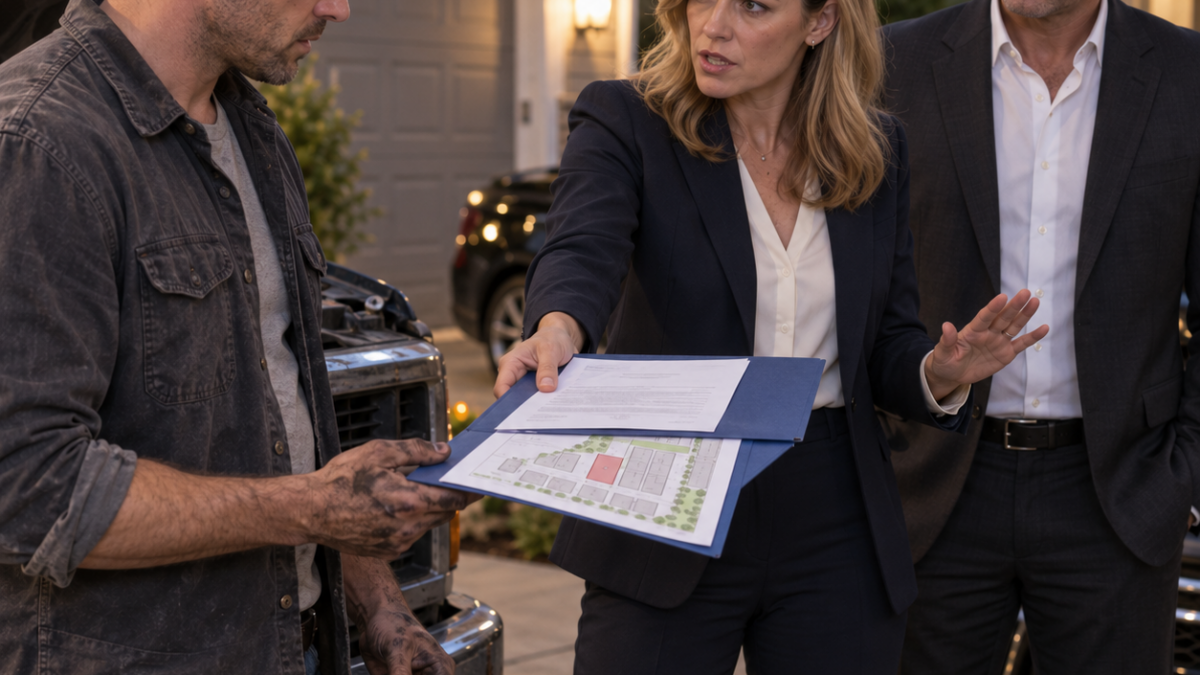
Then Dana walked down the porch steps holding a blue folder.
“We need to talk about the garage.”
That almost made me laugh.
We had been married fifteen years, and somehow the conversation about another man had already become a conversation about property.
The garage was a two-bay cinderblock building my father left me when he died three years earlier. It sat on less than half an acre on the edge of Columbus, Ohio, squeezed between an auto-parts warehouse and one of Graham Voss’s car dealerships.
Graham had spent months trying to buy it.
Dana had spent months telling me I should sell.
She called it an aging building in a changing neighborhood.
I called it the last thing my dad ever trusted me to take care of.
Dana held out the folder.
“Sign the offer tonight. Graham’s deadline is Monday.”
“What deadline?”
“For the expansion.”
Chloe folded her arms.
“Dad, it’s a garage. You don’t even work there.”
Luis Ortega did.
He had rented both bays from my father for seventeen years and ran a small repair shop with his nephew. The rent wasn’t much, but it covered the taxes and most repairs.
Dana knew that.
She also knew Graham was offering $190,000.
She had repeated the number so often it had started sounding less like an offer and more like a fact.
“It would pay for college,” Chloe said.
“You already have a college account.”
“Not enough for anywhere I actually want to go.”
Dana gave her a look that was supposed to end the conversation.
It didn’t.
Headlights swept across the driveway.
A black sedan pulled to the curb.
Graham Voss stepped out wearing a dark suit without a tie, the kind of casual rich people wear when they want you to know the suit still costs more than your mortgage payment.
He owned five dealerships around central Ohio.
He was also one of Dana’s biggest clients.
And judging by the way Chloe suddenly stopped looking embarrassed, he was no stranger to conversations about our family.
Graham walked toward us.
“I brought the clean version.”
He tapped the blue folder.
“One signature and we can put the property issue behind us.”
I looked at Dana.
“Why does your client have paperwork involving property I own?”
“Because I asked him to bring it.”
Graham glanced toward his car.
“Dana and I have dinner with the development team. I’d rather not keep everyone waiting.”
There it was.
Not a request.
A schedule I was apparently expected to accommodate.
I wiped my hands on a shop rag and opened the folder.
The first page still showed $190,000.
Behind it was a purchase agreement.
Behind that was something Dana clearly hadn’t expected me to reach.
A site plan.
VOSS MOTORS — NORTH HIGH STREET EXPANSION, PHASE II.
Graham’s dealership buildings were outlined along the left side.
A new service building filled the center.
And directly where my father’s garage currently stood, the drawing showed a delivery entrance and employee parking.
I looked closer.
The strange part wasn’t that they had already designed over my property.
It was the small notation beside my parcel.
SITE CONTROL CONFIRMED.
“What does ‘site control confirmed’ mean?”
Dana looked at the page, then at Graham.
“It’s planning language.”
“For property I haven’t sold?”
Graham stepped closer.
“Our consultants build plans around likely acquisitions. It doesn’t mean anything is final.”
“Then you won’t mind if I keep this.”
Dana’s mouth tightened.
“We need that packet.”
“I’ll make a copy.”
I closed the folder.
Nobody went to dinner immediately after that.
The next morning, I drove to the garage before seven.
Two orange survey marks had been sprayed near the driveway entrance.
A wooden stake stood beside the rear fence.
Luis came out wiping his hands on a red shop towel.
“You finally sell?”
“No.”
His eyebrows lifted.
“Then why have survey guys been here twice?”
I stared at him.
“What did they say?”
“That the dealership expansion was moving ahead and this parcel was basically done.”
Luis went inside and returned with a folded photocopy one of the surveyors had left on his workbench.
It showed the same expansion plan.
At the bottom was an acquisition note saying seller cooperation had been confirmed through counsel.
Beneath that was the name of the attorney handling the property discussions.
Dana Mercer.
My wife.
I stood beside the workbench reading her name until Luis finally asked whether I was okay.
“No.”
It was the first honest answer I had given anyone that weekend.
He glanced at the paper.
“Want me to call the survey company?”
“Not yet.”
“What about Dana?”
“Definitely not yet.”
Luis knew enough about my marriage to understand that answer meant something larger than real estate.
My father had hired him when I was still in high school.
He had watched me leave for community college, drop out after one year, join a construction crew, marry Dana, buy our first house, and eventually become a site superintendent.
He had also watched my father die.
The garage had never been impressive.
Concrete floors.
A roof that needed patching every third winter.
A tiny office with fake wood paneling from 1986.
My father had spent thirty-one years repairing cars there before arthritis pushed him out from under them.
When his health failed, Luis kept the business going as a tenant.
My father left the building to me because, as he put it, “Your sister would sell it before my funeral flowers wilt.”
He was probably right.
I folded the site plan.
“Did they go inside?”
“No.”
“Did they ask?”
“One guy did. I told him to call you.”
“Good.”
“You want me to keep everybody off the property?”
“Yes.”
Luis nodded.
“That I can do.”
I called a real-estate attorney from the parking lot.
Her name was Lena Park.
A project manager I worked with had used her during a commercial easement dispute and described her as “expensive enough to listen to.”
She answered my message Monday morning.
By Tuesday afternoon, I was in her office with the blue folder, the survey plan, my father’s deed, and a headache that had been behind my right eye for three days.
Lena was forty-six, compact, direct, and apparently allergic to reassuring people before she understood the facts.
She read the acquisition offer.
Then the site plan.
Then the parcel notation.
“Who owns the garage?”
“I do.”
“Individually?”
“Yes. My father’s estate transferred it directly to me.”
“Any mortgages?”
“No.”
“Any option agreements?”
“No.”
“Right of first refusal?”
“No.”
“Any document you signed with Voss Motors?”
“No.”
“Anything Dana signed for you?”
“Not that she had authority to sign.”
Lena finally looked up.
“Good.”
“Good?”
“It means the starting point is simple. Nobody gets your property because they drew a parking lot over it.”
I leaned back.
“What does site control mean?”
“It can mean several things depending on who wrote the note. Ownership. Option. Purchase contract. A strong expectation of acquisition. Sometimes it is just sloppy shorthand.”
“Seller cooperation confirmed through counsel?”
“That concerns me more.”
I slid the second page toward her.
She read Dana’s name again.
“Is your wife representing Voss Motors?”
“She handles some of their commercial work.”
“On this acquisition?”
“She never said she was.”
Lena tapped the page.
“Then I would like to know why someone thinks she is confirming your cooperation.”
I told her about the driveway.
Graham.
The dinner.
Chloe.
The sentence I had overheard.
I left out nothing except how stupid I felt.
When I finished, Lena closed the folder.
“You need separate family counsel.”
“I haven’t decided whether I’m divorcing her.”
She stared at me.
That was uncomfortable.
“I’m deciding,” I said.
“Then decide before you sign property documents connected to the man she may be personally involved with.”
“I didn’t say she was involved with him.”
“You didn’t have to.”
That afternoon, Lena sent formal notices to Voss Motors, the surveying company, and Dana’s law firm.
The message was simple.
I had not agreed to sell.
Nobody had permission to enter the property for surveys or preconstruction work without authorization.
All future acquisition discussions went through Lena.
The response came quickly.
Too quickly.
Voss Motors’ outside counsel wrote back the same day saying there was no executed purchase agreement and that the site-control notation reflected “anticipated acquisition.”
That should have made me feel better.
It didn’t.
Because anticipated acquisition was not what Dana had spent months telling me.
She had told me Graham was making a modest offer on an inconvenient little parcel.
She never mentioned the dealership had already designed an expansion around it.
I ordered an appraisal.
Dana found out two days later.
She was standing in the kitchen when I got home.
“You hired a lawyer?”
“Yes.”
“For a property offer?”
“For my property.”
“You could have talked to me.”
I put my keys on the counter.
“Like you talked to me before survey crews showed up?”
“They were doing preliminary work.”
“You confirmed my cooperation.”
Her face changed.
“I didn’t sign anything for you.”
“That is not what I said.”
She folded her arms.
“I told their acquisition team I believed you would sell.”
“Why?”
“Because you’ve been saying for three years that the garage is a headache.”
“I said the roof was a headache.”
“Ryan, come on.”
There it was.
My name spoken in the tone people use when they want your resistance to sound childish.
“The building is old. Luis pays below market. You spend weekends fixing things there for free. Graham is offering cash for a property you don’t even use.”
“I use it.”
“For what?”
“To own it.”
She laughed once.
That hurt more than I expected.
I looked at her.
“Are you sleeping with him?”
The laugh disappeared.
For several seconds, she said nothing.
Then she sat at the kitchen table.
I stayed standing.
“How long?” I asked.
“Six months.”
Six months.
Not fifteen years.
Not our whole marriage.
Six months was almost worse because I could remember the exact version of my life that existed six months earlier.
Chloe’s school conference.
Dana’s birthday dinner.
The weekend we drove to Cincinnati for her mother’s retirement party.
Christmas.
The night Dana came home after midnight and told me Graham’s acquisition closing had turned into drinks with the client team.
I pulled out a chair but didn’t sit.
“Does Chloe know?”
Dana looked away.
“How much does she know?”
“She knows Graham and I are close.”
“Close.”
“She knows our marriage hasn’t been good.”
“Did you tell her we were separating?”
Dana rubbed her forehead.
“I told her we were having problems.”
“That is not the same question.”
“She figured out more than I intended.”
That sounded convenient.
“When was the first time she met him outside work?”
Dana hesitated.
“Ryan.”
“When?”
“Graham took us to a concert in October.”
I stared at her.
“Us?”
“Chloe and me.”
“You told me Chloe went with Madison’s family.”
“Because I knew how you would react.”
My daughter had lied to me.
My wife had taught her how.
That thought landed harder than the affair.
Dana stood.
“I never wanted her in the middle.”
“You put her there.”
“No. The marriage put her there.”
“Our marriage did not buy concert tickets.”
“You know what I mean.”
“I don’t think I do anymore.”
She looked tired.
For a moment, she looked like the woman I had married.
Dana and I met when I was twenty-three and she was twenty-five.
I was running concrete crews.
She was in her second year of law school and working nights at a restaurant where the staff hated the owner but loved each other.
She used to steal fries from my plate and leave casebooks all over my apartment.
When Chloe was born, Dana took six weeks off and hated every minute of being away from school and work.
I admired that about her.
She wanted things.
She chased them.
I never thought ambition was a character flaw.
Somewhere along the way, though, she started treating my slower version of success as evidence that I lacked it.
I still worked construction.
I still came home with dust on my boots.
I still drove a truck I could repair myself instead of a leased luxury SUV.
Graham had become an easy comparison.
Dana went upstairs.
Twenty minutes later, she came down carrying an overnight bag.
“I’m staying at a hotel.”
“His?”
“No.”
I didn’t ask.
She stopped near the door.
“I still think you should sell the garage.”
I stared at her.
“Of course you do.”
The appraisal came back at $645,000.
I thought it had to be wrong.
I called the appraiser.
He walked me through it.
The building itself was not special.
The land was.
Voss Motors owned or controlled nearly every parcel around mine.
Without my half-acre, the proposed service entrance had to be redesigned.
Truck circulation became harder.
Parking count dropped.
Storm-water work became more expensive.
My parcel was worth more to Graham than it was to almost anyone else.
“How much more?” I asked.
“That becomes a negotiation question.”
“Is $190,000 reasonable?”
The appraiser paused.
“Not based on the use they appear to be planning.”
I emailed the report to Lena.
She called ten minutes later.
“Do not send this to Dana.”
“I wasn’t going to.”
“Good. I’m starting to like you.”
I was not ready to laugh.
But I almost did.
Chloe stopped speaking to me properly after Dana moved out.
She answered practical questions.
School pickup.
Dinner.
Where she was going.
Nothing else.
Finally, one Thursday night, I found her in the living room with headphones on.
I turned off the television.
“We need to talk.”
“I have homework.”
“No, you have a laptop open to a shoe website.”
She closed it.
“What?”
“Why did you say Graham treats your mom like she matters?”
Her face hardened.
“Because he does.”
“How do you know?”
“I’ve seen it.”
“At concerts?”
She looked at me sharply.
“Mom told you.”
“Eventually.”
Chloe pulled one knee toward her chest.
“You never take her anywhere.”
“We go places.”
“Home Depot doesn’t count.”
Despite everything, I laughed.
She didn’t.
“He takes her to restaurants. Events. He listens when she talks about work.”
“I listen.”
“You always look tired.”
That one was fair.
Construction did that.
So did a marriage I apparently had not understood.
“Did your mom tell you we were already separating?”
Chloe looked down.
“She said you basically were.”
“When?”
“Last summer.”
Last summer.
Months before Dana said the affair started.
That detail mattered.
“What did she say exactly?”
“That you two were more like roommates. That she’d tried talking to you and you didn’t want anything to change.”
I sat opposite her.
“Did she say I knew she was seeing Graham?”
Chloe didn’t answer.
“That’s a no.”
“She said it was complicated.”
“It is.”
“She said you’d make everything about the garage and money.”
I leaned back.
There it was again.
The garage.
“Did Graham talk to you about it?”
“Not really.”
“Chloe.”
She rolled her eyes.
“He said selling it would give everybody options.”
“What options?”
“College. Travel. Maybe Mom wouldn’t have to work at her firm forever.”
My stomach tightened.
“What does that mean?”
“I don’t know.”
“You just said it.”
“He said Mom had bigger opportunities coming.”
I stood.
Chloe’s expression changed.
“What?”
“Nothing.”
“You’re doing that thing.”
“What thing?”
“Where you get quiet and act like everybody else is stupid.”
I stopped.
That was another fair hit.
“I don’t think you’re stupid.”
“You think Mom is.”
“I think your mother has made decisions I don’t understand yet.”
“Because she wants more?”
“No.”
“Then what?”
“Because she brought you into adult decisions and gave you one version of them.”
Chloe stood too.
“You’re just mad I like Graham.”
“I’m mad you were asked to like one parent’s future before anybody told me my marriage had ended.”
Her eyes filled.
I regretted the sentence immediately.
Not because it was untrue.
Because she was sixteen.
“I’m sorry,” I said.
She wiped under one eye angrily.
“Don’t.”
Then she went upstairs.
For the first time since the driveway, I stopped thinking of Chloe as one of the people against me.
She was a kid who had been living in a story somebody else was narrating.
That did not erase what she had said.
It changed how much responsibility I gave her for saying it.
The first major document exchange happened three weeks later.
By then, I had hired family counsel through Lena’s firm.
Dana had her own attorney.
Voss Motors had stopped contacting me directly.
Graham did not come to the house again.
His acquisition team increased the offer to $260,000.
Lena sent back one sentence.
Seller declines.
Two days later, $325,000.
Declined.
Then nothing.
That was when I started understanding how badly they needed the parcel.
A month after the driveway confrontation, Lena called me into her office.
She had a stack of correspondence from the property dispute.
“Voss agreed to produce enough of its acquisition file to explain the site-control representation.”
“What does enough mean?”
“Enough to irritate everyone.”
She slid one email toward me.
It was from Dana to Graham’s acquisition director.
The date was six weeks before the driveway.
Ryan is sentimental about the building, but he has no practical use for it. Keep the number below 200 for now. Chloe is starting to understand what the sale could do for college. He will come around once it stops feeling like he is giving up his father.
I read it twice.
Then a third time.
“She used Chloe.”
Lena did not answer.
“She knew Chloe was pressuring me.”
“The email suggests she expected that pressure to help.”
I pushed the page away.
That was the significant thing about betrayal.
It kept changing shape.
First, Dana had cheated.
Then she had involved Chloe.
Then she had professionally represented my cooperation.
Now I knew she had deliberately viewed our daughter as leverage.
Lena handed me another page.
Internal acquisition budget.
The parcel was listed at a target range of $575,000 to $725,000.
I stared at the numbers.
“Dana told me one ninety was fair.”
“I know.”
“Graham told me it was a clean offer.”
“I know.”
“Why start that low?”
“Because buyers prefer paying less.”
“You make that sound normal.”
“It is normal to negotiate. It is not normal for your spouse, who also works with the buyer, to tell you the low number is objectively what the property is worth.”
That distinction sat between us.
“Can I sue them?”
“You can sue almost anyone. That does not mean you should.”
“What would you do?”
“I would finish gathering facts.”
I hated lawyers when they were right.
By spring, the divorce was moving.
Slowly.
Chloe split her time between the house and the apartment Dana rented.
She initially spent more nights with her mother.
I did not fight her.
She was sixteen, not six.
Forcing her into my house would not rebuild anything.
One Saturday, she showed up while I was replacing a leaking water line at the garage.
Luis was under a Chevy Tahoe.
I was in the back office trying to understand why a shutoff valve installed during the Clinton administration had decided that afternoon was its last.
Chloe stood in the doorway.
“Mom said you’re trying to stop her from getting a new job.”
I put down the wrench.
“What new job?”
“She said you know.”
“I don’t.”
“She said Graham offered her something and you’re making it impossible.”
My entire body became alert.
“What exactly did she say?”
Chloe crossed her arms.
“That if you keep blocking the expansion, the position might disappear.”
“What position?”
“I don’t know. Some legal job.”
I wiped my hands.
“When did Graham offer it?”
“I don’t know.”
I believed her.
I called Lena before Chloe left the parking lot.
“Dana has a job offer from Voss.”
A pause.
“Do you know that?”
“Chloe just told me.”
“Do not interrogate your daughter for employment terms.”
“I didn’t.”
“Good.”
“Can we get it?”
“If it has financial value relevant to divorce disclosure, probably.”
Three weeks later, we did.
It appeared on Dana’s disclosure schedule.
Conditional employment offer.
Voss Automotive Holdings.
General Counsel.
Base compensation: $245,000.
Annual target bonus.
Long-term phantom equity participation.
Proposed start date tied to completion of specified expansion milestones and Dana’s release from existing client obligations.
The letter was dated four months before the driveway confrontation.
I sat in Lena’s conference room with the document in front of me.
Four months.
Dana had been telling me the garage was worth $190,000 while holding a job offer from the company trying to buy it.
A job that became more valuable if the expansion happened.
That was the Main Reveal for me.
Not the affair.
By then, I already knew she loved somebody else, or believed she did.
The job letter explained the pressure.
The low number.
The urgency.
The way Graham spoke as if my signature were a scheduling problem.
The way Dana kept invoking Chloe’s college.
The way she had told our daughter there were “bigger opportunities” coming.
My property was not just emotionally inconvenient to Dana.
It was sitting between her and the future she had already designed.
Lena watched me read.
“Say something.”
“What do you want me to say?”
“Anything that tells me you’re not planning to drive to Graham’s dealership and yell in the showroom.”
“I’m not.”
“Good.”
“I’m going to mediation.”
“That would be my preference.”
The property mediation happened separately from the divorce mediation.
Voss Motors brought outside counsel and an acquisition executive.
Graham did not attend.
Neither did Dana.
They offered $610,000.
That was the first number I considered seriously.
Luis had no idea the offers had risen that high.
When I told him, he sat on an upside-down bucket in the garage and whistled.
“You should sell.”
I looked at him.
“You work here.”
“I can work somewhere else.”
“You’ve been here seventeen years.”
“And I am old enough to know the difference between loyalty and stupidity.”
“That’s helpful.”
He grinned.
“Your dad would tell you to take the money.”
“No, he’d tell me to make them pay eight hundred.”
Luis laughed so hard he started coughing.
I went home with the offer in my bag.
For two days, I considered it.
That was important.
I did not refuse because the garage had become a sacred battlefield.
It was real money.
Enough to change my mortgage.
Enough to secure Chloe’s college account.
Enough to put something serious into retirement.
Enough to move Luis properly if I gave him time.
Then Voss’s counsel added a condition.
Closing had to occur before Dana’s proposed employment start date.
I read the line.
And the decision became easier.
Not because I wanted revenge.
Because I was finished making my property part of Dana’s transition plan.
I declined.
Voss increased the offer to $690,000.
I declined again.
Lena called.
“You understand they may never offer this much again.”
“I do.”
“You understand refusing money is not morally superior to accepting it.”
“I know.”
“Then why?”
“Because I still don’t know whether I want to sell.”
That was the whole answer.
For the first time, uncertainty belonged to me.
The divorce mediation was harder.
Dana sat across from me in a neutral conference room.
Her hair was pulled back.
She looked exhausted.
So did I.
There were attorneys on both sides.
Boxes of documents.
Coffee nobody wanted.
We spent the morning on the house, retirement accounts, vehicles, Chloe’s expenses, and the ordinary mathematics of taking one household apart.
After lunch, Dana asked for a private conversation with lawyers present but no mediator.
I agreed.
She looked directly at me.
“You cost me that job.”
I expected anger.
Her voice was quiet instead.
“I did not offer you the job.”
“You knew the deal depended on the expansion.”
“I learned that during disclosure.”
“You knew Graham needed the garage.”
“Yes.”
“And you refused because of me.”
“No.”
She stared at me.
“You expect me to believe this has nothing to do with us?”
“It has everything to do with us. It does not mean I owe you the sale.”
“Ryan, I spent fifteen years supporting your work.”
I almost smiled.
“Dana, my work did not require your inherited property.”
“That’s not fair.”
“Neither was telling me one ninety was fair while you knew their internal budget went past seven hundred.”
Her eyes shifted toward her attorney.
That was the first moment she understood how much I had seen.
“You have their internal budget?”
“My attorney does.”
She looked down.
I continued.
“You told Chloe selling the garage would help pay for college.”
“It would.”
“You told Graham she was starting to pressure me.”
Dana’s face went still.
“That email was taken out of context.”
“Give me the context where using our daughter as leverage sounds better.”
“I was trying to solve a practical problem.”
“No. You were trying to close a deal that also helped your next job.”
She exhaled sharply.
“You think everything I’ve done for fifteen years was some scheme?”
“No.”
That answer surprised both of us.
I leaned back.
“I think we had a real marriage. I think we loved each other. I think you got tired of parts of our life. I think Graham gave you a version of success that looked easier and more exciting than the one we had.”
Dana’s eyes filled.
I kept going.
“And somewhere in that process, you started treating me like an obstacle instead of a person you owed honesty to.”
She looked toward the window.
“You stopped trying with me years ago.”
“Maybe I did in ways I should have seen.”
That cost me something to say.
It was also true.
I worked long hours.
I assumed showing up, paying bills, fixing things, and being faithful were enough.
Dana wanted conversation I sometimes did not have energy for.
She wanted travel I kept postponing.
She wanted me at professional dinners I hated.
None of that justified what she did.
But I was done needing her to be wrong about absolutely everything.
“You could have left,” I said.
“I know.”
“You could have told me you were unhappy.”
“I tried.”
“Then you could have told me again. Or filed. Or moved out. There were about a hundred options before sleeping with your client and using Chloe to get my signature.”
Dana wiped one eye.
Her attorney looked down at her notes.
I did not feel victorious.
I felt old.
The divorce settled that evening.
We sold the house.
Neither of us wanted it enough to buy out the other.
My retirement stayed largely intact.
Dana kept hers.
Chloe’s existing college account was placed under rules requiring both parents to approve withdrawals for education.
No parent got to use it as leverage again.
We agreed to shared parenting with enough flexibility for a sixteen-year-old to have a voice.
The garage remained outside the marital settlement under the final property terms.
Dana moved permanently into her apartment.
I rented a smaller house ten minutes from the garage.
Her firm removed her from Voss-related work after the personal conflict became formal.
She was not fired.
That mattered because real consequences are rarely as clean as people want them to be.
She later moved to another firm.
The Voss general-counsel job never happened.
I do not know whether Graham withdrew it because the expansion stalled, because Dana’s divorce created complications, because his company decided the arrangement looked bad, or because their relationship began falling apart.
Probably some combination.
By fall, Chloe told me Dana and Graham were no longer together.
I said, “Okay.”
She waited.
“That’s it?”
“What do you want me to say?”
“I don’t know.”
“Neither do I.”
We were sitting in my kitchen.
She had come over for dinner voluntarily, which was still new.
Our relationship had been slow to recover.
There was no dramatic apology the first week.
No sudden realization that Dad had been right.
For months, Chloe remained angry at me for changing the story she had believed.
That is one of the strange things about correcting a lie.
The person hearing the truth sometimes resents you because the lie was emotionally easier.
Dana’s version had been simple.
Our marriage was already dead.
I refused to move on.
I cared more about an old building than my family.
Graham represented a better future.
Then documents arrived.
Dates.
Offers.
Emails.
I did not show Chloe everything.
She was still our daughter.
But I showed her enough.
The appraisal.
The original $190,000 offer.
The later $690,000 offer.
I showed her that the garage had never been worth what she had been told.
I told her the Voss job existed before Dana pushed me to sign.
I did not show her the ugliest email about using her pressure.
That one stayed between adults.
One evening, Chloe asked me directly.
“Did Mom lie to me?”
I took a long time answering.
“She told you a version that left out things you should not have been responsible for in the first place.”
“That means yes.”
“Sometimes.”
Chloe looked down at the table.
“I said you were pathetic.”
“You said something close to that.”
“You heard me.”
“Yes.”
Her eyes filled.
“I’m sorry.”
I nodded.
She looked frustrated.
“That’s all?”
“What do you want?”
“I don’t know. Yell or something.”
“I spent half a year being angry. I’m tired.”
“I really thought you were holding her back.”
“I know.”
“She said you wouldn’t let anything change.”
“I probably resisted change more than I should have.”
Chloe looked up.
“Why are you defending her?”
“I’m not. I’m trying not to turn you against your mother just because she turned you against me.”
That ended the conversation for a while.
Then Chloe asked whether I had really turned down almost seven hundred thousand dollars.
“Yes.”
She stared at me like I had confessed to eating drywall.
“Why?”
“I didn’t want to sell yet.”
“That’s insane.”
“Possibly.”
“Grandpa would have sold.”
“Luis says the same thing.”
“So everybody thinks you’re wrong.”
“Not everybody.”
“Who thinks you’re right?”
“Me.”
For the first time in months, she laughed.
Voss Motors eventually redesigned Phase II.
They purchased a different strip of land on the opposite side of the dealership and changed the service entrance.
It cost them time and money.
Nobody went bankrupt.
No empire collapsed.
Graham remained rich.
The dealership remained open.
I found that comforting.
My life did not need his destruction to become legitimate.
I kept the garage.
That decision created its own problems.
The roof needed replacement sooner than expected.
The electrical panel failed inspection during an insurance review.
Luis had been paying below-market rent so long that I could not afford every improvement without changing something.
We sat down.
I showed him the numbers.
He looked miserable.
“I told you to sell.”
“I remember.”
We agreed on a gradual rent increase over two years.
I paid for the roof.
He paid for several interior upgrades.
His nephew became a formal partner in the repair business.
The arrangement was less romantic than preserving my father’s legacy.
It involved invoices.
Permits.
Complaints about dumpsters.
That was probably why it worked.
Dana and I learned to communicate about Chloe without reopening the marriage every time.
School.
College applications.
Insurance.
A wisdom-tooth appointment.
The first few months were brutal.
Then routine did what routine always does.
It made difficult things less dramatic.
Chloe applied to six colleges.
Not the fantasy list Graham had once talked about.
Her list.
Two in Ohio.
One in Michigan.
One in North Carolina.
Two schools she knew would be financial reaches.
We discussed costs at my kitchen table.
She had scholarships at three.
The college fund was healthy.
I told her exactly what I could contribute.
Dana did the same.
No garage sale required.
One Saturday in February, nearly a year after the driveway confrontation, Chloe came to the shop while Luis was out to lunch.
I was working on my truck.
Same truck.
Different driveway.
She stood near the open bay in jeans and an Ohio State sweatshirt.
“You still working on that thing?”
“It has character.”
“It has rust.”
“Character.”
She picked up a ratchet from the cart.
“What are you doing?”
“Front brakes.”
“Can I help?”
I looked at her.
She rolled her eyes.
“I know. Shocking.”
I handed her a pair of gloves.
We worked for twenty minutes before she spoke again.
“Mom said Graham offered you the money again.”
“Last month.”
“How much?”
“Seven hundred.”
She dropped the socket into the tray.
“You said no again?”
“Yes.”
“Dad.”
“What?”
“Seriously?”
I laughed.
She shook her head.
“What are you waiting for?”
I looked around the garage.
Luis’s old radio sat near the office window.
A customer’s minivan was parked outside.
The new roof did not leak.
The wall where my father used to hang handwritten labor-rate sheets had been repainted, but you could still see the outline if you knew where to look.
“I don’t know.”
“That’s not an answer.”
“It is.”
She stared at me.
I wiped my hands.
“For a long time, everybody around that property knew what I should do with it. Your mom knew. Graham knew. You thought you knew. Luis knows every Thursday.”
“He’s probably right.”
“He often is.”
“So why keep it?”
I looked at the truck.
“Because if I sell it one day, I want the reason to be mine.”
Chloe did not answer.
I worried the sentence sounded more dramatic than I intended.
Then she nodded.
“Okay.”
That was it.
No speech.
No apology.
She crouched beside the wheel again.
A minute later, she asked which socket I needed.
“Eighteen.”
She handed me the seventeen.
“Close.”
“You said eighteen?”
“Yes.”
“They look exactly the same.”
“That explains a lot about your grades in geometry.”
She threw the shop towel at me.
I laughed.
She did too.
The divorce had not made me richer.
Keeping the garage had probably made me poorer, at least on paper.
Dana had not become a villain in Chloe’s life.
Graham had not been punished by the universe.
Nobody stood in a courtroom and announced that I had been right all along.
What changed was smaller.
I stopped allowing other people’s certainty to substitute for my consent.
The garage might be sold someday.
Luis might retire.
Chloe would leave for college.
Dana and I would keep becoming people who used to know each other better than we did now.
None of those things frightened me the way they once would have.
I reached my hand out from beneath the truck.
“Eighteen millimeter.”
This time Chloe checked the number before handing it over.
The wrench was warm from her hand.
I took it.







