My Sister Mocked Me for Raising My Son Alone—Then Her Fiancé’s Phone Call Didn’t Add Up
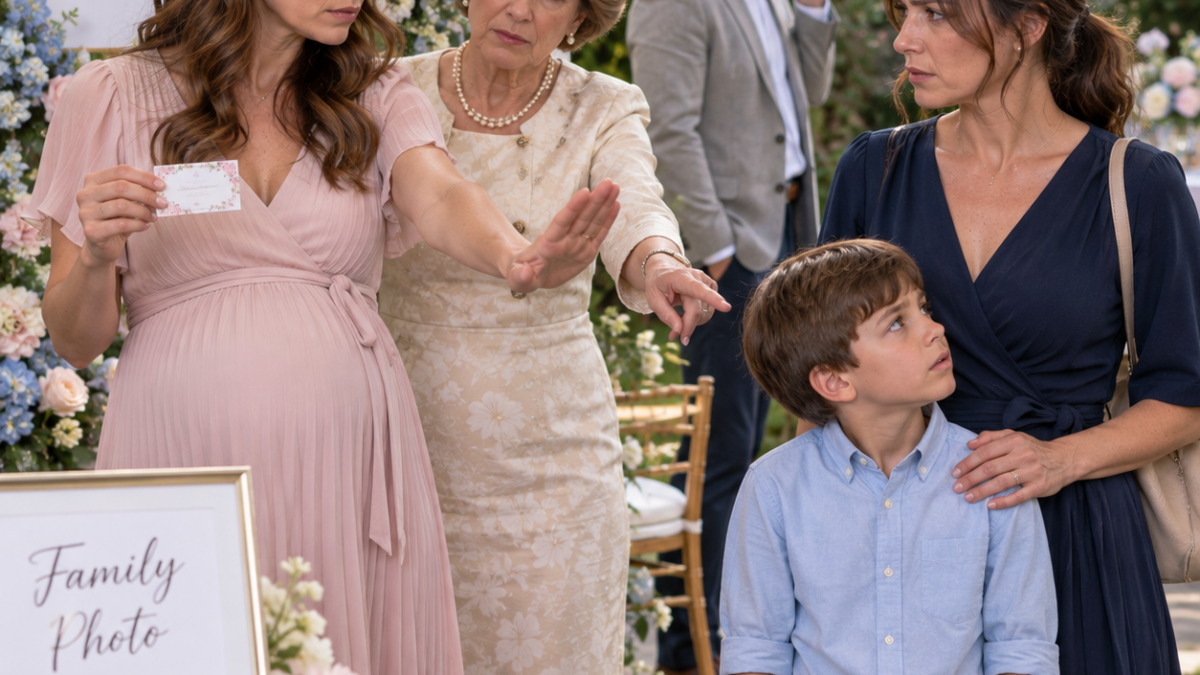
My pregnant sister took my nine-year-old son’s place card off the family table and said, “This section is for couples. You two can sit near the garden.”
I looked at her.
Then at my mother, who was standing beside her.
Mom gave me the same tight smile she’d used for years whenever she wanted to say something cruel without sounding cruel.
“Let Tessa have one afternoon where the pictures look the way she imagined them.”
The way she imagined them.
Apparently a widow and her son ruined the picture.
My name is Erin Caldwell. I’m thirty-six, I work as a risk analyst for a regional credit union in Raleigh, and I’ve raised my son Noah alone since my husband Evan died seven years ago.
Tessa was twenty-nine, seven months pregnant, and engaged to Grant Mercer, a forty-year-old management consultant who had entered our family eleven months earlier with an expensive watch, a leased luxury SUV, and an answer for everything.
Mom adored him.
More accurately, Mom adored what she thought he represented.
Money.
Status.
A man who picked up dinner checks without looking at the total.
Tessa’s baby shower was being held at an upscale garden venue outside Raleigh. Nearly sixty guests were drinking champagne under white umbrellas while a photographer moved people between flower arches and linen-covered tables.
I had spent $1,800 on the dessert table because Mom told me the family was “splitting the important pieces.”
That afternoon I learned splitting meant I paid for dessert while Grant apparently paid for everything impressive enough to be photographed.
Then, twenty minutes before lunch, the venue coordinator approached Mom about an unpaid catering upgrade.
Mom immediately turned toward me.
“It’s only thirty-two hundred. Can you put it on your card until Grant sorts it out?”
“No.”
Her face tightened.
“You have savings.”
“So does Tessa.”
“Tessa has a baby coming.”
“I have a child sitting ten feet away.”
Mom lowered her voice.
“Erin, you know what I mean. You don’t have the same household expenses.”
That was how my family had always talked about my life after Evan died.
As though losing my husband had somehow made me financially convenient.
Tessa overheard enough to roll her eyes.
“Forget it, Mom. Grant will handle it.”
Then she looked at me.
“Not everybody understands what it’s like to have a partner who provides.”
I should have left right then.
Instead, I stayed because Noah had been excited about the cake, because I had promised myself I wouldn’t make my sister’s shower about our history, and because after seven years I had become very good at sitting through sentences designed to make widowhood sound like a character flaw.
The photographer called for immediate family.
I stood.
Tessa stopped me.
“This one is couples and grandparents.”
Noah looked up at me.
Mom added, “Just give her the photo, Erin.”
So I sat back down.
Grant stood beside Tessa with one hand resting on her shoulder while Mom arranged herself on the other side.
They looked exactly like the picture they wanted.
Stable.
Successful.
Complete.
Noah leaned toward me.
“Can we go soon?”
“Yes.”
When the photos ended, I took him toward a quieter side patio to get our things.
That was when he asked me something that made me stop.
“Mom, who are Emma and Lily?”
“I don’t know. Why?”
He shoved his sketchbook into his backpack.
“Grant was on the phone by the bathroom earlier. He said, ‘Tell Emma and Lily Daddy loves them. I’ll call before bed.’”
I stared at him.
“Are you sure he said Daddy?”
Noah nodded.
Then he added one more detail.
“When Grant saw me standing there, he told the person on the phone he had to go.”
I didn’t question Noah again. I told him he hadn’t done anything wrong and that adult conversations were not his responsibility. We left before dessert.
That evening, Tessa texted me.
Can you please tell Noah not to repeat random things he hears? Grant said he misunderstood a work call.
I read the message twice.
I hadn’t told Tessa what Noah heard.
“Did Grant tell you what Noah supposedly misunderstood?” I asked.
She replied almost immediately.
Something about kids. He has clients with families. It’s nothing.
I didn’t argue.
Instead, I searched Grant’s full legal name in public North Carolina business records.
His consulting company existed, but its registered address was a mailbox service.
Then I searched property records in Virginia, where he claimed to travel several times a month for clients.
One result appeared in Henrico County outside Richmond.
Grant Alexander Mercer.
The middle name matched his engagement announcement.
The property was a four-bedroom house purchased six years earlier.
Current ownership:
Grant A. Mercer and Melissa J. Mercer.
The mailing address was still the same property.
The current-year tax record still classified it as an owner-occupied residence.
I stared at Melissa’s name.
Wife?
Ex-wife?
Sister?
Business partner?
I didn’t know.
But I knew enough not to call Tessa with a theory.
I saved the record.
Then I noticed one more thing.
The property had never been transferred out of Grant’s name.
I went to work Monday morning and tried to behave like a normal person.
That lasted until 9:17.
My job involves reviewing consumer-lending risk models for a regional credit union. I don’t approve individual loans, and I don’t have magical access to everyone’s financial life. Most of my work is statistical, procedural, and dull enough that Noah once asked whether my office job was “looking at boxes on a computer.”
He was not entirely wrong.
But years in risk management had taught me one habit that carried into ordinary life.
When information conflicts, don’t choose the version you prefer.
Identify what can be verified.
I could verify the property record.
I could verify Grant owned the house jointly with Melissa.
I could not verify who Melissa was.
I could not verify whether Grant was legally married.
I could not verify whether Emma and Lily were his children.
And I definitely could not justify calling my pregnant sister and announcing that her fiancé had a secret family because a nine-year-old overheard one phone call.
So I did nothing.
For three days.
On Thursday, Grant called me.
He almost never called me directly.
“Hey, Erin.”
His voice was too casual.
“What’s up?”
“I wanted to clear up that thing with Noah.”
“What thing?”
“You know. At the shower.”
“I know what Noah told me.”
“He heard part of a conversation and filled in the rest.”
“Okay.”
A pause.
“I’d appreciate it if you didn’t put ideas in Tessa’s head.”
That annoyed me.
“I haven’t said anything to Tessa except answering the text she sent me.”
“What did you say?”
“That I hadn’t discussed your call with her.”
Another pause.
Then he laughed lightly.
“You do this for a living, right? Analyze things?”
“Risk.”
“Exactly. You’re always looking for something wrong.”
I leaned back in my chair.
“Grant, if there’s nothing wrong, why are you calling me?”
“I’m protecting Tessa from unnecessary stress.”
“Then we agree on one thing.”
“What?”
“She doesn’t need unnecessary stress.”
He ended the call not long after that.
I wrote down the time.
Not because I was building a case.
Because the call bothered me and I wanted a clean record of what had happened before memory polished it into something else.
That evening, Mom called.
Her opening sentence was, “Please stop stirring things up.”
I almost laughed.
“With who?”
“Tessa.”
“I haven’t spoken to her since Sunday.”
“Grant says you’re researching him.”
There it was.
“What exactly did Grant tell you?”
“That you’ve been digging into his business.”
“I looked at public property records.”
Mom exhaled dramatically.
“Why?”
“Because Noah overheard something.”
“He’s nine.”
“I’m aware.”
“Children misunderstand things.”
“Yes.”
“So let it go.”
I looked at the saved Henrico County record on my laptop.
“Would you?”
“This is what I mean about you, Erin.”
“What do you mean?”
“You cannot stand that your sister is finally happy.”
I went quiet.
My mother had said versions of that sentence most of my life.
When Tessa got engaged, I was “too practical” about the wedding budget.
When she bought an expensive car, I was “judgmental” because I asked whether she had priced insurance.
When she announced the pregnancy, Mom told me not to “bring my sadness into Tessa’s happy season.”
I had never done that.
But my widowhood had become a lens my family used to interpret anything I said.
If I was cautious, I was bitter.
If I was quiet, I was jealous.
If I declined to pay for something, I was selfish because I supposedly had fewer responsibilities.
I said, “Mom, I’m not going to argue with you.”
“Good.”
“But I’m also not pretending I didn’t see the property record.”
She went silent.
“What property record?”
That told me Grant had not shared everything.
“A house in Virginia owned by Grant and a woman named Melissa Mercer.”
Mom recovered quickly.
“Probably his ex-wife.”
“Maybe.”
“He told us he was divorced.”
“Did you see anything confirming that?”
“Normal people don’t demand paperwork from family.”
I thought about that.
“Then I guess I’m abnormal.”
She hung up.
Saturday afternoon, Tessa showed up at my house.
No warning.
No Grant.
No Mom.
No makeup either, which for Tessa usually meant the situation was serious.
Noah was at a friend’s birthday party.
I let her in.
She stayed standing in the kitchen.
“Show me.”
I knew exactly what she meant.
I opened my laptop and pulled up the property record.
Tessa read Grant’s name.
Then Melissa’s.
She crossed her arms.
“He told me Melissa is his ex-wife.”
“Okay.”
“So?”
“So nothing. You asked me to show you.”
“He said they kept the house in both names because of the kids.”
That was the first time Tessa had mentioned children.
I kept my face still.
“The kids?”
She looked at me.
“Two daughters.”
“Emma and Lily?”
Her expression changed.
Very slightly.
“You already knew their names.”
“Noah heard them.”
Tessa sat down.
For a moment, neither of us spoke.
“How old are they?” I asked.
“Ten and seven.”
“Does Grant see them?”
“He said not often.”
“Why?”
“Melissa makes it difficult.”
I did not react.
I had heard that story before from divorced people whose relationships with children were genuinely difficult.
It could be true.
“What did he tell you about being married?”
“They’ve been separated for three years.”
“Legally divorced?”
“Yes.”
“Have you seen the divorce order?”
Her eyes narrowed.
“Do you ask everybody for legal records before you believe them?”
“No.”
“Then why him?”
“Because his name is still on an owner-occupied house with the woman he says he divorced.”
Tessa stood.
“You wanted something to be wrong.”
“No.”
“Yes, you did. Ever since he met us, you’ve treated him like some fraud.”
“I’ve barely said anything about Grant.”
“You look at him like you’re auditing him.”
That phrase sounded familiar.
Grant had clearly been talking.
I closed my laptop.
“If you believe him, then ask him for the divorce order and stop worrying about what I think.”
“I’m not worried.”
“Good.”
She grabbed her purse.
At the door she turned around.
“Don’t talk to Mom about this anymore.”
“I wasn’t planning to.”
“And don’t involve Noah.”
“I never did.”
She left.
Three hours later, she called.
Her voice sounded different.
“He won’t show me.”
I sat down.
“The divorce papers?”
“He says they’re in storage.”
“Okay.”
“Then he said his attorney has them.”
I waited.
“Then he got angry and asked why I suddenly don’t trust him.”
“What did you say?”
“I said if the divorce is real, showing me should be easy.”
“That seems reasonable.”
Tessa started crying.
Not dramatically.
Quietly.
The kind of crying that sounds like a person is trying to keep the rest of their life standing upright.
“Erin, what do I do?”
For years my sister had treated my life like a cautionary tale.
Part of me wanted to say something sharp.
Something about real providers.
Something about photographs that looked complete.
That part of me existed.
I’m not proud of it.
But I looked at the empty chair where Noah usually dumped his backpack and remembered what it felt like after Evan died.
People kept telling me I was strong when what they really meant was that they hoped I wouldn’t require too much from them.
I did not want to do that to Tessa.
“You don’t confront him until you know what you’re confronting.”
“I already did.”
“Then stop now.”
“How?”
“Ask for facts. Marriage record. Divorce record. Whatever financial documents matter before you marry him.”
She sniffed.
“You sound like work.”
“I know.”
“I hate that.”
“I also know.”
Tessa came back the next morning.
This time she brought a folder.
Grant had left it in their apartment after spending the night somewhere else.
She had not broken into anything.
The folder had been sitting in an unlocked desk drawer they both used for household paperwork.
Inside were statements for three credit cards.
All in Tessa’s name.
She knew the cards existed.
What she did not know was how high the balances had become.
$14,800.
$11,200.
$9,600.
More than thirty-five thousand dollars.
Most of the charges were not fraud.
Tessa had willingly opened the cards.
Grant had told her to use them for wedding deposits, furniture, travel, and baby expenses because his money was tied up in contracts and he would pay them down once client payments cleared.
He had paid some.
Then stopped.
There was also a personal loan for $18,000.
Tessa knew about that too.
It had been used for the leased SUV down payment, the baby shower deposit, and several home furnishings.
She believed Grant was reimbursing it monthly.
He had made two payments.
Then none.
“What do you owe because of him?” I asked.
She looked at the pages.
“Over fifty thousand.”
“And what does he owe?”
“I don’t know.”
“What assets are in his name?”
She looked at me.
“I don’t know.”
That scared me more than the balance.
Grant’s wealth had been a story told through objects.
Car.
Watch.
Restaurants.
Hotels.
Clothes.
Nobody had ever seen the underlying structure because nobody in my family thought wealth needed verification if it looked expensive enough.
Tessa whispered, “Mom is going to kill me.”
I stared at her.
“No.”
“You don’t understand.”
“I understand exactly.”
“She told everyone—”
“Tessa.”
She looked up.
“You are about to have a baby. The problem is not whether Mom feels embarrassed.”
That sentence seemed to reach her.
I called a family-law attorney I knew socially through work—not to represent Tessa automatically, but to ask for a referral in Richmond if the marriage issue involved Virginia.
The attorney gave me the name of a lawyer who handled interstate family cases.
Tessa made the call herself.
That mattered.
Three days later, she had a certified Virginia marriage record.
Grant Alexander Mercer.
Melissa Jane Carter.
Married twelve years earlier.
No divorce record appeared in the counties Grant had named.
That still did not prove no divorce existed anywhere.
The attorney explained that clearly.
So Tessa asked Grant one last time.
“Where was your divorce filed?”
He said Henrico County.
There was no record there.
Then he said Fairfax.
Nothing there either.
Then he stopped answering.
Tessa called me from her car.
“He’s lying.”
“Yes.”
“I feel stupid.”
“You trusted someone you planned to marry.”
“That sounds like a polite way to say stupid.”
“It isn’t.”
“You hated him.”
“I didn’t hate him.”
“You didn’t like him.”
“I didn’t know him.”
That turned out to be the truest sentence in the whole story.
Neither did she.
The next information did not come from me.
It came from Melissa.
Tessa’s attorney advised her not to contact Melissa impulsively while the legal status was unclear.
But after confirming enough identifying information, the attorney sent a formal inquiry through counsel because Grant’s marital status affected Tessa’s own plans and potential financial exposure.
Melissa called Tessa herself.
Tessa asked me to be in the room.
Not on speaker.
Not participating.
Just there.
We sat at my dining table while she answered.
“Hello?”
The voice on the other end was a woman.
Calm at first.
Then increasingly confused.
Tessa introduced herself.
There was a long silence.
Finally Melissa said, “How do you know my husband?”
Tessa closed her eyes.
That was the Main Reveal.
Not property records.
Not Noah’s overheard call.
Not credit-card balances.
Grant had never divorced Melissa.
They were still married.
Not technically.
Not because paperwork had stalled.
Married in every ordinary sense Melissa understood.
Grant spent roughly half of every month in Virginia.
He told Melissa his Raleigh travel was consulting work.
When he stayed in North Carolina, he told her he was managing a long-term client project.
When he was with Melissa and their daughters, he told Tessa he had meetings in Virginia.
Emma was ten.
Lily was seven.
The girls had no idea their father was engaged to another woman.
Melissa had no idea Tessa existed.
She definitely did not know Tessa was pregnant.
Tessa whispered, “I’m thirty-one weeks.”
Melissa stopped speaking.
Then she said, very quietly, “I’m sorry.”
The two women spent nearly an hour comparing facts.
Christmas.
Grant told Tessa he had to fly to Denver for a corporate retreat.
He was in Richmond with his family.
Memorial Day.
He told Melissa he was attending a client conference in Charlotte.
He was at the beach with Tessa.
His supposed consulting business did exist.
But Melissa said the income had been unstable for two years.
The leased SUV?
Tessa’s credit.
The watch?
Bought on a promotional card.
The expensive dinners?
Often paid through cards Grant later asked Tessa to cover because a client reimbursement was “delayed.”
The baby shower?
Grant had not financed it.
My mother had paid a large deposit.
Tessa had financed another portion.
The rest was still outstanding.
My $1,800 dessert table was one of the few things actually paid in full.
When the call ended, Tessa put her phone facedown.
She sat there for a long time.
Then she asked one question.
“Did you know before Noah said something?”
“No.”
“You ever suspect he was married?”
“No.”
“You thought he was fake, though.”
“I thought he spent like someone who wanted people to notice.”
“That’s not the same thing.”
“No.”
She looked toward the window.
“Mom kept saying I finally picked better than you.”
There it was.
The competition I had never entered.
“Tessa.”
She covered her face.
“She said Evan left you with nothing.”
I felt something cold move through me.
“Evan died.”
“I know.”
“She knows.”
“I know.”
My husband had died in a highway accident when Noah was twenty-two months old.
There had been no abandonment.
No scandal.
No bad choice.
Just an exhausted state trooper at my door at 1:10 in the morning.
But after enough years, my mother had rewritten widowhood into evidence that I had failed to secure the kind of life she valued.
Tessa had absorbed it.
I said, “You need to stop measuring yourself against me long enough to decide what protects you and your baby.”
She started crying again.
This time I moved around the table and held her.
Not because she deserved instant forgiveness for every ugly thing she had said.
Because she was my sister.
Those were separate questions.
The confrontation happened four days later at Mom’s house.
Not my idea.
Tessa wanted neutral ground.
Mom insisted Grant deserved a chance to explain.
I came because Tessa asked me to.
Grant arrived twenty minutes late.
No expensive SUV.
He came in a rideshare.
That detail would have seemed funny a month earlier.
Nobody laughed.
Mom sat at the head of the dining table like she could still manage the outcome.
Tessa sat across from Grant.
I sat beside her.
“Are you married to Melissa Mercer?” Tessa asked.
Grant’s eyes flicked toward me.
That irritated me immediately.
“Look at me,” Tessa said.
He did.
“It’s complicated.”
Mom made a small sound.
I almost laughed.
Tessa did not.
“Are you legally married?”
“Yes.”
The word sat there.
Mom whispered, “Oh my God.”
Grant raised both hands.
“We’ve been emotionally separated for years.”
“Does Melissa know that?”
He looked away.
Tessa continued.
“Does Melissa know we’re engaged?”
Silence.
“Does she know I’m pregnant?”
Grant stood.
“This isn’t how I wanted you to find out.”
My mother actually said, “Sit down.”
He looked at her as though surprised she was no longer automatically on his side.
Tessa pulled a bank statement from her folder.
“Are you going to repay the cards?”
“Yes.”
“When?”
“When this project closes.”
“What project?”
“My Virginia client.”
Tessa looked at me once.
Then back at him.
“Melissa says you don’t have a Virginia client.”
His face changed.
That was the first moment he understood the two halves of his life had met.
“You talked to her.”
“Yes.”
“Tessa, you had no right.”
That sentence ended whatever sympathy Mom still had for him.
“No right?” she snapped. “She’s carrying your child.”
Grant rubbed his forehead.
Then he started explaining.
The marriage to Melissa had been bad.
He felt trapped.
He stayed because of Emma and Lily.
He met Tessa during a period when he planned to leave.
Then Melissa’s father became ill.
Then money got tight.
Then there was never a good time.
The explanations piled up.
Some were probably true.
That was the difficult part.
People do not need every sentence to be false for the life they built around those sentences to be fraudulent.
Tessa asked about the debt.
Grant admitted he had let her carry more than he should have.
“More?”
“Tessa.”
“You let me borrow fifty thousand dollars while you showed up pretending you were paying for everything.”
“I was going to make it right.”
“When?”
“After the next contract.”
“What contract?”
He stopped.
There was no contract big enough to fix it.
Maybe there was no contract at all.
Tessa removed her engagement ring.
She placed it on the table.
Grant stared at it.
“I’m not marrying you.”
His face went pale.
“Don’t make a permanent decision while you’re upset.”
I saw Tessa’s shoulders stiffen.
Then she said something simple.
“The marriage already exists, Grant. Just not with me.”
That was her decision.
The action came afterward.
She hired her own attorney.
Separated every account she legally could.
Closed cards after arranging balance transfers and payment plans.
Cancelled the wedding venue.
Some deposits were lost.
She returned gifts.
She sold furniture she could not afford.
The leased SUV was surrendered early at a painful cost.
Nothing vanished cleanly.
Consequences rarely do.
Melissa filed for divorce in Virginia.
I learned that only because Tessa needed the information for paternity and support planning after the baby was born.
Grant was the father.
He did not disappear.
I want to be careful about that because it would be easy to write him as a cartoon villain who evaporated the moment he got caught.
He didn’t.
He attended the birth.
He acknowledged paternity.
He started paying court-ordered support after the appropriate process.
He also had two older daughters dealing with the discovery that their father had built another family story three hours away.
There were no winners.
The first major consequence in my own family happened three days after the confrontation.
Mom called me.
“I owe you an apology.”
I waited.
She continued.
“For the baby shower.”
“That’s a small place to start.”
“I know.”
“You told people my life was a bad choice.”
Her voice broke.
“I was trying to celebrate your sister.”
“By humiliating me?”
“I didn’t think of it that way.”
“That was the problem.”
Mom cried.
That did not automatically move me.
I had spent years training myself not to require her approval.
One apology could not erase that.
But I listened.
“I thought security meant having a man who could provide,” she said.
I looked around my kitchen.
Paid-off car.
Mortgage I could afford.
No consumer debt.
No secret spouse.
No second family.
No luxury party with unpaid invoices.
“You confused appearance with security.”
“Yes.”
That admission mattered more than I expected.
It did not fix us.
But it was accurate.
Tessa moved into Mom’s house for the last six weeks of her pregnancy.
I expected that arrangement to explode.
Instead, it forced them to stop performing for each other.
Mom saw the collection calls.
She saw Tessa cancel subscriptions.
She saw her daughter cry over a wedding dress hanging in a garment bag she could not return.
She saw how much debt had been hiding beneath the expensive watch and dinners.
Tessa saw Mom stop talking about “providers.”
That word disappeared from family conversation almost entirely.
My relationship with Tessa was more complicated.
For the first month after the confrontation, she called me constantly.
Questions about credit.
Budgets.
Insurance.
How much emergency savings should she keep?
How did I manage daycare after Evan died?
How did I go back to work?
I answered until one night I realized I was starting to become her emergency system.
That was not healthy either.
“Tessa, you need your own financial plan.”
“I thought you were helping me.”
“I am.”
“So why won’t you tell me what to do?”
“Because I’m your sister, not your financial manager.”
She went quiet.
I expected anger.
Instead she said, “Fair.”
That was new.
We built boundaries.
She found a nonprofit credit counselor.
Her attorney handled Grant.
Her employer adjusted her schedule after maternity leave.
Mom helped with childcare.
I helped sometimes.
Not always.
Noah asked me whether Tessa’s baby “had a real dad.”
I hated that question the moment I heard it because I knew exactly where the language came from.
I sat beside him on the couch.
“Remember the baby shower?”
“Yes.”
“When Tessa said things about families?”
He nodded.
“She was wrong.”
“About Grant?”
“About families.”
He waited.
“A dad isn’t made real because he lives in the same house or makes more money.”
“Evan was real.”
My throat tightened.
“Yes.”
“You’re still a family even though he died.”
“Yes.”
“So Tessa and the baby are a family too.”
“Yes.”
He thought about that.
“Grant is still the baby’s dad though.”
“Yes.”
Noah frowned.
“Adults make things complicated.”
“That is one of the first correct things anyone has said about this situation.”
He laughed.
Tessa’s daughter, Ava, was born in early winter.
Healthy.
Loud.
Beautiful in the wrinkled furious way newborns are beautiful.
Grant was at the hospital, but the legal and emotional arrangements were kept structured.
Tessa did not let his presence become reconciliation.
That impressed me.
Three months earlier, she would have mistaken a bouquet and an expensive apology for proof of change.
Now she asked for consistency.
Support payments.
Parenting schedules.
Honesty about his availability.
Nothing glamorous.
Real things.
Melissa eventually contacted Tessa again.
Not often.
They had no desire to become friends.
But their children shared a father.
That fact required some communication.
Emma and Lily learned about Ava gradually through their mother and a family therapist.
Six months later, Tessa agreed to let the girls meet their baby half-sister.
Grant was not in the room for the first meeting.
That was something the adults decided with professional guidance because the girls had a lot of anger toward him.
Emma held Ava first.
She was eleven by then.
She looked terrified.
Then Ava grabbed one of her fingers.
Emma started crying.
Nobody took a picture.
I was glad.
Not every family moment needs to be turned into evidence that the family is functioning.
Sometimes people need to experience something before they package it.
The baby shower photo eventually resurfaced.
Mom found it while organizing digital albums.
The one where Tessa and Grant stood under the flower arch.
Mom beside them.
Noah and me absent because we had been told to sit out.
She sent it to me accidentally in a batch.
For a moment, I stared at it.
Grant looked exactly the way everyone expected success to look.
Tailored jacket.
Watch.
Hand on Tessa’s shoulder.
Tessa looked radiant.
Mom looked proud.
Nothing in the photograph showed another house in Virginia.
Nothing showed Melissa.
Nothing showed Emma and Lily.
Nothing showed fifty thousand dollars of debt.
Nothing showed the catering invoice waiting to be paid.
The picture had not been false.
It had simply been incomplete.
That distinction mattered.
A year after Ava was born, Tessa invited us to a small birthday party at a public park.
No country club.
No flower wall.
No champagne.
Pizza.
Cupcakes.
Kids running through grass.
Mom arrived carrying too many balloons.
Noah brought Ava a stuffed turtle.
Grant came for the first hour under the parenting arrangement.
He was quieter than I remembered.
He said hello to me.
I said hello back.
That was all.
I no longer needed him to look ruined.
His life was not my scoreboard.
Near the end of the party, Mom asked everyone to stand together for a picture.
I almost stayed seated out of habit.
Then Tessa called my name.
“Erin. Noah. Get over here.”
I walked over.
Mom started arranging people.
Tessa stopped her.
“Everybody who’s here goes in.”
Simple.
No categories.
No couples-only section.
No complete-family section.
Grant had already left.
The picture contained Mom, Tessa, Ava, Noah, me, two cousins, three children with frosting on their faces, and a balloon string crossing directly in front of my forehead.
It was objectively a terrible photograph.
I love it.
Afterward, while we cleaned up paper plates, Tessa came beside me.
“Do you remember what I said at the shower?”
“Yes.”
“I wish I didn’t.”
“You probably should.”
She looked at me.
“I was awful.”
“Yes.”
“I kept treating your life like something I had beaten.”
“I know.”
“I think I needed to believe I had.”
That was more honest than an apology alone.
“Why?”
She folded a tablecloth.
“Because you were okay.”
I frowned.
“You lost Evan, and it was horrible, but eventually you had a house and a career and Noah was happy. You didn’t need anybody to rescue you.”
She paused.
“I needed the expensive version of my life to mean I had done better.”
I tied a trash bag.
“You weren’t competing with me.”
“I know that now.”
I looked toward Noah, who was trying to stop Ava from eating grass.
Tessa laughed.
Then she asked, “Do you forgive me?”
I thought about it.
Not the way people think forgiveness happens in stories.
No single decision.
No clean switch.
“I’m getting there.”
She nodded.
“That’s fair.”
Mom called us over to help with the balloons.
We went.
I still work in risk.
Most days, the numbers are boring.
I prefer them that way.
I no longer believe every conflict contains some hidden ledger waiting to expose the truth.
People are more complicated than spreadsheets.
But I did learn one thing from Grant.
When somebody’s entire value depends on what they can make other people believe, questions feel dangerous to them.
Grant could answer almost anything until Noah accidentally asked the one question he had no prepared answer for.
Who are Emma and Lily?
Noah did not expose a criminal mastermind.
He did not save my sister.
He overheard his uncle say goodnight to two children.
Then the adults finally started checking the facts they should have checked before building a wedding around him.
That mattered.
So did what came after.
Tessa still has debt.
Less every month.
Mom still says things that irritate me.
Less often.
Grant is still Ava’s father.
He is also Emma and Lily’s father.
Those relationships will take years to become whatever they are going to become.
My family is not fixed.
It is simply harder to impress now.
That may be an improvement.
A few weeks after Ava’s first birthday, Noah asked why I kept that ugly park photo framed on my desk.
“There’s a balloon in your face,” he said.
“I noticed.”
“Grandma’s eyes are closed.”
“I noticed.”
“Ava has frosting on her shirt.”
“Also noticed.”
“So why that one?”
I looked at the picture.
Nobody had been arranged according to status.
Nobody had been removed because they made the picture less perfect.
Nobody was pretending the shape of a family proved its value.
“Because everybody in it knew why they were there.”
Noah shrugged.
“Okay.”
Then he went looking for a snack.
I stayed at my desk another minute.
At Tessa’s shower, my mother had asked me to step out of a photograph so my sister’s life could look complete.
A year later, we finally took one that looked messy enough to be true.







