My Sister Left Four Kids at My Door—Then I Found Their Dad’s Message
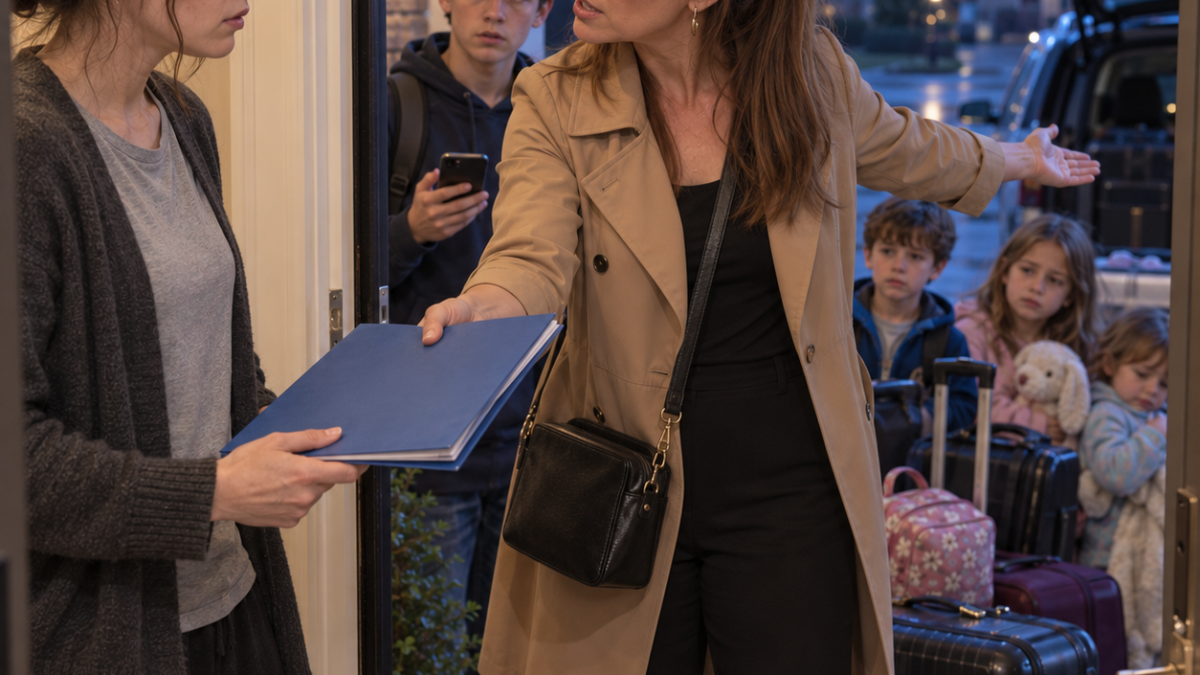
My sister announced that I would keep her four children for a seventeen-day trip to Portugal even after I had already told her no twice. My father backed her up because I worked from home, as if a $42,000 freelance contract due that week were a hobby I could pause. Then, at 5:31 Thursday morning, my sister unloaded four sleepy kids, six bags, and a blue instruction folder onto my porch and hurried toward the airport. I almost started rearranging my life like I always had. Instead, I opened the folder. One sentence had been underlined twice: Do not contact Ryan unless there is a true emergency. Ryan was the children’s father. He lived twenty-seven minutes away. Before I could decide what that meant, my thirteen-year-old nephew looked at me and said, “Dad thought we were staying with him.”
My name is Ava Reynolds. I was thirty-one, single, and worked as an independent brand designer in Raleigh, North Carolina.
My family loved calling my career flexible.
For years, I had mistaken that word for a compliment.
Flexible meant Dad could ask me to wait four hours for a repair technician because I “was home anyway.”
Flexible meant Mom could call at eleven in the morning and ask me to drive across town to return something before a store closed.
Flexible meant my older sister Morgan could text from a school parking lot and ask whether I could collect one of her children because a meeting ran late.
My deadlines were apparently flexible.
Their plans were not.
Most of the time, I helped.
I loved Morgan’s kids.
Owen was thirteen and had started developing the dry humor of someone who noticed much more than adults realized.
Lucy was ten, quiet until she trusted you, then capable of talking about horses for forty-five uninterrupted minutes.
The twins, Ben and Max, were eight and believed every room existed primarily for wrestling.
They were not the problem.
The problem was that helping had gradually become indistinguishable from being assigned.
Morgan had been separated from their father, Ryan Keller, for almost three years.
Their relationship was tense, but the children spent regular weekends and school breaks with him.
He lived across town, attended games, school events, and pediatric appointments, and had a bedroom for each child in the house he rented after the divorce.
So when Morgan called me on Tuesday night and said, “I need you from Thursday through the twenty-second,” I thought she was asking for an airport ride.
“For what?”
“The kids.”
I stopped working.
On my screen was a campaign presentation due Monday for a regional hotel group.
It was the largest independent contract I had ever landed.
“I can’t.”
Morgan laughed.
Not cruelly.
Worse.
Like my answer was impractical.
“Ava, I already told them they’re staying with you.”
“Then tell them the plan changed.”
“The flights are nonrefundable.”
“That has nothing to do with me.”
“You work from home.”
“I work from home. I don’t not work.”
Her voice tightened.
“Miles and I haven’t taken a real trip in two years.”
“I’m sorry.”
“It’s seventeen days.”
“I know how calendars work.”
She hung up angry.
Twenty minutes later, Dad called.
“Ava, your sister needs help.”
“She needs childcare.”
“Family helps family.”
“Then you keep them.”
He immediately had reasons.
Mom was attending a professional conference during the first week.
He had two golf commitments he did not want to cancel.
Their guest room was being painted.
Every obstacle in his life was treated as permanent.
My contract was treated like a preference.
At dinner the following evening, Morgan tried again.
She placed a printed schedule beside my plate.
School times.
Soccer.
Piano.
Food restrictions.
Medication.
Pickup contacts.
It looked less like a request than an employee onboarding packet.
“I already said no.”
Dad leaned back.
“Seventeen days won’t kill you.”
“No. Losing a forty-two-thousand-dollar client might damage my business, though.”
Morgan rolled her eyes.
“You always make your freelance stuff sound so dramatic.”
I looked at her.
For one second, I considered arguing.
Explaining the contract.
The client meetings.
The revision schedule.
The fact that I paid my mortgage with this “freelance stuff.”
Then something in me went quiet.
My family had heard every version of that explanation for years.
They did not misunderstand.
They simply expected my no to expire before their plans did.
So I looked at Morgan’s schedule and said, “Fine.”
Her entire face relaxed.
“Thank you.”
Dad smiled.
“I knew you’d come around.”
I smiled too.
At 5:31 the next morning, headlights swept across my living-room wall.
By 5:36, Morgan was standing on my porch in travel clothes while Miles loaded the last suitcase into the airport car.
The kids looked half asleep.
Morgan handed me the blue folder.
“Everything’s in there.”
Then she lowered her voice.
“Ryan doesn’t need to know all the details.”
I looked at her.
“What does that mean?”
“It means don’t involve him unless there’s an actual emergency. I don’t need him turning this into another custody argument.”
Miles called from the curb.
“We have to go.”
Morgan kissed the kids, hugged me quickly, and left.
Inside, I made toast while the twins argued over strawberry jam.
Then I opened the folder.
Near the bottom of the second page, Morgan had written one sentence in dark ink and underlined it twice.
Do not contact Ryan unless there is a true emergency.
I read it again.
Owen was watching me from across the table.
Then he said, “That’s weird.”
“What is?”
“Dad thought we were staying with him.”
My hand stopped on the page.
I looked at Owen. “What do you mean?” “He texted me yesterday asking whether Mom was dropping us off Thursday or Friday.” “Did you answer?” “I told him Mom said plans changed.” Lucy stopped eating. “Mom said Dad had work.” Owen shook his head. “He told me he took the week off.”
I stepped into my office and called Ryan. He answered immediately. “Ava?” “Did you know Morgan left for Portugal this morning?” Silence. Then, “She left?” “The kids are here.” Another silence. “What do you mean they’re there?” “She asked me to keep them.”
Ryan exhaled sharply. “I offered to take all four for the whole trip.” “When?” “Two weeks ago.” My stomach tightened. “What did she say?” “That the Portugal trip had been moved to December.”
I looked through the doorway at four children eating breakfast under a schedule built around a lie.
Ryan continued. “We have a right-of-first-refusal clause for any childcare longer than forty-eight hours.” “I’m not asking you to interpret anything legally.” “I know.” He paused. “I’m telling you I was available, I asked for the time, and she told me the trip wasn’t happening.”
My laptop chimed. A message from Ryan appeared. Three screenshots from their parenting app. The first showed his offer to take the children for all seventeen days. The second showed Morgan saying the trip had been postponed. The third had been sent forty-eight hours earlier. Ryan had asked whether Portugal was back on. Morgan had never answered.
I stared at the messages for a long time.
The easiest version of the morning would have been to tell myself this was none of my business.
Morgan had left.
The kids were safe.
I could rearrange seventeen days.
Plenty of people did harder things every day.
That was exactly how I had talked myself into every other family assignment.
I can manage.
It won’t kill me.
It’s easier if I just do it.
I returned to the kitchen.
The twins had finished toast and were building a wall from cereal boxes.
Lucy was brushing crumbs into a neat pile.
Owen watched me.
“Are we in trouble?”
That question pulled the problem back into focus.
“No.”
“Mom’s going to be mad.”
“Probably.”
He looked toward the folder.
“Are we staying here?”
“I’m figuring that out.”
I called Ryan again.
“I need to ask something practical.”
“Go ahead.”
“If the kids came to you today, can you actually handle school, activities, meals, everything?”
“Yes.”
“You’re not saying yes because you’re angry at Morgan?”
“No.”
His answer came fast enough to sound honest.
“I moved two client visits. I already arranged school pickup for next week because I thought they were supposed to be with me.”
He paused.
“Ava, I’m not asking you to choose sides. If you decide they stay with you, I’m not coming over to create a scene. But I want my parenting time if Morgan is gone.”
I appreciated the way he said it.
No threat.
No victory.
Just availability.
“I’m going to bring them over.”
Ryan exhaled.
“Okay.”
“I want everything boring.”
“I agree.”
“No arguments in front of them.”
“Absolutely.”
“No talking about their mother like she committed some crime.”
“Agreed.”
“I’m photographing the folder she gave me.”
“Smart.”
That morning was the first time I understood that setting a boundary sometimes feels disappointingly administrative.
I photographed the schedule.
The insurance cards.
The medication notes.
The sentence telling me not to call Ryan.
I saved the screenshots he had sent.
Then I told the kids.
“Your dad is available, so you’re going to stay with him while your mom is traveling.”
Ben immediately asked whether Ryan still had the pancake mix with chocolate chips.
Max asked whether the game console had been fixed.
Lucy wanted to know if her riding lesson was still on Saturday.
Owen said nothing for a few seconds.
Then his shoulders dropped.
That reaction told me how much tension he had been carrying.
“Mom knows?” he asked.
“I’m going to tell her.”
“When?”
“After I know you’re settled.”
He nodded.
The drive to Ryan’s house took twenty-seven minutes.
No dramatic music.
No family showdown.
Just traffic.
Backpacks.
The twins arguing about a charger.
Lucy telling me I had missed a turn even though I had not.
Ryan waited outside when we arrived.
He looked tired.
He did not look triumphant.
That mattered.
He carried bags into the house.
Owen disappeared upstairs to check his room.
The twins headed for the kitchen.
Lucy hugged me.
“Are you coming Saturday?”
“For what?”
“My lesson.”
“I have to work.”
She nodded.
“Okay.”
No accusation.
No guilt.
Just okay.
Ryan walked me back to the car.
“Thank you.”
“I didn’t do this for you.”
“I know.”
“I did it because I’m not keeping four children for seventeen days after I said no when their parent is available.”
“That makes sense.”
“Apparently not to everybody.”
He gave me a tired smile.
“Keep it in writing.”
“I plan to.”
On the drive home, my car felt unnaturally quiet.
For years, saying no to my family had left me buzzing with guilt.
This felt different.
The kids were safe.
Ryan was willing.
I had not created the conflict.
I had simply refused to hide it.
Back home, I reopened my hotel campaign.
Three illustrations waited unfinished.
The client presentation was Monday at ten.
Morgan’s flight was still over the Atlantic.
I worked.
At 3:42 p.m., my flight tracker showed their plane had landed in Lisbon.
I waited another twenty minutes.
Then I sent one message.
The kids are with Ryan. He was available, had already offered to keep them for the full trip, and sent me the messages showing you told him Portugal was postponed. I am not providing seventeen days of childcare after saying no, and I will not participate in keeping their father out of an arrangement that involves his children. Everyone is safe. Future discussions about the kids need to stay between the adults responsible for them.
The message showed delivered.
My phone rang twelve seconds later.
Morgan.
I let it ring.
Again.
Then Miles.
Then Dad.
Then Mom.
I muted the phone and kept drawing.
For seven minutes, that worked.
Then the family group chat started.
Morgan:
Call me NOW.
Dad:
Ava, answer your sister.
Mom:
Are the children safe?
I answered Mom only.
Yes. They are safely with Ryan.
Morgan:
YOU HAD NO RIGHT.
I stared at the sentence.
It was strange how powerful those words sounded when written by someone who had ignored my right to decide what happened with my own time.
Dad:
You agreed.
I typed:
After I refused twice and all three of you decided my answer could be overridden.
Morgan:
You said fine.
Ava:
Yes. And then I learned you lied about Ryan being unavailable.
The chat went quiet.
Three minutes later, Dad called again.
I answered.
“What were you thinking?” he demanded.
“I was thinking the children have an available father.”
“You humiliated Morgan.”
“She is in Portugal.”
“That’s not the point.”
“What is the point?”
“You do not make a parenting decision behind her back.”
I almost laughed.
“She made a childcare decision behind Ryan’s back and a work decision on my behalf.”
Dad lowered his voice.
“Ava, this isn’t helping.”
“Did Morgan tell you Ryan offered to take them?”
Silence.
“Dad.”
“No.”
“Did she tell you she told him the trip was postponed?”
Another silence.
“I’m sending you the screenshots.”
He exhaled.
“Don’t turn this into evidence.”
“It became evidence when everyone started telling me I misunderstood.”
I sent them.
Dad did not call back.
Mom did.
Her voice was different.
Not angry.
Uncertain.
“Is this real?”
“Yes.”
“Morgan told us Ryan said he couldn’t do it.”
“He offered to take all seventeen days.”
“I didn’t know.”
“I believe you.”
That was important.
My parents had pressured me.
But the lie underneath the pressure belonged to Morgan.
I did not need to invent more blame than the facts supported.
Mom was quiet.
“You really said no before dinner?”
“Twice on the phone.”
“And your father called you?”
“Yes.”
She sighed.
“We should have listened.”
That was not an apology.
It was the first crack in the family story.
Meanwhile, Portugal was beginning badly.
I learned the details in pieces.
Miles had believed Ryan refused to keep the kids.
Morgan told him that was why she “had no choice” but to rely on me.
He had booked nonrefundable hotel upgrades after she said childcare was settled.
When my message arrived, he asked one question.
“Did Ryan offer to take them?”
Morgan apparently answered with a speech about how Ryan used extra parenting time to control her.
Miles asked again.
“Did he offer?”
She did not answer directly.
Then he saw the screenshots.
They reached their hotel.
They argued for two hours.
Their train to Porto was scheduled for the following afternoon.
Miles refused to continue the trip until Morgan stopped calling my parents trying to force me to collect the children again.
That night, Morgan sent me a voice message.
I listened once.
She said I had undermined her.
Embarrassed her.
Chosen Ryan over my sister.
Threatened her custody arrangement.
Destroyed the vacation she had planned for months.
I listened carefully.
One phrase stood out.
Threatened her custody arrangement.
That was new.
The next morning, Ryan called.
“I need to tell you something because your name may come up.”
“What?”
“Morgan filed for a parenting-time review three months ago.”
I sat down.
“I thought you already had joint custody.”
“We do.”
“What is she trying to change?”
“She wants more school-week control.”
“Why?”
“She says my work is inconsistent and she has to rely on relatives when I’m unavailable.”
I did not speak.
Ryan continued.
“I disagreed because she often asks relatives before asking me.”
The blue folder sat on my desk.
I suddenly understood why Morgan had been so adamant that I not contact him.
“If you kept them for seventeen days,” Ryan said slowly, “that could become another example of her using third-party care.”
I felt sick.
“Are you saying she dumped them on me to make you look unavailable?”
“I can’t tell you what she was thinking.”
That restraint mattered.
“The facts I know are that I offered, she said the trip was postponed, and she left them with you instead.”
The main reveal did not arrive like a movie twist.
It arrived as a recontextualization.
Morgan had not merely wanted convenient babysitting.
She had a reason to avoid giving Ryan seventeen additional days.
Maybe she believed he would use them against her.
Maybe she genuinely thought I was easier.
Maybe both were true.
Either way, my free labor had become useful inside an adult conflict no one had told me I was entering.
“What do I need to do?” I asked.
“Nothing.”
“I mean about your review.”
“Nothing. Don’t get involved.”
“Good.”
“I may submit the messages through my attorney.”
“That’s between you and her.”
“And the folder?”
“If you need the photo showing she told me not to contact you, ask your lawyer to request it properly.”
Ryan paused.
“Thank you.”
“For what?”
“Not turning this into a bigger family war.”
I looked at the exploding group chat.
“I’m not sure everyone got that memo.”
By nine that morning, three relatives had messaged me.
Aunt Karen:
I heard you abandoned Morgan’s children while she was overseas.
My cousin Elise:
Did you really agree to keep them and then dump them at Ryan’s?
Uncle Peter:
Family should not punish children over adult disagreements.
That last one irritated me enough to make me stand up.
I almost called everyone individually.
That was my old pattern.
Explain.
Defend.
Reassure.
Spend three hours proving I was not cruel.
Instead, I opened a blank document.
Timeline.
Tuesday 6:18 p.m. — Morgan asked me to keep the children for seventeen days.
Tuesday 6:21 p.m. — I declined.
Tuesday 6:34 p.m. — Morgan asked again, saying my work was flexible.
Tuesday 6:37 p.m. — I declined again.
Wednesday 7:19 p.m. — At family dinner, Morgan placed the childcare schedule beside my plate after Dad pressured me to reconsider.
Thursday 5:31 a.m. — Morgan left the children at my house.
Thursday 6:14 a.m. — Ryan confirmed he had offered to care for them for the entire trip and Morgan told him Portugal was postponed.
Thursday 7:18 a.m. — Children arrived safely at Ryan’s home.
I attached the screenshots.
I attached a photograph of Morgan’s note instructing me not to contact Ryan except in an emergency.
Then I posted it once in the family chat.
I added:
I will not discuss separate edited versions of this story with different relatives. These are the dates. Please read them before repeating claims that I abandoned anyone.
I put my phone face down.
The first response came from Aunt Karen.
That is not what I was told.
Then Uncle Peter.
Why were we told Ryan refused?
Then Elise.
Wait. You said no before they left?
Mom responded next.
Yes. Ava did.
Dad took almost twenty minutes.
Then:
I also pressured her to reconsider. I did not know Ryan had already offered.
That was the moment the crowd disappeared.
Not because everyone suddenly supported me.
Because the story stopped being simple enough to weaponize.
Morgan called Mom from Portugal.
Mom later told me she spent almost an hour insisting that Ryan was difficult, manipulative, inconsistent, and looking for reasons to challenge her parenting.
Some of those complaints may have been legitimate.
Divorce rarely produces one innocent adult and one villain.
But none of them answered the factual question.
Why tell Ryan the trip was postponed?
Why tell my parents he was unavailable?
Why tell Miles I had volunteered?
Three audiences.
Three stories.
One outcome.
Morgan got the arrangement she wanted without having to negotiate with any of us.
Miles saw it too.
Their vacation lasted two nights.
He canceled the Portugal road trip portion and changed his flight home.
Morgan blamed me for the change fee.
I did not pay it.
She blamed me for the lost hotel nights.
I did not pay those either.
She returned Sunday evening.
By then, I had completed the hotel campaign presentation.
Monday morning, I presented it to the client.
My hands shook during the first five minutes.
Not because the work was bad.
Because family chaos had trained my nervous system to believe I was neglecting something whenever I prioritized my career.
The client loved the campaign.
At the end of the meeting, their marketing director said:
“We want to retain you for the winter launch too.”
I muted myself.
Then sat back.
The contract I had nearly sacrificed because my family called my work flexible was about to become recurring income.
“Absolutely,” I said.
We discussed scope.
When the call ended, I stared at my laptop for a full minute.
Then I laughed.
Not at Morgan.
At myself.
For years, I had behaved as though my commitments became real only after everyone else’s needs were satisfied.
The client had never treated my work that way.
Only I had.
Dad scheduled a family conversation for Sunday.
I nearly refused.
Mom called separately.
“The kids will stay with Ryan.”
That helped.
“Miles wants to come.”
That surprised me.
“Why?”
“He says Morgan lied to him too.”
I agreed.
The meeting took place at my parents’ house.
Same dining table.
No printed schedule beside my plate.
Morgan arrived twenty-five minutes late.
Miles came separately and sat at the far end.
Dad opened with:
“We all made mistakes.”
“No.”
The word left my mouth before he finished.
Everyone looked at me.
“I’m willing to discuss what each person did. I’m not beginning with a sentence that spreads responsibility equally.”
Dad nodded slowly.
“Fair.”
Morgan laughed.
“Of course everybody is bending over backward for Ava now.”
I placed the timeline on the table.
She did not touch it.
“You ruined my trip.”
“I refused to provide childcare.”
“You said fine.”
“After I said no twice and you decided no meant keep asking.”
“You knew what I meant.”
“Yes.”
I looked at her.
“I knew you planned to drop the kids anyway.”
“So you deliberately tricked me.”
“No. I stopped trying to persuade you.”
Her face tightened.
“You called Ryan behind my back.”
“You left me instructions not to call him because you knew he was available.”
Dad looked at Morgan.
“Is that true?”
She turned on him.
“Don’t start.”
Mom spoke.
“That was a question.”
Morgan looked toward Miles.
“Are you going to sit there while they gang up on me?”
Miles folded his hands.
“You told me Ryan refused.”
“He’s impossible.”
“That’s not what I said.”
“I didn’t want seventeen days used against me.”
There it was.
Directly this time.
Ryan’s parenting review.
Dad frowned.
“What are you talking about?”
Morgan looked furious that the subject had escaped her control.
“He’s trying to change the schedule.”
Mom asked:
“And you thought the kids staying with Ava would help?”
Morgan said nothing.
Miles answered.
“She didn’t want him getting extra time.”
Morgan glared at him.
“You have no idea what co-parenting with him is like.”
“You’re right.”
Miles remained calm.
“But I know what you told me.”
Then he listed it.
“You told me Ryan couldn’t take the kids.”
“You told your parents he refused.”
“You told Ryan the trip was postponed.”
“You told Ava childcare was already settled.”
Morgan’s confidence slipped.
Miles continued.
“I made plans based on information you changed depending on who you were talking to.”
She looked at me as if I had written his speech.
I had not.
That was important too.
I was not the only person injured by the manipulation.
The family pattern had protected Morgan from consequences for years, but this specific event involved choices she had made with multiple adults.
Dad rubbed his forehead.
Then he looked at me.
“I owe you an apology.”
Morgan rolled her eyes.
He ignored her.
“You said no. I decided I knew what you should be willing to do.”
I waited.
He continued.
“I treated your work like it was optional because you work from home.”
“Yes.”
“I was wrong.”
The apology was not dramatic.
It was specific.
That mattered more.
Mom apologized next.
“I should not have joined the pressure after you said no.”
Then she turned toward Morgan.
“We also need to stop rescuing you from the cost afterward.”
Morgan stared at her.
Mom continued.
“Your father and I paid your flight change because you said you were stranded. We are not paying the hotel losses.”
“So everyone is punishing me.”
“No,” Mom said. “You paid for a vacation. You changed it. Those are your expenses.”
I had never heard my mother say anything like that to Morgan.
For years, Mom’s instinct had been smoothing.
Quietly covering.
Helping everyone return to normal.
Normal had required somebody else to absorb the cost.
That day, she let the cost stay where it originated.
Miles spoke next.
He said he was moving back to his own apartment instead of moving into Morgan’s house the following month.
He was not ending the engagement at the table.
He wanted space.
More importantly, he would not combine finances or sign a new lease with Morgan until he trusted the information she gave him.
Morgan’s face crumpled.
For a moment, I felt guilty.
The feeling arrived automatically.
Then I reminded myself:
I had not created his decision.
Two days later, Morgan and Ryan met with their parenting coordinator.
I did not attend.
I did not ask to see their private communications.
Ryan later told me only what involved me.
Future travel longer than forty-eight hours would be entered into the parenting app.
Each parent would formally offer the time to the other before arranging third-party care.
Neither parent could list me as backup childcare without written confirmation from me.
That final rule was almost funny.
A professional coordinator had documented what my family had refused to accept.
My time required my agreement.
The parenting review continued.
Ryan did not receive some dramatic victory.
Their schedule remained mostly the same.
The coordinator did note that communication around additional parenting time needed improvement.
Morgan was instructed to stop representing third-party childcare as proof that Ryan was unavailable unless she had actually offered him the time.
That consequence mattered.
She had tried to control the record.
The process made the record harder to control.
My parents changed too.
Dad stopped volunteering me for errands.
The first time he called after the meeting, he said:
“Are you free Tuesday morning?”
I almost did not recognize the question.
“What for?”
“The cable company is coming.”
“I’m not free.”
“Okay.”
Then he arranged it himself.
The world survived.
Mom started asking:
“Would you like to?”
Instead of:
“Can you?”
Small linguistic changes.
Large psychological difference.
Morgan barely spoke to me for a month.
The old version of me would have experienced that silence as punishment.
I would have sent a peace offering.
Asked about the kids.
Found a reason to reconnect.
This time, I waited.
The children were not removed from my life.
Ryan invited me to Lucy’s riding lesson one Saturday.
I went.
Morgan attended too.
We stood on opposite sides of the arena.
We were polite.
No argument.
Afterward, Lucy hugged me.
“Can you come to my birthday?”
“If your mom invites me.”
Morgan heard.
She looked at me.
Then said:
“You’re invited.”
That was enough.
My work became busier.
The hotel group renewed my contract for a full year.
I hired a part-time project coordinator named Lena so I could stop doing scheduling, invoicing, revisions, and production alone.
The first month I paid someone else out of my business account terrified me.
Then my workload became manageable for the first time.
The flexibility my family had treated as spare capacity became something I learned to manage intentionally.
I blocked off Fridays after three.
I stopped answering family calls during client meetings.
I put my working hours on my phone’s focus settings.
Not because technology could enforce boundaries for me.
Because it helped me remember I had them.
I also returned to illustration for myself.
Before freelance branding became my full income, I used to make personal pieces.
I had stopped because client work came first and family requests filled whatever remained.
A neighborhood gallery announced an open exhibition around the theme “Domestic Space.”
I submitted one piece.
A kitchen table.
Calendars.
Keys.
Sticky notes.
A laptop.
A stack of half-finished drawings.
And one empty chair pulled slightly away from the table.
I titled it Available.
The gallery accepted it.
At the opening, Dad stood in front of it for several minutes.
Then he walked over.
“I get it.”
“Good.”
“I don’t like it.”
“That’s also okay.”
He smiled.
We did not need another apology.
Six weeks after Portugal, Morgan asked me to meet for coffee.
No folder.
No children.
No parents.
No audience.
She looked exhausted.
For the first fifteen minutes, she talked around the point.
She said co-parenting was hard.
Ryan sometimes changed weekends.
His job occasionally required travel.
She felt like everybody judged mothers more harshly than fathers.
All of that could be true.
I listened.
Eventually, she said:
“I shouldn’t have assumed you’d keep them.”
I waited.
“That wasn’t the only problem.”
She stared into her coffee.
“I shouldn’t have told Mom and Dad you agreed.”
I nodded.
“And I shouldn’t have told Ryan the trip was postponed.”
That was closer.
Then she said:
“But you could have warned me before I got on the plane.”
There it was.
A small doorway back into the old structure.
Her choices.
My responsibility to manage them better.
“I warned you when I said no.”
Morgan looked at me.
“I hate that answer.”
“I know.”
She sat with it.
Then something in her face softened.
“But I understand it.”
That was enough for that day.
We did not hug.
We did not become best friends.
Trust does not grow because someone says the correct words over coffee.
Miles remained in his own apartment.
He and Morgan attended counseling.
Six months later, they ended the engagement.
Morgan told me the breakup was not about Portugal alone.
They had disagreed about money.
Parenting.
Moving.
Miles wanted children someday.
Morgan was not sure she wanted more.
The trip had simply exposed how often she managed conflict through different stories rather than direct conversations.
I did not celebrate.
Morgan was devastated.
I sent flowers.
No advice.
No lecture.
No reminder that she had caused part of it.
Helping someone after they face consequences is not the same as erasing those consequences.
That distinction had taken me years to learn.
My relationship with Ryan remained appropriately limited.
We were not allies against Morgan.
We were adults connected through children we both loved.
Sometimes he invited me to a birthday.
Sometimes Morgan did.
Sometimes both.
I never discussed their custody details unless something directly involved me.
The kids never became evidence.
They did not need to know which parent had lied about which schedule.
They needed predictable adults.
Owen understood more than anyone told him.
About a year after Portugal, he asked me:
“Did Mom really leave us with you after Dad said yes?”
We were driving back from a soccer game.
I kept my eyes on the road.
“That is something you should ask your parents.”
“So yes.”
“I didn’t say that.”
“You say that when the answer is yes.”
I laughed despite myself.
He smiled.
Then became serious.
“Were you mad at us?”
“No.”
“Not even the twins?”
“Frequently at the twins.”
He laughed.
“I was never angry at you for being on my porch.”
His face relaxed.
That mattered more than explaining the adult conflict.
The strangest aftermath belonged to my father.
Dad had spent his life as the family mediator.
At least that was how he described himself.
What he actually did was identify the person most likely to compromise and push that person until peace returned.
Often that person was me.
After Portugal, he started noticing the pattern in other relationships.
Mom volunteered him to drive Aunt Karen to an appointment one morning.
He said:
“Ask me first.”
Mom stared.
Then they both looked at me.
I started laughing.
Dad pointed at me.
“This is your fault.”
“No.”
He smiled.
“Fine. Your influence.”
Their marriage survived the revolution.
So did our family.
That is the part people miss when they act like boundaries automatically destroy relationships.
Some relationships broke.
Miles left.
Morgan and I became less enmeshed.
Other relationships improved because access was no longer confused with affection.
My parents discovered they could ask me for help without assuming the answer.
I discovered I could say yes without creating a permanent precedent.
One Saturday, Dad asked whether I could drive him to a procedure because Mom would be out of town.
I checked my calendar.
“I can.”
“Really?”
“Yes.”
“Are you sure?”
I smiled.
“That is what yes means.”
We went.
He bought lunch afterward.
Nothing felt coerced.
The favor was lighter because I had chosen it.
Morgan learned similar lessons more slowly.
She hired a teenager in her neighborhood for occasional babysitting instead of automatically calling relatives.
She and Ryan began using their parenting app for schedule changes even when the issue seemed trivial.
She stopped calling me “flexible.”
The first time she asked for help after our coffee meeting, she sounded almost formal.
“Owen has a tournament Saturday. I have Lucy’s recital at the same time. Are you interested in going to the tournament?”
Not:
I need you to take Owen.
Are you interested?
I was.
I went.
He scored twice.
Morgan did not owe me for it.
I did not resent it.
That was what healthy help felt like.
Two years later, my design studio had three regular contractors and a small office downtown.
I could have kept working from home.
I chose not to.
Part of that choice was practical.
Part was psychological.
For too long, everyone had treated my house as evidence that I was not really at work.
I wanted a door I could close.
The studio had a conference room, two desks, large windows, and one wall covered in project sketches.
On my first day there, Dad stopped by.
He looked around.
“So this is work?”
I stared at him.
He raised both hands.
“Bad joke.”
“Very.”
He carried in a plant Mom sent.
The card said:
For your real office.
I called her.
“You know my home office was also real.”
“I know.”
“Then why does the card say that?”
She sighed.
“I am trying.”
I laughed.
“So am I.”
We kept the plant.
The hotel campaign that almost disappeared beneath Morgan’s childcare plan became one of the strongest projects in my portfolio.
That client referred me to another hospitality company.
Then another.
Within three years, roughly forty percent of my studio’s revenue came from travel and hospitality branding.
Sometimes I thought about how close I came to telling them I needed an extension because my sister had placed four children on my porch after I refused.
Maybe they would have understood.
Maybe they would not.
The point was that I never should have been forced to find out.
My work deserved protection before it became an emergency.
The blue folder still exists.
I kept it.
Not as ammunition.
As a reminder.
It sits in a box with old tax returns and family documents.
On the second page is the underlined sentence:
Do not contact Ryan unless there is a true emergency.
I no longer read it as the worst thing Morgan did.
The worst thing was the assumption underneath it.
She believed she could define which relationships I was allowed to use, which responsibilities I had to absorb, and which answers from me counted.
For years, my family had treated my no as the beginning of a negotiation.
Portugal changed that.
Not because I screamed louder.
I did the opposite.
I stopped debating.
Reality handled the rest.
Morgan lost money on a trip she changed.
She damaged Miles’s trust because she lied to him.
She complicated her co-parenting review because documentation contradicted her story.
My parents had to admit they pressured me based on false information.
None of those consequences required revenge from me.
I did not cancel a flight.
I did not contact a hotel.
I did not publish private custody documents.
I did not insult my sister in front of her children.
I placed four kids with their available father.
Protected my contract.
Corrected lies when they were spread about me.
Then I stopped rescuing people from what their own choices cost.
That was enough.
Last summer, Morgan took the kids to Maine for a week.
Three months before the trip, she entered the dates in the parenting app.
Ryan approved.
Then Morgan texted me.
We’ll be gone August 4–11. No babysitting request. Just telling you so you don’t think I’ve been replaced by a responsible adult.
I laughed.
Then replied:
Growth looks good on you.
She sent a rude emoji.
That was probably the closest thing we had to affection at that point.
The trip went fine.
No one called me.
No one changed flights.
No family group chat exploded.
Sometimes success is boring.
I have come to value boring.
I used to think being needed was evidence that I mattered.
My family helped teach me that belief because it was convenient for them.
If everyone called me, I must be important.
If everybody trusted me with errands, children, repairs, and crises, I must be loved.
But usefulness and love are not the same thing.
Useful people are often the easiest people to exploit precisely because they are proud of being dependable.
I am still dependable.
Ask my clients.
Ask my friends.
Ask Morgan’s children.
The difference is that dependability no longer means permanent access.
I can help Tuesday and be unavailable Friday.
I can love my sister and refuse to rearrange seventeen days of work.
I can adore her children and still believe their parents are responsible for arranging care.
I can care what my father needs without treating his golf schedule as more legitimate than my contract.
A boundary is not proof that love ended.
Sometimes it is the first evidence that love is no longer being used as leverage.
A few months ago, Lucy called me herself.
She is thirteen now.
“Are you busy next Saturday?”
I smiled.
“Why?”
“Mom says I have to ask correctly.”
“Your mother is learning.”
Lucy laughed.
“My school has an art fundraiser. I want you to come.”
“That sounds like an invitation.”
“It is.”
“Then yes.”
She paused.
“You didn’t even check your calendar.”
I looked at the calendar on my desk.
Saturday was open.
“I checked before you finished asking.”
She laughed.
“Okay. See you there.”
After we hung up, I sat for a moment looking around my studio.
The Available painting hangs near the conference room now.
The empty chair is still pulled away from the table.
Clients sometimes ask what it means.
I usually tell them:
“It’s about time.”
That answer is true.
Just incomplete.
It is about the years I believed being available made me good.
The morning I discovered that unavailable did not make me cruel.
The family argument that taught me no only works if you eventually behave as though you meant it.
And the simple fact that my life changed when I stopped treating other people’s disappointment as an emergency I was required to solve.
Morgan once thought she had won because I said, “Fine.”
She was wrong.
So was I.
The important moment was never when I said yes.
It was when I finally stopped making my no depend on whether anyone else accepted it.







