My Sister Humiliated My Son at His Birthday—Then a Guest Showed Me What She Planned
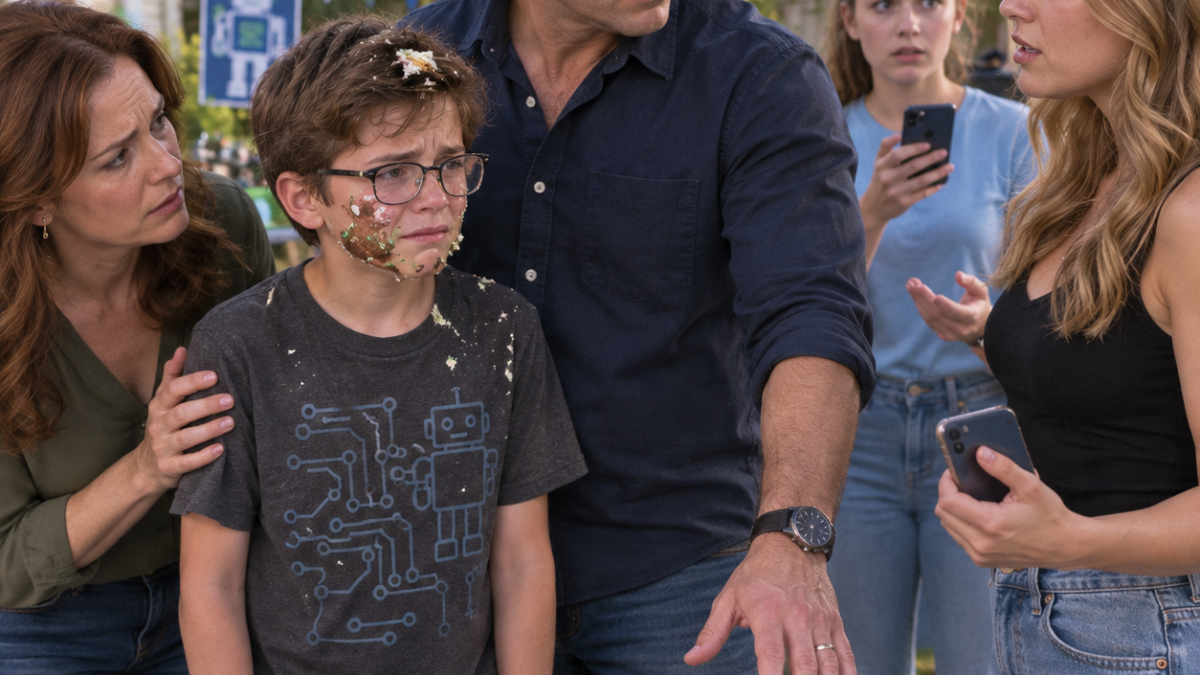
My younger half-sister shoved my twelve-year-old son Eli’s face into his birthday cake after I had warned her repeatedly not to turn his party into one of her social-media jokes. Eli had been nervous about her for weeks because she had pulled the same stunt on me at another family gathering, and Madison knew exactly why I had drawn the boundary. She did it anyway. While my son stood in front of fourteen classmates with frosting across his face and tears in his eyes, she laughed and reached for her phone. My father immediately defended her. He said Eli needed to learn how to take a joke. I was ready to end the party and send everyone home when one of the teenage guests quietly handed me her phone and said, “Mr. Brooks, you need to see what Madison posted before she got here.”
My name is Ethan Brooks.
I’m thirty-eight, I own a commercial electrical contracting company outside Louisville, Kentucky, and I’m usually the person other people call when something has already gone wrong.
My wife, Rachel, says that is probably why I stayed calm as long as I did.
Our son Eli had been planning his twelfth birthday for nearly two months.
He is obsessed with robotics.
Not casually interested.
Obsessed.
Our dining-room table regularly contains enough motors, wires, sensors, and tiny screws to make eating dinner a negotiation.
For his birthday, he asked for something simple.
Sixteen kids from school and his robotics club.
Pizza.
A few build stations in the backyard.
A rented telescope after dark.
And a custom cake that looked like a circuit board.
Eli helped design it.
Green frosting traces ran across dark chocolate icing.
Tiny edible components made it look like an oversized control board.
There was even a little fondant robot in the center holding a number twelve.
He was ridiculously proud of it.
The one person he did not want near the cake was my half-sister Madison.
Madison is twenty-seven.
She and I have the same father, Frank, but different mothers.
Her mother died when Madison was nine.
Dad has spent most of the years since then confusing guilt with parenting.
Madison rarely heard no.
When she quit community college, Dad paid her apartment until she “figured things out.”
When she decided she wanted to make lifestyle content online, he bought the camera.
Then the laptop.
Then helped with her rent.
Then covered the car payment when sponsorship income was inconsistent.
Every bad decision became evidence that Madison needed more support.
Every objection became proof that the rest of us lacked compassion.
Six months before Eli’s birthday, Madison had pushed my face into Dad’s retirement cake during a family barbecue.
Everyone laughed.
I didn’t.
Neither did Eli.
He was standing maybe ten feet away.
That night, he asked Rachel whether Aunt Madison might do the same thing to him at his birthday.
That question changed the situation for me.
I called Madison the next morning.
“I’m going to make this very simple.”
She laughed.
“That sounds dramatic already.”
“Do not touch Eli’s cake.”
“Seriously?”
“Do not shove him toward it. Do not smear frosting on him. Do not film some prank.”
“You cannot possibly still be upset about Dad’s party.”
“I’m not discussing Dad’s party.”
I kept my voice even.
“I’m telling you what the boundary is for my son.”
She gave an exaggerated sigh.
“Fine.”
A week before the birthday, I reminded her.
Then again the night before.
Rachel thought I should uninvite her.
I considered it.
But Madison had acted offended by the accusation.
“I said I heard you,” she told me.
So I gave her the benefit of the doubt.
That was my mistake.
The party started at two on Saturday.
For the first hour, everything was great.
The kids built small brush-powered robots.
They programmed LED patterns.
They competed to see whose cardboard bridge could hold the most washers.
Eli was relaxed.
Then Madison arrived.
She was almost forty minutes late.
She hugged Dad.
Took pictures with Grandma June.
Recorded a few clips of the backyard setup.
I intercepted her near the patio.
“Remember.”
She rolled her eyes.
“I remember.”
“No cake joke.”
“I said I remember.”
Eli heard us.
I saw his shoulders relax slightly.
At four-thirty, Rachel brought out the cake.
The kids gathered around.
Eli stood behind it while everybody sang.
He looked happier than I had seen him all afternoon.
He leaned forward to blow out the candles.
Madison stepped behind him.
I saw her move.
“Madison.”
She put both hands on Eli’s shoulders.
I reached across the table.
Too late.
She pushed him forward.
His face hit the soft upper layer of the cake.
The room went silent.
Not funny silent.
Shock silent.
Eli came up immediately.
Frosting covered his nose, cheeks, glasses, and hair.
His glasses had twisted sideways.
He looked around at fourteen kids staring at him.
Then he started crying.
Madison laughed.
“Oh my God, Eli. Your face.”
She reached for her phone.
Rachel got to our son first.
I stepped between Madison and him.
“Put the phone away.”
She stared at me.
“Relax.”
“Leave.”
Her smile disappeared.
“You’re serious?”
“Leave my house.”
Dad stepped in immediately.
“Ethan, enough.”
I looked at him.
He shook his head.
“She made a joke. Eli is fine.”
My son was crying into Rachel’s shoulder.
“He doesn’t look fine.”
Dad lowered his voice.
“Don’t turn this into some family crisis because you’re overly protective.”
Then someone touched my elbow.
It was Ava, the sixteen-year-old daughter of one of Rachel’s cousins.
She looked uncomfortable.
She held out her phone.
“Mr. Brooks?”
I looked at her.
“You need to see what Madison posted before she got here.”
Ava opened a private story Madison had posted that afternoon. The first clip showed Madison sitting in her car outside our neighborhood. She was smiling at the camera. “My brother officially banned me from messing with the birthday cake.” Then she leaned closer. “So obviously we know what has to happen.” The next screenshot was from a family group chat I was not part of. Madison had written, “Ethan is going to lose his mind.” Dad had replied, “He’ll calm down. Kids recover from everything.” My stomach dropped. Ava whispered, “I screen-recorded it because it felt mean.” I looked toward my father. He was still standing beside Madison. He had known. Maybe he had not known exactly what she intended to do. But he knew she planned to violate the boundary I had set. And instead of stopping her, he had dismissed the consequences before they happened. Madison saw the phone in my hand. Her face changed. “What is she showing you?” I locked the screen and handed it back to Ava. “Thank you.” Then I looked at Dad. For the first time that afternoon, he stopped telling me Eli would get over it.
I did not confront Dad immediately.
That surprised everyone.
It surprised me.
Madison was still talking.
“What is this? Why is everybody acting like I attacked him?”
I looked at her.
“Leave.”
“Ethan—”
“Now.”
Dad started again.
“Son.”
I held up one hand.
“No.”
He stopped.
“You are not going to explain her behavior to me.”
His face tightened.
“I’m trying to calm this down.”
“I don’t want it calmed down.”
That was new for me.
Growing up, I had always been the one who calmed things down.
Madison was emotional.
Dad was defensive.
Linda, my stepmother, hated conflict.
So Ethan translated.
Ethan softened.
Ethan changed subjects.
Ethan accepted apologies that had not really been made.
Not this time.
I looked at Madison.
“You were warned.”
She crossed her arms.
“You’re making a ridiculous scene.”
“I’m not the one who put a twelve-year-old’s face into a cake after being told not to.”
“He’s fine.”
Rachel appeared behind me.
Eli was no longer with her.
One of his friends’ mothers, Dr. Melissa Grant, had taken him inside to help clean his glasses and check his face.
Rachel’s expression was controlled in a way I recognized from twelve years of marriage.
Controlled Rachel was much more serious than shouting Rachel.
“He is not fine.”
Madison rolled her eyes.
Rachel said:
“You need to leave before I stop asking politely.”
That worked.
Madison grabbed her bag.
Dad followed her toward the gate.
I called after him.
“Dad.”
He turned.
“Are you leaving with her?”
He looked offended.
“Somebody needs to make sure she gets home.”
“She drove herself here.”
“She’s upset.”
I looked toward our house.
“My son is upset.”
Dad did not answer.
That answer told me enough.
He left with Madison.
Linda stayed.
Grandma June stayed.
So did most of the parents.
I expected everyone to leave.
Instead, Dr. Grant came outside and said Eli was physically okay.
His glasses were bent but usable.
No cut.
No injury beyond some redness from the frosting being wiped away.
The damage was humiliation.
Fear.
The confirmation that the adult he had worried about had done exactly what he feared.
I found Eli upstairs in his room wearing a clean T-shirt.
His hair was wet.
Three of his closest friends sat on the floor with him.
One was showing him something on a handheld game.
They looked up when I entered.
“Hey.”
Eli gave me a small smile.
“You okay?”
He shrugged.
I hated the shrug.
“Do you want everyone to go home?”
He looked at his friends.
“No.”
“Do you want to keep the party going?”
Another shrug.
“I guess.”
I sat beside him.
“This is not a test.”
“You don’t have to be tough.”
“If you want everyone to leave, they leave.”
“If you want to keep going, we keep going.”
Eli looked at me.
“Can we still use the telescope?”
“Absolutely.”
He nodded.
“Then I want them to stay.”
So we stayed.
Rachel ordered another cake from a grocery store.
Nothing custom.
White frosting.
Blue border.
The bakery employee wrote Happy Birthday Eli in letters that leaned slightly downhill.
When it arrived, every kid acted like it was the most impressive cake ever made.
Nobody made a joke about the first one.
Nobody tried to touch Eli.
They sang again.
He blew out the candles.
That mattered.
At seven-thirty, we set up the telescope.
Saturn was visible.
Eli forgot himself for a few minutes.
He became the kid who had spent weeks reading about rings and moons.
I watched him explain Titan to another boy and felt my chest loosen slightly.
After everyone left, Ava’s mother emailed me the screen recording her daughter had saved.
I did not ask Ava to send it directly.
I did not want a teenager dragged further into adult family conflict.
I watched it once.
Then again.
Madison had made three separate clips before arriving.
In one, she joked that I had become “the birthday police.”
In another, she said:
“If I get the cake thing on video, it will be worth listening to Ethan complain for a month.”
That was the moment the word joke stopped working.
A joke is spontaneous.
This was planned.
Dad’s message sat beneath hers.
He’ll cool down. Kids recover from everything.
Dad did not say:
Don’t do it.
He did not say:
Ethan told you not to.
He did not say:
Leave the kid alone.
He predicted my reaction and treated it as the only problem.
Rachel watched over my shoulder.
Then she said:
“Frank cannot be alone with Eli right now.”
I turned.
“What?”
“If he thinks Eli’s boundaries are optional when Madison wants something, then I don’t trust him to enforce our rules.”
That hurt.
Dad loved Eli.
He attended robotics competitions.
Took him fishing.
Taught him how to strip wire properly when Eli became curious about circuits.
Eli adored him.
But Rachel was right.
Trust is not only about whether somebody personally intends harm.
It is also about whether they will protect a child when protection becomes inconvenient.
Dad had failed that test.
“What do we tell Eli?”
“The truth.”
Rachel sat at the kitchen table.
“Grandpa made a bad decision.”
“He isn’t being punished forever.”
“But until he understands the problem, visits are with us.”
I nodded.
Then we discussed Madison.
That part was simpler.
No contact with Eli.
No family gathering at our home.
No photos.
No videos.
No showing up uninvited.
Not forever automatically.
But until she took responsibility and Eli felt safe.
I sent the message the next morning.
Short.
No insults.
No threats.
Madison responded in under three minutes.
You are insane.
Then:
You’re seriously keeping my nephew away from me because of cake?
Then:
This is emotional abuse, Ethan.
I did not respond.
Dad called.
I did.
“You cannot cut your sister out over one mistake.”
“She planned it.”
“You saw some stupid social-media joke.”
“I saw three clips.”
Silence.
“And I saw your message.”
Another silence.
“What message?”
I read it back.
He’ll calm down. Kids recover from everything.
Dad sighed.
“I didn’t know she was actually going to do it.”
“You knew enough to know I had banned it.”
“I thought she was joking.”
“Then why didn’t you tell her to stop?”
He became irritated.
“Because I am not going to police a twenty-seven-year-old woman’s sense of humor.”
“You had no problem policing my response.”
“That’s different.”
“How?”
“Because you escalate.”
I laughed.
That was the moment I understood our family dynamic more clearly than I ever had.
Madison could act.
I was expected to absorb.
If I refused to absorb it, I was the person escalating.
“I’m done doing that.”
Dad went quiet.
“Doing what?”
“Being responsible for keeping your relationship with Madison comfortable.”
“This is about Eli.”
“Yes.”
“And that’s why you don’t get unsupervised time with him for now.”
He sounded genuinely wounded.
“You think I would hurt my grandson?”
“No.”
“Then what is this?”
“I think you would minimize something that hurts him if admitting it would upset Madison.”
He hung up.
For two weeks, nobody spoke much.
That was unusual.
Our extended family was normally loud and interconnected.
Birthdays.
Sunday dinners.
Text chains.
Photos.
Suddenly everything divided into small private conversations.
Grandma June came over first.
She was eighty-one and had the rare ability to ask a question without making it sound like she had already decided the answer.
“May I see the video?”
I showed her.
She watched all three clips.
Then Dad’s message.
She handed the phone back.
“Frank saw this?”
“The message.”
“Not necessarily the video.”
“Correct.”
She nodded.
“So he did not cause what Madison did.”
“No.”
“But he knew she intended to break the rule.”
“Yes.”
June looked toward the backyard.
Eli was outside testing a small wheeled robot against the patio stones.
She said:
“Your father has spent eighteen years trying to make sure Madison never feels abandoned.”
I knew where this was going.
“That doesn’t mean Eli gets sacrificed.”
“I agree.”
That surprised me.
June continued.
“When Madison’s mother died, Frank promised that girl he would always be there.”
“He turned always being there into never allowing consequences.”
“Yes.”
She said it without defending him.
“That is not the same thing.”
“No.”
“And now he is afraid that if he stops protecting her, it means he failed her mother.”
I sat quietly.
That explained Dad.
It did not excuse Dad.
June understood the distinction.
She asked:
“What do you want from them?”
That question was harder than I expected.
“I don’t want revenge.”
“Good.”
“I want Madison to admit she knew Eli was afraid and did it anyway.”
June nodded.
“And Frank?”
“I want Dad to stop calling the problem my reaction.”
June looked satisfied.
“That sounds specific.”
“I’ve had practice.”
“Commercial electrician.”
“Exactly.”
She smiled.
Then became serious.
“I am hosting Thanksgiving in two months.”
I waited.
“Madison will not be invited unless this has been addressed.”
“You don’t have to do that for me.”
“I am not.”
She looked at Eli.
“I am doing it because I do not invite adults into my home after they deliberately humiliate children and then refuse to apologize.”
That was Grandma June.
Clear.
Not dramatic.
Not negotiable.
Dad was furious when he heard.
He called her.
I only know about the conversation because June told me later.
“Mother, you are dividing the family.”
“No, Frank.”
“You are.”
“No.”
“You’re choosing Ethan over Madison.”
June apparently said:
“I am choosing behavior.”
Dad had no response to that.
Madison had another problem.
She had posted part of the cake incident before leaving our house.
Not Eli crying.
She had enough sense not to upload that.
But she posted a short clip from immediately before the shove with a caption implying she was about to “save a boring birthday.”
Someone who followed her recognized our yard.
One of the parents from the party commented:
Please don’t post my child from this event.
Another parent wrote:
This was not funny in person either.
Madison deleted the clip within an hour.
But one of her small sponsorship partners saw the comment exchange.
The company sold home organization products and used Madison for occasional paid videos.
They emailed her asking for context.
I only learned that because Madison complained to Dad.
The partnership was paused.
Not because I reported her.
Not because anyone ran a campaign against her.
A business looked at public conduct and made its own decision.
Madison blamed me anyway.
You cost me a contract.
I did not respond.
A week later:
Do you know how much money I lost because your friends attacked me?
Still no response.
Then:
Fine. Enjoy destroying your own family.
I archived everything.
Rachel suggested I block her.
I didn’t.
Not yet.
I wanted one path open if she ever decided to communicate like an adult.
That turned out to matter later.
The bigger change came from Linda.
Dad’s wife had stayed mostly quiet throughout Madison’s adulthood.
She had opinions.
She simply expressed them privately.
Three weeks after the birthday, she asked Dad to meet with a financial adviser.
That had nothing to do with me.
Apparently she had been worried for months.
Dad was sixty-one.
He still worked full-time as a construction superintendent.
His retirement savings should have been healthy.
They weren’t.
He had taken two loans against retirement accounts over six years.
Partly for home repairs.
Partly for Madison.
He paid $2,250 of her monthly rent.
$640 toward her car and insurance.
Her phone.
Health insurance.
Several credit-card bills.
It added up to more than $40,000 a year.
Linda showed me the numbers later only after Dad gave permission.
He had delayed retirement to maintain a lifestyle Madison could not fund.
The adviser told him something painfully simple.
If he continued at the same rate, he would need to work well into his seventies or significantly reduce his own retirement standard.
Dad finally had to choose.
Not between children.
Between helping Madison and refusing to let her become responsible for herself.
He told her the rent support would end in ninety days.
Her car payment would end at the end of the year.
He would continue paying health insurance temporarily.
Everything else stopped.
Madison called me that night.
“You did this.”
“No.”
“You got into Dad’s head.”
“I didn’t know he was changing anything.”
“Bull.”
“I haven’t discussed your finances with him.”
“You humiliated him in front of Grandma.”
“No.”
“You turned everyone against me.”
“No.”
She was crying now.
“My whole life is falling apart because of one joke.”
There it was.
I finally responded to the actual issue.
“Madison, your life is changing because several people stopped preventing consequences.”
She became quiet.
“What does that mean?”
“It means I set a boundary for Eli.”
“Grandma set one for her house.”
“Your sponsor made its own choice.”
“Dad made a financial decision.”
“I did not control any of those people.”
“This started because of you.”
“No.”
“It started because you pushed a child into a cake after being told repeatedly not to.”
She hung up.
That conversation was our last for almost three months.
Madison moved out of the downtown apartment when Dad’s rent support ended.
She could not qualify for something comparable on her inconsistent income.
For a while, she moved back into Dad and Linda’s house.
She hated it.
She stopped posting aspirational apartment content because there was no apartment.
The car went back when she could not take over the remaining payments.
Dad did not replace it.
She borrowed Linda’s older sedan.
Then Linda set a rule.
“You need it for work? Fine.”
“You need it to drive around taking brunch pictures? Use the bus.”
Madison accused Linda of treating her like a teenager.
Linda replied:
“Then stop requiring teenage-level support.”
I wished I had been there.
Eventually Madison took a regular job.
Not minimum wage punishment.
Not something Dad arranged.
A full-time social-media coordinator position for a local fitness center.
The salary was modest.
The hours were real.
Nine to five.
Deadlines.
A supervisor.
She kept some personal content online, but the constant luxury posts disappeared.
From what Linda told me, Madison hated the job for the first month.
Then something changed.
She started becoming good at it.
Apparently being required to produce content for someone other than herself revealed she actually had useful skills.
Photography.
Editing.
Short-form video.
Scheduling.
Copywriting.
She had just never needed to package those skills into dependable work.
Dad was proud.
For once, he did not celebrate by buying her something.
He told her.
That difference mattered.
Meanwhile, Eli improved.
He never needed therapy in the dramatic way everyone had predicted.
Rachel is a pediatric nurse practitioner, and we spoke with a counselor because I wanted to make sure we were not minimizing what happened.
The counselor met with Eli twice.
Her recommendation was mostly about restoring agency.
Let him decide which relatives he saw.
Let him know adults had rules too.
Do not force reconciliation.
Do not repeatedly make him retell the incident.
So we didn’t.
Eli went back to robotics club.
He joked with friends.
He planned another project.
His glasses were replaced because the frame never sat correctly after the party.
Madison sent Rachel $180 for the replacement without a message.
We accepted it.
Restitution is not the same thing as reconciliation.
Thanksgiving came.
Grandma June kept her word.
Madison was not invited.
Dad almost stayed home in protest.
Then Linda told him:
“If you choose not to see your mother because Madison refuses to apologize to a child, that is your decision.”
Dad went.
He was quiet.
Eli was polite to him.
Nothing more.
When Dad asked if he wanted help setting up a small electronics kit June had bought him, Eli said:
“No thanks.”
Dad looked hurt.
He said:
“Okay.”
No pressure.
That was progress.
After dinner, Dad approached me outside.
“I miss him.”
“I know.”
“I didn’t realize how much.”
I looked through the window.
Eli was showing June how a small servo motor worked.
Dad said:
“He used to call me every week.”
“I know.”
“Do you think I’ve lost that forever?”
“I don’t know.”
His face tightened.
I did not soften the answer.
He needed uncertainty.
That was part of consequence too.
Then he said:
“I was wrong.”
I looked at him.
“About what?”
He breathed out.
“I thought because Madison did not mean to injure him, the harm didn’t count.”
I waited.
“And I was more worried about you being angry with her than about why Eli was crying.”
That was it.
The sentence I needed.
Not:
I’m sorry everybody is upset.
Not:
Madison went too far, but—
No but.
“What are you going to do about it?”
Dad looked toward the window.
“Whatever Eli allows.”
That was the right answer.
A week later, he mailed Eli a letter.
He did not ask me to read it first.
Eli showed it to me afterward.
It was short.
Eli,
I saw you were upset at your birthday and I treated your feelings like they mattered less than keeping Aunt Madison out of trouble.
That was wrong.
Your dad had already warned her, and I knew enough to tell her to stop.
I didn’t.
I am sorry.
You do not owe me a visit or a quick forgiveness.
I love you.
Grandpa
Eli read it twice.
Then put it in his desk.
A month later, he asked if Grandpa could come to his robotics competition.
“Do you want him there?”
“Yes.”
“Then invite him.”
Dad came.
He sat in the back.
Did not interfere.
Did not try to force a hug.
Eli’s team finished third.
Dad waited until Eli walked over.
Then said:
“Good job.”
Eli said:
“Thanks.”
That was the beginning.
Madison took longer.
January became February.
Then March.
Occasionally I heard updates from Dad or Linda.
She was working.
Saving.
Complaining less.
She had started seeing a counselor through her employer’s benefits, which I only knew because she later told me herself.
I did not ask what they discussed.
That was hers.
Then one Sunday afternoon, a message arrived.
Ethan, I want to apologize to Eli.
I stared at it.
I did not answer immediately.
Another message came.
Not on video. Not online. No public post. I know that would make it about me again.
That got my attention.
I replied:
I’ll ask Rachel and Eli.
She wrote:
Okay.
Nothing else.
Rachel and I spoke with Eli.
He was thirteen by then.
“What do you want?”
He shrugged.
“I don’t know.”
“You can say no.”
“I know.”
“You can say not yet.”
He thought.
“Can she write it?”
“A letter?”
“Yeah.”
“That sounds reasonable.”
I told Madison.
Five days later, an envelope arrived.
No gift.
No money.
No dramatic package.
Just a letter.
Eli opened it at the kitchen table.
I asked if he wanted privacy.
“No.”
He read silently.
Then passed it to me.
Eli,
I knew your dad had told me not to touch you or your cake.
I knew you were nervous because of what I did to him before.
I decided getting a funny video mattered more than respecting you.
Then when you cried, I laughed because admitting I had hurt you would have meant admitting I was wrong in front of everyone.
That was selfish and cruel.
Grandpa defending me does not excuse what I did.
I am sorry I made your birthday feel unsafe.
I paid for your replacement glasses because I damaged them, not because money fixes the rest.
I will not post you, photograph you, touch you as a joke, or come to your events unless you want me there.
You do not have to forgive me.
Aunt Madison
I read it twice.
So did Rachel.
Eli folded it.
“What do you think?” I asked.
“She finally said it right.”
That was exactly what I thought.
“Do you want to answer?”
“Not yet.”
“Okay.”
Two months later, Eli asked whether Madison could come to his school robotics showcase.
I was surprised.
“Why?”
“She apologized.”
“That does not mean you have to invite her.”
“I know.”
He smiled slightly.
“I kind of want her to see the robot.”
So I texted Madison.
Eli would like you at the showcase.
Her response came immediately.
I’ll be there.
Then, five seconds later:
Phone stays in my bag unless he asks for a picture.
Good.
At the showcase, Madison arrived early.
No dramatic outfit.
No live stream.
She wore jeans and a black sweater.
She hugged Dad.
She nodded to me.
Then waited.
Eli approached her.
“Hi.”
“Hi.”
Awkward.
Real.
He led her toward his project.
He and two teammates had built a small automated sorting machine that used colored blocks.
Madison listened while he explained it.
Actually listened.
At one point she reached toward her purse.
Then stopped.
“Can I take a picture of the robot?”
Eli thought.
“Just the robot.”
“Deal.”
She photographed the machine.
Not him.
That tiny act told me more about change than six months of family arguments.
She had learned to ask.
By summer, Dad stopped paying her health insurance too.
Madison could cover it through work.
She found a small apartment with a roommate.
No rooftop pool.
No luxury lobby.
She was proud of it anyway.
She invited Linda to help choose curtains.
Dad offered to buy a couch.
Madison said:
“No. I’m saving for one.”
Dad called me afterward.
“She told me no.”
“Did you survive?”
“Barely.”
I laughed.
Then he said:
“I almost offered three more times.”
“I know.”
“How?”
“You’re you.”
He laughed too.
“That is apparently changing.”
Slowly.
The family did not become perfect.
Madison still likes attention.
She still posts too many pictures of brunch.
Dad still wants to fix everything.
Linda still occasionally waits too long to speak up.
Grandma June still terrifies everyone when she clears her throat before making a point.
Rachel still watches my family gatherings like a security professional whenever Madison is near dessert.
And I still struggle with the instinct to manage everyone’s relationships.
But we became more honest.
Dad stopped financing Madison’s entire life.
Not because I demanded it.
Because he finally admitted that rescuing her constantly was hurting both of them.
Madison learned she could actually support herself.
Eli learned adults could be wrong and still be required to repair what they did.
And I learned something I wish I had understood years earlier.
A boundary without a consequence is usually just a request.
I had spent years telling Madison what bothered me.
Stop filming people without asking.
Stop turning family events into content.
Stop pushing jokes after somebody says no.
Every time she ignored me, Dad made the aftermath easier.
So nothing changed.
At Eli’s birthday, the consequence was not that I destroyed her career or made her broke.
I could not control those things.
The consequence was that she lost access to Eli.
Dad lost unsupervised access too.
Grandma June stopped inviting Madison into spaces where she refused to take responsibility.
A sponsor made its own decision.
Dad made a financial decision.
Madison faced the adult task of paying her own expenses.
None of that required revenge.
It required everyone to stop protecting her from the results of her choices.
A year after the cake incident, Eli turned thirteen.
This time he wanted a smaller party.
Eight friends.
Pizza.
Robotics.
A telescope.
No custom cake.
Not because he was afraid.
He said custom cakes were overpriced.
That sounded like my son.
We ordered a simple chocolate cake from a neighborhood bakery.
Madison was invited.
So was Dad.
Before the candles came out, Madison walked over to Eli.
She held her phone in one hand.
“Question.”
He looked suspicious.
“Can I get a picture of you with the cake before everyone destroys it?”
Eli considered her.
“Dad too.”
She looked at me.
“Apparently I’m part of the safety system.”
Everyone laughed.
Even Eli.
I stood beside him.
Madison took one picture.
Then put her phone away.
No prank.
No hands on shoulders.
No joke about being boring.
When the candles were lit, Dad stood several feet back.
Madison did too.
Eli made a wish.
Blew them out.
Applause.
Nothing happened.
That sounds almost anticlimactic.
It was one of the best moments of the year.
Because safety is often anticlimactic.
Respect does not create viral videos.
It creates ordinary birthdays.
After cake, Eli went outside with his friends.
Madison helped Rachel clear plates.
Dad came over to me.
“He looks happy.”
“He is.”
Dad nodded.
Then he said:
“I thought protecting Madison meant making sure she never felt the kind of loss she had as a child.”
I listened.
“I think I actually taught her that discomfort was dangerous.”
“That sounds right.”
“And I taught everyone else to absorb it for her.”
“Yes.”
He looked toward the kitchen where Madison was carrying paper plates to the trash.
“She seems better.”
“She seems more responsible.”
Dad smiled.
“Same thing, maybe.”
“Not always.”
He laughed.
Then his face became serious.
“I’m sorry it took Eli getting hurt for me to see it.”
I believed him.
“I wish it hadn’t.”
“So do I.”
We stood quietly.
Then Dad asked:
“You think he trusts me again?”
“Ask him.”
Dad smiled.
“Right.”
He was learning.
Later that night, after everyone left, Eli brought the leftover cake into the kitchen.
He cut himself another slice.
Then looked at me.
“That birthday last year was really bad.”
“Yeah.”
“But it fixed some stuff.”
I considered that.
“You didn’t have to get hurt for adults to improve.”
“I know.”
“None of what happened was your responsibility.”
“I know.”
He ate a bite.
Then said:
“Aunt Madison is less annoying now.”
I laughed.
“That’s the family’s official measure of growth.”
He smiled.
Then he picked up his plate and went upstairs.
I stayed in the kitchen for a while.
Thirteen candles sat beside the sink.
One year earlier, I thought protecting my son meant destroying the person who hurt him.
I was angry enough to want that.
I am glad I did not.
Destroying Madison would not have taught Eli anything useful about boundaries.
Watching her face proportionate consequences did.
Watching Grandpa apologize did.
Watching Grandma June refuse to normalize what happened did.
Watching his mother and me let him decide when he was ready to reconnect did.
Most of all, watching adults change their behavior showed him that “I’m sorry” is supposed to cost something.
Not money.
Not humiliation.
Change.
Madison did not become poor because I ruined her life.
She became financially independent because Dad finally stopped paying for the version of her that could not function without him.
Dad did not lose his grandson forever.
He lost automatic access until trust could be rebuilt.
Our family did not split permanently.
Some relationships became smaller for a while.
Then healthier.
That is very different from pretending nothing happened.
The cake incident is now a story nobody jokes about.
That is one of my conditions.
Eli can joke about it someday if he wants.
Nobody else gets to turn it into family comedy.
Madison understands that.
Dad does too.
A few months ago, I was repairing a light fixture at Dad’s house when Madison stopped by.
She walked into the kitchen carrying groceries.
Dad looked at the bags.
“You need money?”
Madison stared at him.
“No.”
“I was just asking.”
“I bought groceries, Dad.”
“Okay.”
She started putting them away.
Dad looked at me.
I smiled.
“Don’t.”
“I didn’t say anything.”
“You have a face.”
“Apparently runs in the family.”
Madison laughed.
Then she pulled a receipt from one bag and handed it to Dad.
“Your coffee was on sale. I bought you two.”
Dad looked genuinely touched.
“Thank you.”
She shrugged.
“Family helps family.”
I almost choked.
Madison looked at me.
“Relax. I paid for it.”
Dad laughed so hard he had to sit down.
That joke worked.
Because it acknowledged the difference.
She gave something that belonged to her.
Dad accepted it.
Nobody was forced.
Nobody was filmed.
Nobody cried.
Sometimes the simplest lesson takes a family years to learn.
Love does not remove boundaries.
Being family does not turn another person’s body, money, home, time, or dignity into communal property.
And calling something a joke does not erase the word no.
My son understood that before most of the adults around him did.
We finally caught up.







