My Parents Threw My Daughter and Me Out—Then I Found $39,600 Claimed in My Name
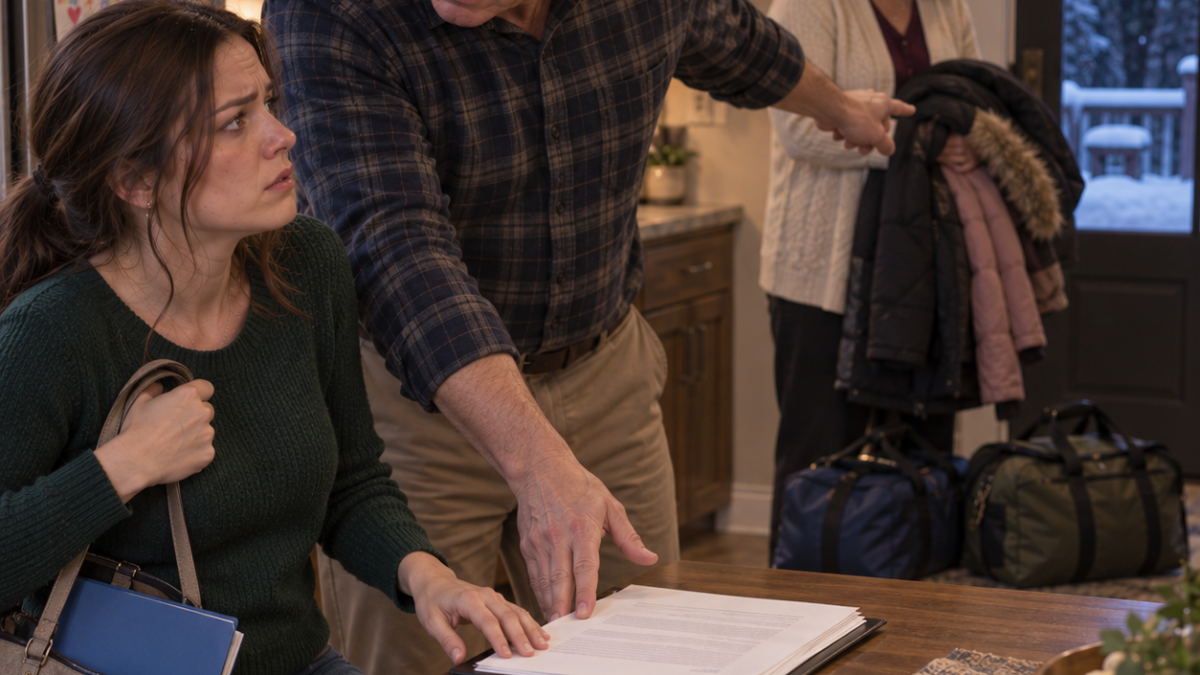
At 10:40 on a January night, my father put two packed duffel bags beside the front door and told me to take my six-year-old daughter and leave. Ten minutes earlier, he had demanded my signature on a housing declaration saying my parents had supported us for eighteen months and I had contributed nothing. I had actually paid them $900 every month from my grocery-store paycheck. When I asked to read the attached pages, Dad closed the packet and called me ungrateful. Mom already had our coats in her hands. I was twenty-eight, had $112 in checking, and nowhere safe to sleep. I left anyway. Three hours later, my former high-school counselor opened the blue folder I had carried out and went silent at one number: $39,600.
My name is Maren Cole.
My daughter Ivy was six that winter.
We had been living with my parents, David and Ellen Cole, in Marion, Iowa, for eighteen months.
Moving home had originally been temporary.
That was the word everyone used.
Temporary.
I had separated from Ivy’s father when she was three, and by the time our divorce was final, rent had risen faster than my wages at the grocery store where I worked as a front-end supervisor.
Dad offered us my old bedroom.
“You get back on your feet,” he said. “Family helps family.”
The arrangement was not free.
I paid my parents $900 every month.
Dad called it “helping with the house.”
Mom called it “being responsible.”
I called it rent, because that was what it was.
The transfer left my checking account on the fourth Friday of every month.
I also bought groceries, paid for Ivy’s school supplies, and covered my own car, insurance, phone, and childcare.
I was not proud of being back in my childhood bedroom at twenty-eight.
But I was not ashamed either.
I was working.
I was raising my daughter.
I was trying to save enough for a deposit on an apartment.
What made living there difficult was not the money.
It was how quickly help became evidence that my parents were entitled to make decisions for me.
Dad opened mail addressed to me because he said important paperwork affected “the household.”
Mom added herself to Ivy’s school pickup list without asking because she was Grandma.
When I mentioned taking evening classes, Dad said it made more sense to wait until Ivy was older.
“You have enough on your plate.”
That was the sentence I had heard since I was seventeen.
Enough on your plate.
It had once convinced me to give up a college-preparation program after Mom had surgery.
I told myself Dad was being practical.
I had been telling myself that about him for ten years.
The document appeared on a Sunday afternoon.
Dad placed a six-page packet beside my coffee.
“I need your signature before Wednesday.”
“What is it?”
“Just a housing verification.”
I read the first paragraph.
It said I was an adult learner living in my parents’ home while returning to education.
I was not enrolled anywhere.
The next section said my parents provided housing without financial contribution from me.
“That’s wrong.”
Dad barely looked up.
“It’s administrative wording.”
“I pay you nine hundred a month.”
“It goes toward household expenses.”
“So I contribute.”
He folded the packet closed.
“Maren, the program knows how these forms work.”
“What program?”
He became impatient.
“The Pathways Adult Learner Housing Fund.”
I had heard the name.
Dad worked for Bridgeway Opportunity Network, a local nonprofit that helped administer several education and housing programs.
He worked in facilities and purchasing.
At least, that was how he described his job.
“What does this have to do with me?”
“You and Ivy live here.”
“That doesn’t answer my question.”
Mom entered the kitchen.
“You’re making this harder than it needs to be.”
I reached for the packet.
Dad put his hand on top of it.
“I need the signature, not an audit.”
That sentence changed the temperature in the room.
“I’m not signing something I haven’t read.”
Dad looked at Mom.
Mom looked toward the hallway.
That was when I noticed our coats hanging over her arm.
Behind her, beside the front door, stood two duffel bags.
Mine.
And Ivy’s.
They had been packed before the argument started.
I stared at them.
“Were you planning to throw us out if I said no?”
Dad stood.
“You’ve been living here because we allowed it.”
“I pay you rent.”
“Not enough to cover what you cost.”
Ivy appeared at the end of the hallway holding a plastic cup.
She looked from Dad to me.
The cup slipped from her hand and spilled across the kitchen floor.
Mom jumped toward the towels.
Dad did not.
He grabbed the paperwork first.
That detail stayed with me.
Ivy began apologizing.
“I’m sorry, Mommy.”
I crouched beside her.
“You didn’t do anything wrong.”
Dad pointed toward the bags.
“If you’re going to accuse us after everything we’ve done, take your things and go.”
Mom whispered, “David.”
He did not look at her.
Then he saw the blue document folder tucked inside my open tote.
His expression changed.
“Leave that folder.”
I looked at him.
“Why?”
“It has family papers in it.”
“It has my papers.”
Dad’s jaw tightened.
“Leave it.”
I slid the folder deeper into my bag.
Then I put Ivy’s coat on.
Ten minutes later, we were outside.
I drove six blocks before realizing I had no destination.
I parked beneath the lights of a twenty-four-hour grocery store and checked my account.
$112.37.
Most of my paycheck had gone to my parents four days earlier.
I bought Ivy dry socks and hot chocolate.
Then I opened the blue folder.
Inside were our birth certificates, my old school records, eighteen months of printed bank transfers, and a business card from Marisol Vega, my former high-school counselor.
I had run into her at the library months earlier.
She had told me, “If you ever want your old scholarship records, call me yourself.”
At 11:06 p.m., I called.
By midnight, Ivy was asleep in Marisol’s guest room.
I showed her the photograph I had taken of Dad’s housing declaration before he closed the packet.
Her finger stopped beside the program total.
$39,600.
“Maren, did your parents receive this?”
“I didn’t know it existed.”
She enlarged the photograph.
The form said I was enrolled full-time and paid nothing toward housing.
Neither was true.
Then Marisol noticed the signature block.
Someone had signed my name on an earlier certification.
The first letter leaned sharply backward.
Mine never did.
Marisol did not accuse anyone.
She opened her laptop.
“We request the records first.”
The next morning, the first archived email arrived.
Marisol read it twice.
Then she looked at me.
“Maren, this isn’t the first time someone answered for you.”
The email was ten years old.
I recognized the name of the program immediately.
Future Forward Scholars.
At seventeen, I had been selected for it through my high school.
The program paired students from working-class families with college-preparation support.
Test fees.
Transportation.
Summer classes.
Mentoring.
A small scholarship competition.
I had wanted it badly.
Then Mom had surgery.
Nothing catastrophic.
A hysterectomy with a difficult recovery.
Dad said the family needed me home after school.
My younger brother Lucas was fourteen.
According to Dad, he was too young to handle meals and household responsibilities.
I was seventeen.
Apparently that made me old enough.
I told Future Forward I needed to pause.
At least, that was what I remembered.
Marisol turned the laptop toward me.
The first archived message was from her.
Maren can remain enrolled on a reduced schedule. Transportation is available three afternoons weekly. Please let us know which option works best.
Dad’s reply:
Maren has decided to withdraw completely. She does not wish to continue.
I stared at the screen.
“I never said that.”
Marisol nodded.
“I know.”
Another email offered weekend tutoring.
Dad declined for me.
A third offered remote test preparation.
Dad replied that I was no longer interested in college.
I had never seen any of those emails.
Then came the attachment.
A withdrawal form.
My typed name.
My student identification number.
A handwritten signature.
Not mine.
The M leaned backward.
Exactly like the signature on the housing document.
I stood so quickly my chair scraped the kitchen floor.
I walked into Marisol’s laundry room and shut the door.
I did not cry immediately.
I held both hands against the dryer and tried to breathe.
For ten years, I had explained that lost opportunity as my failure.
I should have fought harder.
I should have figured out transportation.
I should have returned after Mom recovered.
I should have been more ambitious.
Dad reinforced that story whenever education came up.
“You had opportunities.”
“You chose family.”
“You never really liked school anyway.”
I had believed him.
Not completely.
Enough.
Marisol waited until I returned.
“I’m sorry,” she said.
“For what?”
“I should have tried to reach you directly.”
“You thought my parent was speaking for me.”
“I did.”
She did not ask me to make her feel better.
That helped.
“What do I do?”
“With which problem?”
I almost laughed.
That was the first moment I understood there were several.
The old school record.
The housing application.
The money.
My signature.
Our immediate housing.
Ivy’s school.
My job.
Everything felt connected.
Marisol separated it.
“Tonight, you and Ivy are safe.”
I nodded.
“Tomorrow, you go to work.”
Another nod.
“Then you request the records that carry your name.”
“What if Dad finds out?”
“He probably will.”
My stomach tightened.
Marisol did not say not to be afraid.
She said:
“Being afraid does not mean you have to sign anything.”
I went to work.
I had slept three hours.
My manager, Aisha, took one look at me and moved me off the customer-service desk.
“You want to tell me?”
“Not really.”
“Okay.”
She assigned me inventory reconciliation in the office.
No questions.
At lunch, I submitted formal requests for my Pathways file.
I requested every document listing me as a beneficiary.
Every certification.
Every payment attributed to my household.
Every enrollment confirmation.
The program required identity verification.
I completed it in my car.
Two days later, Mom called.
I had not blocked her.
I should have known the silence would end when money did.
“What did you do?”
“I requested my records.”
“The payments are frozen.”
“What payments?”
She went silent.
That was the first direct confirmation.
“How much have you and Dad received?”
“You lived here.”
“That isn’t what I asked.”
“We fed you.”
“I bought groceries.”
“You used electricity.”
“I paid rent.”
“Maren, stop calling it rent.”
“What would you call nine hundred dollars every month?”
“Family contribution.”
“Then why does the form say I paid nothing?”
Mom started crying.
I was not ready for the sound.
“You’re taking away money we depend on.”
“I didn’t know the money existed.”
“Your father handled the paperwork.”
“Did you know?”
A long pause.
“Mom.”
“I knew there was assistance.”
“Did you know it was under my name?”
“It was for the household.”
“Did you know the forms said I was enrolled in school?”
She became defensive.
“You were always talking about going back.”
“That’s not enrollment.”
“You were supposed to eventually.”
I closed my eyes.
“I need everything in writing from now on.”
“Maren.”
“I have to go.”
She said:
“Your father will never forgive this.”
I ended the call.
Three weeks later, the Pathways records arrived.
I opened them at Marisol’s kitchen table.
Ivy colored beside us.
The first payment had been issued eighteen months earlier.
$2,200.
Then another.
And another.
Eighteen months.
$39,600 total.
The file described me as an unemployed adult learner returning to education while raising a dependent child.
I was employed.
It described my parents as providing housing without financial contribution from me.
My bank statements showed $16,200 in transfers to them during the same period.
The file included quarterly enrollment confirmations.
I had never attended the institution listed.
Two notices were supposedly emailed to me.
The address looked almost correct.
My real address ended in 318.
The application used 381.
Dad had entered one transposed number.
Close enough to look accidental.
Far enough that I received nothing.
Then I found the conflict-of-interest page.
Bridgeway employees were required to disclose family relationships connected to applications they handled or influenced.
The box beside employee relationship was blank.
Dad worked for Bridgeway.
His name appeared nowhere on the application.
Mom was listed as the host.
I began making a list.
Not accusations.
Facts.
I work at Benton Market.
The file says unemployed.
I am not enrolled.
The file says enrolled full-time.
I paid $900 monthly.
The file says zero.
I did not sign these certifications.
Dad works for Bridgeway.
The disclosure is blank.
Marisol watched me.
“You sound like an investigator.”
“I sound like a woman who spent ten years being told she remembered things wrong.”
She did not answer.
I submitted a written dispute.
I attached bank records showing the monthly transfers.
I included my employment verification.
I stated plainly that I had not enrolled in the listed program and had not signed the certifications.
I asked that no additional application or renewal be processed in my name without direct contact.
That was all.
No public post.
No confrontation.
No accusation of fraud.
Two days later, Pathways confirmed that further payments to my parents were suspended pending review.
That same afternoon, Ivy’s school called.
My mother was at the front desk asking to take Ivy home.
My stomach turned to ice.
I had updated the pickup list after leaving my parents’ house.
Mom was no longer authorized.
The school followed the new record.
They kept Ivy in the office.
Mom told the secretary I was unstable and staying with “someone from my past.”
I left work early.
Lost two hours of pay.
Drove across town.
Ivy was sitting in the library drawing.
She had not seen the argument.
I thanked the school staff.
Then I stepped outside.
Mom stood beside my car.
“You can’t erase us.”
“I’m not erasing you.”
“You removed me from the school.”
“You tried to take Ivy without asking me.”
“I’m her grandmother.”
“I’m her mother.”
Mom stared.
“Then stop making everyone think we did something terrible.”
There it was.
Not:
I miss Ivy.
Not:
Can we repair this?
Reputation.
“If the records are accurate, the review will show that.”
“You know what your father did for you.”
“I know what the paperwork says he did.”
She moved closer.
Not threatening.
Desperate.
“You’re going to destroy him.”
“I asked for records.”
“You know where this leads.”
“No.”
That was true.
I did not know.
I opened my car.
Mom said:
“Family should handle family problems privately.”
I looked at her.
“Then why did Dad use a public assistance program to solve yours?”
She had no answer.
A lawyer’s letter arrived five days later.
My parents wanted regular access to Ivy.
The letter also warned that my “false and inflammatory accusations” were harming their reputations.
I took it to legal aid.
The attorney, Simone Harper, asked me to bring documents rather than summaries.
So I brought them.
School pickup record.
Bank transfers.
Pathways file.
Housing declaration photograph.
Messages from Mom.
The lawyer’s letter.
Simone separated the issues.
“Financial review is one process.”
She made a second pile.
“Family contact is another.”
A third.
“Your housing and education plans are yours.”
I looked at the table.
My entire life had always arrived as one giant family problem.
Simone turned it into folders.
“We answer only what requires an answer.”
The grandparents’ letter was not the automatic legal authority Mom implied it was.
We responded through counsel.
I kept the school restrictions.
I kept communication in writing.
No emergency happened.
The world stayed standing.
Meanwhile, Marisol helped me find a better shift.
A distribution center outside Cedar Rapids was hiring evening inventory coordinators.
Three twelve-hour shifts.
More money than the grocery store.
Fewer days.
The schedule would let me attend daytime classes.
“You still want school?” Marisol asked.
The question hurt.
“Yes.”
“What do you want to study?”
I had not allowed myself to answer that in years.
“Human services.”
“Why?”
I looked at the Pathways file spread across her table.
“Because paperwork should not be able to erase a person.”
I enrolled at Cedar Valley Community College.
Not full-time.
Two courses.
College algebra.
Introduction to social services.
Ivy got a subsidized after-school placement three evenings a week.
Marisol agreed to cover the fourth evening for twelve weeks while I adjusted my schedule.
We wrote the dates on a calendar.
That detail mattered to me.
Help with limits.
Help both people could see.
Nothing implied forever.
My first algebra exam was awful.
Sixty-two.
I sat in the parking lot holding it like proof Dad had been right.
You never finish things.
You had your chance.
I nearly dropped the class.
Instead, I went to tutoring.
The tutor was nineteen.
That humbled me more than the grade.
She explained fractions without making me feel stupid.
The second exam was an eighty-one.
I taped it beside Ivy’s drawing on Marisol’s refrigerator.
Then the Pathways review created a new problem.
I applied for a small relocation grant connected to student parents.
My application stalled.
Why?
Their system still showed me as a previous beneficiary of housing support.
The same money I never received directly was now preventing me from receiving help I actually applied for.
I sat in my car after class and cried.
Not because $39,600 had been taken.
Because a false version of my life had followed me into a new one.
Simone told me to document.
So I did.
Eighteen bank statements.
Every $900 transfer.
Same memo.
Room and household expenses.
I linked each payment to the corresponding statement page.
I included pay stubs.
Childcare receipts.
The lease history from before I moved home.
A letter from Cedar Valley confirming my actual enrollment date.
It took three evenings.
Ivy colored beside me.
Nobody applauded.
I sent the packet.
That packet changed the review.
Pathways contacted me directly.
An investigator named Renee Walsh interviewed me.
She asked careful questions.
Not dramatic ones.
Who completed the household application?
I did not know.
Did I authorize Mom to sign for me?
No.
Did I receive housing funds?
Not that I knew.
Did Dad ever discuss his employment role in relation to my file?
No.
Had he previously completed documents for me?
Yes.
I gave her the Future Forward withdrawal.
Renee looked at it.
“This is a different organization.”
“I know.”
“Why are you giving it to me?”
“Because the signatures resemble each other.”
She accepted the copy.
She did not promise it proved anything.
That was fine.
I was learning the difference between suspicion and evidence.
Two weeks later, Pathways confirmed in writing that I would not be treated as the recipient of the disputed funds while their review continued.
My own relocation application could move separately.
That letter felt like oxygen.
In August, Ivy and I moved into a two-bedroom apartment.
Second floor.
Old carpet.
One kitchen drawer that fell off the track if you opened it too far.
Laundry downstairs.
I paid the deposit with wages, savings from living with Marisol, and a modest student-parent relocation award.
The first night, Ivy spilled cereal milk across the table.
She froze.
I saw it.
The old kitchen.
Dad grabbing paperwork.
Bags beside the door.
I grabbed a towel.
“That drawer is already trying to kill us. Milk can’t make things worse.”
Ivy laughed.
Then wiped the table.
Five minutes later, she was arguing with me about which stuffed animals belonged on her bed.
Normal.
I went into the bathroom and cried quietly.
Not because I was sad.
Because nothing happened when she spilled something.
Nobody lost a home.
Nobody became evidence.
The investigation widened that fall.
Not because I uncovered some hidden empire.
Because the records raised ordinary questions.
Who verified enrollment?
Who approved the household file?
Why was an employee relationship not disclosed?
Why were direct-beneficiary confirmations going to the wrong address?
Bridgeway pulled internal records.
Dad was placed on administrative leave.
Mom called it persecution.
Dad called it retaliation.
I called it the process I had asked for.
Then Lucas called.
My younger brother was twenty-four and finishing a business-management degree.
He lived in an apartment Dad helped pay for.
I had never resented that until he told me I should be grateful for what our parents had done.
“Sign the clarification,” he said.
“What clarification?”
“Dad says it will fix the housing file.”
“Send it.”
He emailed a document.
It stated the Pathways payments had been used entirely for my benefit.
That I had authorized Mom to complete paperwork for me.
That any inaccuracies were misunderstandings caused by informal family arrangements.
At the bottom was a release withdrawing disputes against Bridgeway staff.
“Lucas, did you read this?”
“Dad explained it.”
“That wasn’t my question.”
He sighed.
“You’re making everything legal now.”
“Everything was already paperwork before I knew about it.”
“They’re going to lose the house.”
“They received thirty-nine thousand six hundred dollars while I paid rent.”
“It helped pay the house you lived in.”
“Then the application should have said that.”
Lucas became irritated.
“You always do this.”
“Do what?”
“Turn details into moral issues.”
I looked at the false signature on my screen.
“Details become moral issues when they are someone else’s name.”
He hung up.
Three weeks later, Renee contacted me again.
This time the question involved Ivy.
“Did Lucas provide childcare for your daughter during the spring and summer of last year?”
“No.”
“Regularly?”
“No.”
“Did you reimburse him?”
“No.”
Renee sent a release through Simone so I could review the document carrying Ivy’s information.
It was connected to a student-parent assistance program at Lucas’s university.
He had claimed $11,200 in childcare costs.
Provider:
Lucas Cole.
Child:
Ivy Cole.
The dates were specific.
I recognized them.
During those months, Ivy attended Little Pines After-School Center.
I had paid every bill.
Lucas had picked her up twice.
Two times.
Not eleven thousand dollars’ worth of care.
The provider number on one attachment belonged to Little Pines.
Someone had copied information from a receipt.
I knew how.
The previous year, my printer broke.
I had emailed several childcare receipts to Lucas because he was visiting and offered to print them at the campus library.
My hands shook.
Not because I wanted him punished.
Because the family pattern had spread.
Documents were tools.
My name.
Ivy’s name.
Whatever opened a door.
I called Little Pines.
Requested official receipts.
I requested pickup records.
I sent only the relevant documents to Renee and the university review office after Simone confirmed the process.
I did not call Lucas.
He called me.
“You reported me.”
“I responded to a question about Ivy.”
“I’m going to lose my aid.”
“Did you submit those childcare expenses?”
Silence.
“Lucas.”
“Dad said it was money nobody was using.”
I closed my eyes.
“Did you upload the documents?”
“Yes.”
There it was.
No guessing.
No accusation.
His answer.
“I was almost done.”
“I know.”
“I have an internship.”
“I know.”
“If they suspend me, I lose it.”
For one second, I wanted to fix it.
The reflex was immediate.
Big sister.
Family.
Future.
I hated that the reflex still existed.
“Put your explanation in writing to the university.”
“Maren.”
“I can’t tell them Ivy stayed with you when she didn’t.”
“You’ve changed.”
“Yes.”
That was not an insult anymore.
The university required repayment of the $11,200 and suspended Lucas for an academic term.
He lost the internship because it required current enrollment.
Dad blamed me.
Mom blamed Simone.
Lucas blamed everyone for several months.
Then he stopped calling.
I carried guilt anyway.
Therapy at the community college helped.
My counselor, Priya Desai, asked why I believed truth created consequences.
“Because if I had stayed quiet, none of this would happen.”
She nodded.
“If someone drives through a red light and a camera records it, did the camera create the violation?”
“No.”
“You are not the camera either.”
That annoyed me.
Which meant she probably had a point.
The Bridgeway review finished eleven months after the night I left.
Dad was terminated.
The independent report found that he had used his employee access to facilitate household applications involving relatives without required disclosure.
The report also found irregular vendor reimbursements unrelated to me.
I knew very little about those.
I wanted to keep it that way.
My file was enough.
Mom admitted during the review that she signed several forms using my name because Dad told her family paperwork was “just easier that way.”
Her defense was consistent.
The money paid real household expenses.
Some of it probably did.
That did not make the records true.
If the program had allowed employed adult children paying rent to qualify, then they could have applied honestly.
They did not.
Why?
Because we would not have qualified under the same terms.
That distinction became important when criminal investigators became involved.
I never woke up one morning thinking:
I want my father prosecuted.
I wanted my name corrected.
The correction exposed conduct someone else had authority to evaluate.
Dad eventually reached a plea agreement involving program fraud and restitution.
He received a custodial sentence shorter than the terrifying numbers Mom repeated during the investigation.
Mom received probation, community service, and restitution tied to her role.
The consequences were real.
They were also less cinematic than people imagine.
Payment schedules.
Court dates.
Lawyers.
Employment loss.
Selling their house.
A smaller rental.
Lucas taking a job at a distribution company while sorting out his university debt.
Nobody vanished.
Nobody became a movie villain.
They simply had to start paying bills attached to their own choices.
Fourteen months after I left, Bridgeway announced a public accountability meeting.
The organization had commissioned an external review.
New procedures were being proposed.
Direct contact with beneficiaries.
Independent verification of enrollment.
Clear conflict-of-interest disclosure.
An accessible dispute process for people who discovered records carrying their names.
They invited me to speak.
I almost refused.
My parents registered to attend.
Mom requested time during public comment.
The thought of Dad sitting in the room made my hands sweat.
For most of my life, one disappointed look from him could erase a paragraph I had rehearsed for days.
I drafted an email declining.
Then deleted it.
I had spent too much time avoiding rooms because he was comfortable in them.
So I prepared five pages.
Only five.
Page one:
What my household file said.
Page two:
What my bank records showed.
Page three:
The false enrollment confirmation.
Page four:
How long correcting the file delayed my legitimate housing request.
Page five:
What I wanted changed.
No childhood story.
No scholarship withdrawal.
No Lucas.
No dramatic family history.
One issue.
Clearly documented.
Marisol sat beside me at the meeting.
Simone sat two rows behind.
Mom spoke first during public comment.
She wore the navy blazer she used for church events.
She unfolded a written statement.
“We opened our home when our daughter and granddaughter needed stability.”
True.
“We made administrative mistakes while under financial pressure.”
Also true, in the smallest possible wording.
“We never intended to harm Maren.”
Maybe true.
“Everything we did began with wanting to provide for our family.”
That was where the old story returned.
Providers.
They provided.
I received.
Dad sat beside her.
Hands folded.
Watching me.
My name was called.
I walked to the microphone.
My hands shook when I placed the pages down.
Then I began with a number.
“During the eighteen months covered by the Pathways application, I paid my parents sixteen thousand two hundred dollars.”
The screen behind me showed a redacted table of transfers.
Nobody gasped.
People read.
“The application says my contribution was zero.”
Next slide.
“It says I was enrolled full-time.”
A letter from Cedar Valley confirmed my first actual enrollment date.
Almost two years later.
Then the disputed signatures.
No accusation about who wrote them.
Only:
“I did not.”
I explained the wrong mailing address.
The delayed relocation grant.
The lost work hours spent correcting records.
The school pickup incident was not part of the financial presentation.
Neither was the night outside.
Until Mom had described them as opening their home because they wanted to provide for me.
I stopped.
Looked at the moderator.
Then said:
“I need to correct one part of that statement.”
Dad shook his head.
Once.
Small.
The old signal.
Enough.
Stop.
Do not make this worse.
I looked directly at him.
Then continued.
“The night I refused to sign the renewal without reading it, my bags and my daughter’s bags were already beside the door.”
Mom shifted in her chair.
Dad stared ahead.
“I was told to leave.”
Mom said from her seat:
“There was more to it.”
The moderator reminded her that I had the floor.
I waited.
“Yes,” I said.
“There was more.”
I returned to my pages.
“There were eighteen months of payments I did not know were being claimed under my name.”
Another page.
“There were sixteen thousand two hundred dollars in rent payments the application said did not exist.”
Another.
“And there was a renewal that required my fresh signature shortly before a file review.”
Dad stood.
“We kept a roof over your head.”
I looked at the transfer summary.
“You charged me for it.”
The moderator asked Dad to sit or leave.
He sat.
I wish I could say I felt only sadness.
I did not.
A fierce satisfaction ran through me.
For once, Dad spoke and the room did not automatically rearrange itself around his version.
I let myself feel that.
Then I moved on.
Because the meeting was not supposed to become family theater.
I finished with process.
Direct beneficiary confirmation.
Independent contact information.
Clear appeal channels.
Employee-family disclosures.
“A person should not discover that she exists in a benefits file only when someone asks her to sign the last page.”
That was my final sentence.
I returned to my seat.
Marisol touched my wrist.
“You stayed with the facts.”
That meant more than applause.
After the meeting, Mom approached near the coat rack.
Dad stayed several feet away.
“You could have left us some dignity,” she said.
I looked at her.
“You had a microphone too.”
Her mouth tightened.
“Your father reports next month.”
“I know.”
“Would you write to the court?”
There it was.
Another document.
Another request for my name.
“What would you want me to say?”
“That he supported you.”
“He housed us and took rent.”
“That he loves you.”
“That isn’t relevant to the case.”
Mom stared.
“You really have become cold.”
No.
I had become specific.
“I won’t write it.”
Dad finally looked at me.
“After everything.”
I put on my coat.
“That phrase is how we got here.”
I left.
I cried in Marisol’s car.
Both things can be true.
You can make the right decision and still grieve the people hurt by it.
Two years passed.
I completed my associate degree in human services.
Not perfectly.
One failed statistics course.
One retake.
A semester when Ivy had pneumonia and I nearly withdrew.
I stayed.
Cedar Valley hired me part-time in the student-support office while I finished.
Then full-time after graduation.
My job was not glamorous.
I helped students locate emergency childcare.
I maintained a database of local housing resources.
I explained forms.
I sat with people who were embarrassed because they did not understand a letter.
I learned to say:
“Let’s read what it actually says.”
Those words became important.
At home, Ivy grew.
Seven.
Then eight.
She stopped asking why Grandma did not pick her up from school anymore.
That question hurt.
I answered honestly without giving her adult details.
“Grandma and Grandpa made choices that mean we need distance.”
“Forever?”
“I don’t know.”
Children tolerate uncertainty better than adults sometimes.
She nodded.
Then asked whether she could have another cookie.
Marisol remained in our life.
Her help changed shape.
That mattered too.
At first, we needed her guest room.
Then childcare.
Then rides.
Later, Wednesday dinners.
Eventually, almost nothing practical.
We still went.
Affection remained after necessity disappeared.
That was how I learned the difference between support and control.
Dad finished his sentence and worked maintenance for an apartment complex.
Mom completed community service and took bookkeeping shifts for a small church.
They sold their house to cover legal expenses and restitution.
Lucas worked at a distribution center.
Eventually, he returned to school part-time at his own expense.
I learned that through an email he sent almost three years after everything started.
Subject:
I owe you an apology.
I did not open it immediately.
When I did, the first line surprised me.
I used Ivy’s name because I thought paperwork was just how Dad moved money around.
Not an excuse.
An explanation.
He wrote that he had spent years treating family documents as flexible because Dad did.
Sign here.
Use this address.
Call this amount something else.
It all felt normal inside our house.
Then:
You were the first person who stopped signing.
I read that sentence three times.
He apologized for asking me to lie to his university.
He did not ask for forgiveness.
I replied:
Thank you for saying it.
That was all.
Mom contacted me several times asking to see Ivy.
At first, her letters focused on age.
We’re getting older.
Time is passing.
You’ll regret keeping family apart.
I did not respond.
Then one letter was different.
It said:
I used access to Ivy to pressure you after you left. Going to her school was wrong. I understand why you do not trust me with her.
That was the first letter I kept.
I still did not arrange contact.
An apology can be meaningful without automatically restoring access.
Six months later, Mom wrote again.
No pressure.
No mention of Dad’s health.
Just:
If there is ever a way to rebuild trust that feels safe to you, I will follow your rules.
That was closer.
We met without Ivy.
Public café.
Forty minutes.
Mom looked smaller than I remembered.
She did not defend Dad.
She did not tell me Bridgeway had been unfair.
She said:
“I thought providing a house meant we had authority over what happened inside it.”
“You charged me rent.”
“I know.”
“I wasn’t a child.”
“I know.”
“You filled out documents as though I couldn’t speak.”
She lowered her eyes.
“I know.”
I waited for a but.
None came.
Then she said:
“I don’t know whether I can repair it.”
That was honest.
“I don’t either.”
We met again two months later.
Then three months.
Eventually Ivy asked to come.
I gave her the choice.
She chose yes.
The first visit lasted thirty minutes.
Mom brought no gifts.
I had asked her not to.
She and Ivy colored at the same café table.
Nothing dramatic happened.
That was exactly what I wanted.
Dad and I did not reconcile.
He sent one birthday card.
It said:
I hope someday you understand I did what I thought was best.
I did understand.
That was not the same as agreement.
I did not answer.
For years, I had imagined the perfect ending would require Dad to admit every fact.
The scholarship.
The false signatures.
The money.
The night outside.
My worth.
Eventually, I realized I was postponing peace until another person developed an insight I could not control.
So I stopped.
I did not forgive everything.
I did not forget.
I stopped making his understanding a condition of my future.
That was enough.
On the fourth anniversary of the night we left, Ivy knocked over a glass of water at dinner.
It spread across a worksheet from school.
She jumped up.
“Oh no.”
I grabbed two towels.
She rescued the paper.
We wiped the table.
Then she looked at me.
“What?”
“Nothing.”
“Why are you smiling?”
“I like this table.”
She gave me the look children give adults who have said something obviously ridiculous.
“It’s cheap.”
“I know.”
“Also one leg is weird.”
“I know.”
“So why?”
I looked around our apartment.
The unreliable drawer had finally been replaced.
Her backpack hung by the door.
My community-college diploma was framed above the little desk.
The blue folder sat inside a locked filing box in the hall closet.
Not on the table.
Not controlling the room.
“Because spilling water here is just spilling water.”
Ivy shrugged.
“Okay.”
Then she went back to homework.
Later that night, I opened the blue folder.
I had not looked through it in months.
The old Future Forward withdrawal.
The Pathways records.
Bank statements.
Court letters.
Restitution notices.
Apartment deposit receipt.
College acceptance letter.
My first employee badge from Cedar Valley Student Support.
All of them lived together now.
Evidence of what happened.
Evidence of what happened after.
For a long time, I thought the folder proved my parents had lied.
Eventually it proved something more useful.
A document with my name on it does not become true merely because someone else filled it out.
A family story does not become mine merely because I heard it for years.
I was not the girl who failed to pursue education.
I was the girl whose decision was made for her.
Then I became the woman who made a different one.
I was not an unemployed dependent supported entirely by generous parents.
I was a working mother paying rent while someone else described me differently on paper.
I was not destroying my family by asking questions.
I was stopping other people from answering them for me.
The distinction matters.
Now, when a student sits at my desk with a form they do not understand, I never take the pen and say:
“Just sign here.”
I turn the page around.
I explain what the section means.
Then I ask:
“Does this describe your situation?”
Sometimes they say yes.
Sometimes no.
When they say no, we stop.
It sounds ordinary.
It should be ordinary.
I learned the importance of that ordinary choice the night my father packed our bags before I had even finished reading the document.
He thought removing the house would make me sign.
Instead, losing the house was the first thing that forced me to see how much of my life I had surrendered to keep one.
I would never choose that night.
I would never call what happened a gift.
I would have preferred parents who let me read my own paperwork, choose my own education, and raise Ivy without using help as leverage.
But I cannot edit the past.
I can decide what continues.
My parents once believed family meant they could speak for me.
My brother believed it too.
For years, I believed resistance was ingratitude.
Now I know something simpler.
Love can offer help.
Love can give advice.
Love can disagree.
It does not require your signature on a lie.
And it does not get to answer for you after you have learned to answer for yourself.







