My Parents Sold Grandpa’s Publishing House—Then the Buyer Asked for My Signature
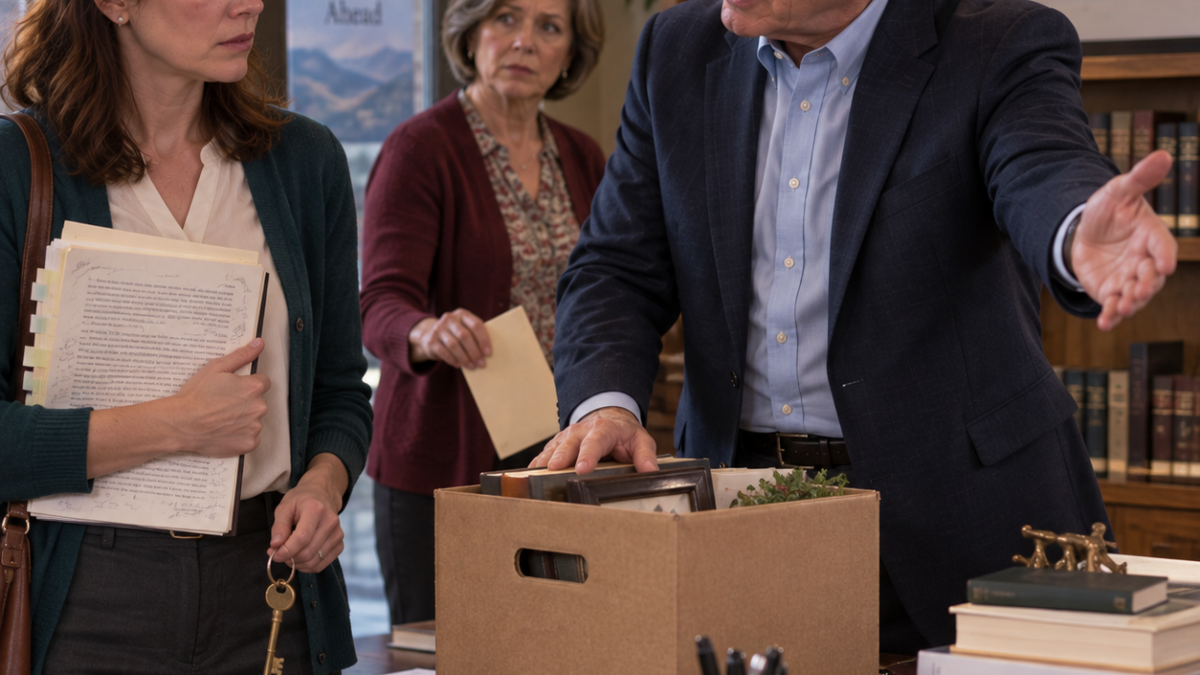
Six weeks after my grandfather died, my parents sold his Richmond publishing house for $760,000 and told me I would receive nothing. My father said the company was theirs; my brother Evan was already getting $260,000 from the proceeds to “steady his business.” I had not come for money. I came for Grandpa Arthur’s handwritten production notes. When I tried my brass key, the office lock had been changed, and my mother handed me one archive box as if years of work could be packed into cardboard. Then Denise Rowan, the longtime office manager, caught me in the hallway and slipped a returned royalty notice under the lid. The publisher named on it was not Blue Ridge Press. It was Arthur Ellis individually. Beneath his name was one line I had never seen: successor authorization required.
My name is Maya Ellis. I was thirty-three and worked as a senior production editor for a university press in Richmond, Virginia.
Blue Ridge Press was the business my grandfather built.
It published restoration manuals, regional architecture guides, local histories, and practical reference books—the kind people kept on workshop shelves until the covers faded.
Grandpa wrote eighty-two of those titles himself.
I never worked there full-time.
That distinction mattered enormously to my parents.
Dad, Paul, managed sales and distribution after Grandpa stepped back.
Mom, Judith, ran administration and finances.
My older brother Evan had his own packaging and fulfillment startup, which my parents described as “high-growth” even during months when they were paying its rent.
I built my career elsewhere.
Still, I spent countless Saturdays with Grandpa preparing revised editions.
I checked captions, verified measurements, cleaned up indexes, tracked photo permissions, and compared old print files against his pencil corrections.
Evan called it moving commas.
Grandpa called it protecting the book after the author got tired.
Six weeks after his funeral, Dad asked me to stop by the office.
A SOLD sign had already been taped over the glass beside the Blue Ridge Press logo.
Inside, Evan was carrying Grandpa’s framed first edition toward his car.
Dad looked almost cheerful.
“Northstar Heritage closed this morning,” he said. “Seven hundred sixty thousand.”
Mom added, “It was the right time.”
I asked what exactly they had sold.
“The company,” Dad said.
“And Grandpa’s books?”
“Everything connected to the press.”
Then he told me Evan would receive $260,000 because his business needed capital and because, as Dad put it, “You already have a stable career.”
I remember looking at the manuscript in my arms.
Grandpa’s penciled edits still ran along the margins.
“I didn’t ask how you divided the money.”
Mom’s mouth tightened.
“You were going to eventually.”
“I came for his notes.”
She handed me the archive box.
My desk had already been removed from the back office.
The shelves where I kept annotated proofs were empty.
Even my old key no longer turned in the lock.
Mom said the buyer needed a clean transition and that anything useful had transferred with the company.
Anything personal, she said, had been boxed.
Anything else might already be gone.
That was when Denise found me near the side door.
She had worked for Grandpa for twenty-one years.
She looked toward my parents’ office before sliding the royalty notice into my box.
“This came back yesterday,” she whispered.
“Why are you giving it to me?”
“Because your mother told me to put it with old rights correspondence, and I don’t think she read the second page.”
At home, I spread the box across my dining table.
Most of it was harmless.
Old proofs.
Meeting notes.
Photographs we never licensed.
A battered style manual with Grandpa’s coffee stains across the cover.
Then I opened the royalty notice.
A specialty distributor was trying to redirect quarterly payments after learning of Grandpa’s death.
Its records did not identify Blue Ridge Press as the copyright owner.
They identified Arthur Ellis.
The second page requested documentation from “the successor rights holder or authorized assignee.”
At the bottom, someone had handwritten a file reference:
MASTER RIGHTS — C. SHAW.
I recognized the name.
Caroline Shaw was an intellectual-property attorney Grandpa had mentioned once during a revision meeting.
I searched my old email.
Three years earlier, Caroline had sent me a message asking me to contact her about “Arthur’s long-term catalog planning.”
I had been moving apartments and assumed it concerned a permissions project.
I never answered.
There was also a second email from eighteen months before Grandpa died.
Please call when convenient. Arthur has completed the next stage of his rights plan.
I stared at that sentence until the words stopped feeling ordinary.
Then I called the number in her signature.
Caroline answered through her office voicemail system and called me back twelve minutes later.
I told her Grandpa had died.
I told her my parents had sold Blue Ridge Press.
She interrupted me for the first time.
“Before you speak to them again, tell me exactly what they said they sold.”
I repeated Dad’s words as closely as I could.
“The company. Everything connected to the press.”
Caroline was quiet.
“Did they show you the purchase agreement?”
“No.”
“Did you sign anything?”
“No.”
“Did anyone ask you to approve a copyright transfer?”
“No.”
Her voice changed.
“Then come to my office tomorrow morning.”
I brought the royalty notice, Grandpa’s manuscript, and the old email.
Caroline asked for identification before she opened her file.
“I represented Arthur personally,” she said.
“Not Blue Ridge Press, not your parents.”
She would not tell me what that meant until she understood the sale.
So I pulled up Northstar Heritage’s public announcement.
The release said the acquisition included Blue Ridge Press, its inventory, trademarks, contracts, and “the complete Arthur Ellis reference catalog.”
Caroline read that sentence twice.
Then she turned her monitor toward me.
A transaction attorney from Northstar had emailed her office the previous week asking where to send the “final Ellis catalog transfer documents.”
Caroline had not replied because she did not represent the sellers.
Attached was part of the completion schedule.
One line listed:
Arthur Ellis catalog assignment — seller to deliver.
The next line listed my name.
Maya Ellis — consent confirmed by family; signature to follow.
My stomach dropped.
“I never confirmed anything.”
“I know.”
“How?”
Caroline reached for a thick cream folder but did not open it.
“Because your grandfather spent two years making sure nobody else could confirm this for you.”
She slid the completion schedule toward me.
At the bottom was a signature block with my name typed beneath it.
The line above my name was still blank.
Caroline opened the cream folder.
Inside was not a will.
That was the first surprise.
My mother had been telling everyone there was no will leaving Grandpa’s books to me.
Technically, she was right.
Grandpa had handled the catalog before his death.
Eighteen months earlier, he signed a copyright assignment transferring his ownership in eighty-two listed titles to me.
The schedule ran twelve pages.
Every book had a title, registration reference, edition history, and notes about rights Grandpa did or did not control.
Some photographs were excluded.
Some third-party essays were excluded.
Foreign rights on six older titles were limited by previous contracts.
The document was careful in the exact way Grandpa had always been careful.
Caroline tapped the first page.
“Read the operative sentence.”
I did.
Arthur Ellis assigned to Maya Ellis all copyright interests he personally owned in the works listed on the attached schedule.
My mouth went dry.
“Why didn’t I know?”
“He wanted to tell you himself.”
She pulled out three letters.
The first was from Grandpa to Caroline.
I want Maya to own the books, not because she is my granddaughter, but because she is the only person in this family who has shown sustained interest in maintaining them accurately.
The second described the structure.
Grandpa retained the right to receive catalog income during his lifetime.
Blue Ridge Press received a limited exclusive publishing license so it could continue printing, selling, and distributing the books.
After his death, the license continued for twenty-four months unless I chose to renew or replace it.
That explained the royalty notice.
The distributor was not asking who inherited Blue Ridge Press.
It was asking who could now authorize rights decisions.
The third letter was addressed to me.
It had never reached me.
Caroline had mailed it to an apartment I had left shortly before Grandpa became seriously ill.
She later emailed twice.
Then Grandpa told her he would explain everything himself after his next oncology appointment.
He never got the chance.
I sat there holding the unopened copy of a conversation we should have had.
The ownership felt less like winning and more like discovering a responsibility after the person who could explain it was gone.
“What is it worth?” I asked.
Caroline did not answer immediately.
Instead, she pulled out an independent valuation Grandpa had commissioned during his succession planning.
The appraiser had studied sales history, royalty streams, licensing opportunities, revision costs, and the remaining commercial life of the titles.
Estimated catalog value:
$4.3 million.
Caroline pointed at the assumptions section.
“That does not mean someone will hand you four-point-three million dollars.”
“I know.”
“Good.”
“It means the rights are valuable.”
“Yes.”
“More valuable than the company my parents just sold for seven hundred sixty thousand.”
“Potentially, yes. But the company has other assets. Inventory. Trademarks. Contracts with other authors. Customer lists. Distribution relationships. We need to be precise.”
I appreciated her precision even while part of me wanted a dramatic sentence telling me my parents had sold an empty shell.
Reality was more complicated.
Blue Ridge Press was a real company.
It had value.
It simply did not own the most valuable part of the Arthur Ellis catalog.
The next document made the problem worse.
It was the license-back agreement between Grandpa and Blue Ridge Press.
Mom had signed for the company.
Her signature appeared beneath an acknowledgment that Arthur retained ownership of the copyrights and could assign them separately.
I looked at Caroline.
“She knew.”
“She signed this.”
“Did Dad?”
“He signed a board consent approving the license.”
I stopped speaking.
My parents had not merely misunderstood old publishing paperwork.
They had participated in the structure.
“Could they have forgotten?”
Caroline considered that.
“People forget details. That is possible.”
She pulled the Northstar transaction schedule closer.
“But somebody recently told the buyer you had agreed to transfer the catalog.”
That was current.
That was not memory.
I asked what we should do.
Caroline’s answer was boring and therefore reassuring.
“We notify the buyer that you have not consented. We request the full sale documents. We preserve the rights records. Then we find out what representations were actually made.”
“No family confrontation?”
“Not yet.”
“Good.”
“I also want you to understand something.”
She closed the valuation report.
“Ownership gives you leverage. It does not give you permission to interfere with contracts you do not own or make statements you cannot prove.”
“I understand.”
“Your parents may have sold assets they were entitled to sell and promised one asset they were not entitled to promise. Those are separate issues.”
That became the framework for everything that followed.
Caroline sent notice to Northstar Heritage that afternoon.
Not an accusation.
A statement.
Maya Ellis claimed ownership of the copyrights in the eighty-two Arthur Ellis titles listed in the enclosed schedule.
She had given no consent to transfer them.
Any representation otherwise should be treated as disputed until supporting documentation was produced.
Northstar replied within three hours.
Their transaction counsel requested a meeting.
Then my mother called.
I let it ring once before answering.
“Why is an attorney contacting the buyer?”
“Because the buyer’s paperwork lists me as someone who agreed to sign.”
Mom’s voice tightened.
“This is a family issue.”
“No. My name is in a sale agreement with a company I’ve never spoken to.”
“You are making this far more complicated than it needs to be.”
“Did you tell Northstar I agreed?”
“I told them the family would cooperate.”
“That is not what I asked.”
She exhaled.
“Maya, your grandfather always intended the press to stay together.”
“Did he?”
“Of course he did.”
“I have a signed assignment that says something different.”
Silence.
Not confusion.
Silence.
“How did you get that?”
“Caroline Shaw.”
My mother’s next words came too quickly.
“Arthur was sick when he did all of that.”
I closed my eyes.
She knew.
Maybe not every detail.
Enough.
“Mom, did you know he assigned the copyrights to me?”
“He talked about it.”
“That is not an answer.”
“He was sentimental. You spent all that time editing with him. He wanted to make you feel included.”
I almost laughed.
“A signed copyright assignment is a strange way to make someone feel included.”
“Do not be smart with me.”
There it was.
The old hierarchy.
Mother explaining reality.
Daughter expected to receive it.
“I’m going to the buyer meeting.”
“No.”
The word was immediate.
“It is not appropriate.”
“My name is in their completion schedule.”
“Your father and I will handle it.”
“That is how my name got there.”
She hung up.
Dad called ten minutes later.
His tone was calmer.
That made him more dangerous when I was younger.
“Maya, nobody was trying to take anything from you.”
“Then why does Northstar think I consented?”
“Because we expected you to be reasonable.”
The sentence settled between us.
“Reasonable means what?”
“Keeping Grandpa’s life’s work with the company he built.”
“That may be a business option.”
“Exactly.”
“An option I decide.”
Dad became quiet.
Then:
“Evan needs this sale.”
There it was.
Not Grandpa’s legacy.
Evan.
His packaging startup had lost a major customer the previous year and was carrying an expensive personally guaranteed credit line.
Dad had planned to use $260,000 of the sale proceeds to keep the company operating.
I knew they helped him.
I had not known how much.
“What does Evan’s business have to do with my rights?”
“He is your brother.”
“I know.”
“You have a career. He has employees.”
I looked at the manuscript on my table.
The same hierarchy had existed my whole life.
My career meant I needed less.
Evan’s instability meant he deserved more.
“You distributed the money already?”
Dad paused.
“Yes.”
“All of it?”
“We allocated it.”
“To whom?”
“That is not your concern.”
“It becomes my concern if the buyer paid based on a promise involving my property.”
He ended the call shortly after that.
The Northstar meeting was scheduled for Monday.
Caroline attended with me.
Northstar sent its chief operating officer, Graham Holt, and transaction counsel.
My parents came with their business attorney.
Evan came too.
He wore a new charcoal jacket and avoided looking at me.
Graham began without drama.
“We paid seven hundred sixty thousand dollars at initial closing based on a transaction structure that still requires delivery of certain catalog rights.”
Dad nodded.
“We’re aware.”
“Where are those assignments?”
Dad’s attorney pushed a thin packet across the table.
It included corporate resolutions, old distribution agreements, and an inventory schedule.
Caroline reviewed it.
Then she placed Grandpa’s assignment and the license-back agreement beside it.
“The sellers do not own the copyrights identified as Arthur Ellis’s individually held catalog,” she said. “Those rights were assigned to Maya eighteen months before Arthur’s death.”
Graham read the first page.
Then the schedule.
Then the license.
He did not say the company was worthless.
He asked better questions.
“What does Blue Ridge Press still have?”
Caroline answered only what the documents supported.
Existing inventory.
A twenty-four-month post-death publishing license.
Company trademarks.
Agreements with other authors subject to their own terms.
Distribution relationships.
Production files.
“What does it not have?”
“Ownership of these eighty-two copyrights.”
Graham looked at my parents.
“Our disclosure schedule states seller will deliver them.”
Dad said, “Maya can.”
Graham turned to me.
“Will you?”
“No decision has been made.”
Mom leaned forward.
“Maya.”
Caroline raised one hand slightly.
Not dramatic.
Enough.
My mother sat back.
Graham’s lawyer opened the completion schedule.
“Ms. Ellis, did you authorize your family to represent that your consent was confirmed?”
“No.”
“Did you authorize them to negotiate transfer terms on your behalf?”
“No.”
“Were you told about this transaction before initial closing?”
“No.”
Mom reached for her water.
Her fingers hit the side of the glass.
It rocked but did not fall.
Then Graham asked the question that changed the room.
“Did you authorize your mother to tell us you were uncomfortable with financial decisions and preferred the family to manage your interests for you?”
I looked at her.
Dad did too.
Evan finally raised his head.
“No.”
Graham slid a printed email across the table.
Mom had written it.
Maya is an excellent editor but becomes overwhelmed by transactional matters. We manage these interests as a family. Once the structure is final, she will sign what is necessary.
I read it twice.
For years, Mom had called me whenever she received a contract she did not understand.
I had reviewed service agreements.
Freelance licenses.
Insurance notices.
Even Evan’s first warehouse lease.
Now she had described my competence as a problem to be managed.
Not to my face.
To a buyer who needed my signature.
Mom tried to recover.
“That is being taken out of context.”
“What context makes it accurate?” I asked.
“You hate conflict.”
“That is not incapacity.”
“I never said you were incapable.”
The word overwhelmed sat on the page.
She did not need to.
Dad’s lawyer asked for a break.
Graham refused politely.
“We need clarity on one more issue.”
The purchase agreement represented the Arthur Ellis catalog as a company-owned asset subject only to routine assignment documentation.
The license Caroline produced said the opposite.
Northstar had options under the contract.
They could delay completion.
Demand cure.
Renegotiate.
Or seek to unwind the transaction.
Dad asked:
“What would cure look like?”
Graham looked at me.
“A voluntary rights agreement with the actual owner would address part of the problem.”
Every face turned toward me.
That was the moment my family expected the old Maya.
The one who hated making rooms uncomfortable.
The one who could be persuaded that preserving peace was a moral duty.
I did not feel powerful.
I felt nauseated.
Still, I answered.
“My catalog is not part of today’s sale.”
Dad’s face hardened.
“Maya.”
I continued.
“If Northstar wants to discuss a future license after the ownership issue is resolved, I’ll review a proposal through counsel.”
“You’re going to destroy the transaction over paperwork?”
My father’s lawyer quietly touched his arm.
Dad ignored him.
“Evan has already committed that money.”
Graham looked sharply at him.
“The closing proceeds have been distributed?”
Nobody answered immediately.
Then Northstar’s lawyer asked for a copy of the distribution statement.
Dad’s attorney requested a break again.
This time Graham agreed.
In the hallway, Mom caught up to me.
“You could have told us before humiliating everyone.”
I looked at her.
“You told a stranger I couldn’t handle my own decisions.”
“We were trying to keep the company together.”
“You could have asked me.”
“You would have said no.”
That answer was honest enough to hurt.
“Then you already knew you did not have my consent.”
Her face changed.
She did not answer.
Caroline stepped out of the conference room.
“We’re going back in.”
Mom stared at me.
“Your grandfather would hate this.”
I looked at the manuscript under my arm.
“I wish he were here to tell us.”
That afternoon, Northstar issued formal notice that completion was suspended.
My parents had ten business days to cure the catalog representation or negotiate an alternative.
They also had to preserve sale communications and refrain from representing that they controlled my rights.
That should have created space for rational negotiation.
Instead, my family produced what Mom called a solution.
Three days later, Caroline forwarded me a document titled Ellis Family Rights Partnership.
I would transfer the catalog into a new entity.
I would receive thirty percent.
My parents would hold forty percent.
Evan would receive thirty percent and a salary to develop commercial partnerships.
I read the percentages twice.
“They’re offering me thirty percent of something I own completely.”
Caroline nodded.
“Correct.”
“Is there any reason I should accept this?”
“That depends on what you want. Economically, I see no obvious reason based on the current proposal.”
The management section gave Dad final approval over major licensing decisions.
Mom would administer royalties.
Evan would control business development.
I would be responsible for editorial maintenance, revision standards, permissions, and production quality.
They wanted my work.
My rights.
And my name.
They did not want my control.
I declined through counsel.
Mom texted minutes later.
You are destroying your brother’s livelihood to make a point.
I did not answer.
Evan came to my apartment that Saturday.
I met him downstairs.
He started with:
“We all made mistakes.”
I almost turned around.
“What mistake did I make?”
He rubbed his hands together.
“That’s not what I meant.”
“Then be specific.”
He looked exhausted.
His startup had eleven employees.
The $260,000 from the sale had already paid down a line of credit and covered three months of supplier balances.
If Northstar demanded the money back, Evan could not simply return it.
“I need time,” he said.
“That is between you, Mom, Dad, and the buyer.”
“You know they gave me the money because the company needed it.”
“I know now.”
“You have a good salary.”
I stared at him.
He stopped.
“Sorry.”
“No, finish.”
“You’re stable.”
“And that means?”
He looked away.
“That Grandpa’s books could help everybody.”
“They can help everybody if I choose terms that help everybody.”
“You want royalties.”
“I want ownership respected.”
“Same thing.”
“No.”
He looked angry now.
“Grandpa gave you something worth four million dollars.”
“An appraisal says the catalog may be worth that under certain assumptions.”
“That is more than I’ll ever have.”
“Maybe.”
“You could give me a third and still be rich.”
There it was.
Not a legal argument.
A fairness argument built entirely from his need.
“You already received two hundred sixty thousand dollars from a sale that depended on rights you do not own.”
“The money is gone.”
“I believe you.”
His face softened for a second.
“Then help me.”
I wanted to.
That was the dangerous part.
Evan had mocked my editorial work.
He had benefited from our parents’ favoritism.
He was still my brother.
I did not enjoy watching his business suffocate.
But helping him could not require signing a false version of the past.
“I won’t transfer a third of the catalog to you.”
He swore under his breath.
I continued.
“If the buyer and our parents reach a settlement that requires a repayment schedule, and your company can survive with a real restructuring plan, I will look at investing separately.”
He stared at me.
“You’d invest?”
“Maybe.”
“Then why not sign this?”
“Because investment is a choice. Ownership is already settled.”
He did not like the answer.
He left.
Two days later, my parents changed strategy.
Their lawyer notified Caroline that they intended to challenge Grandpa’s assignment.
The theory was that he lacked capacity and that I had exercised undue influence because of our close editorial relationship.
I read the letter at work.
For several seconds, all I could hear was the ventilation system above my desk.
They were willing to turn the best hours I had spent with Grandpa into evidence against me.
Every Saturday revision session.
Every long phone call about captions.
Every argument over whether a diagram should be redrawn.
Mom was prepared to describe those as manipulation.
I called Caroline.
“What do we do?”
“We answer the claim.”
“How?”
“Documents.”
That was it.
No emotional campaign.
No family history essay.
Documents.
Grandpa had started succession planning two years before the assignment.
His oncology records showed that he remained competent.
Caroline had met with him privately.
A second attorney witnessed the execution.
The notary had no relationship with me.
I had not attended the signing.
More importantly, Grandpa’s emails after the assignment showed him continuing to negotiate, revise contracts, argue about royalty rates, and reject my editorial suggestions with his usual stubborn precision.
One email made me laugh despite everything.
Maya thinks Chapter Seven should be shortened. Maya is wrong.
Caroline included it in the evidence file.
“So much for control,” she said.
Then we found something stronger.
An email from Mom to Grandpa’s attorney six months before his death.
Thank you for clarifying that Maya will own the listed copyrights and Blue Ridge will continue publishing under the license. Please confirm whether current inventory may be sold through the two-year wind-down if Maya does not renew.
Caroline stared at the screen.
“She knew.”
Again.
Not vaguely.
Not sentimentally.
She had asked a detailed operational question about the exact structure she now claimed Grandpa did not understand.
I felt cold rather than triumphant.
There is something uniquely painful about discovering that a lie was not spontaneous.
It had paperwork.
My father had signed the corporate consent authorizing Blue Ridge to enter the license.
He had also approved royalty accounting under it.
The challenge did not disappear because those records existed.
Lawyers still argued about what they meant.
But the story my parents were telling became harder to sustain.
Northstar pursued its own contractual remedies separately.
They had paid $760,000.
A distribution statement eventually showed the money had been divided exactly as Dad refused to tell me.
$250,000 to Dad.
$250,000 to Mom.
$260,000 to Evan at their direction.
My parents had used part of their shares to pay off the mortgage on a lake cottage and move money into a brokerage account.
Evan had used most of his distribution to cover business debt.
They had treated the closing as finished while the buyer still expected my signature.
That fact drove the settlement pressure.
Caroline filed an action asking the court to confirm ownership of the copyrights and stop my parents from claiming authority to transfer them.
The hearing came four months later.
By then, the catalog dispute had become a set of binders instead of a family story.
I preferred the binders.
They did not care who was the favorite child.
They cared about dates.
Signatures.
Emails.
Rights.
My mother testified first.
Her lawyer asked whether Grandpa ever discussed giving me the catalog.
She said he talked about “letting Maya take care of the books.”
That phrase was carefully chosen.
Take care of.
Not own.
Then she said she understood the arrangement as administrative.
Caroline asked whether Mom remembered signing the publishing license.
“Yes.”
“Did you read it?”
“I read business portions.”
Caroline showed the email asking about the two-year wind-down.
Mom’s face tightened.
“I asked many questions during that period.”
“Did you write, ‘Maya will own the listed copyrights’?”
“Yes.”
“Were those your words?”
“Yes.”
“Why did you write them?”
“My understanding at that moment.”
“What changed?”
Mom looked toward me.
“Arthur became sicker.”
Caroline did not argue.
She moved to the next email.
It was written after Grandpa’s condition worsened.
Mom had asked how royalty statements should be sent “once Maya becomes the successor owner.”
Another document.
Another date.
By the time Mom finished, her explanation had narrowed.
She no longer claimed she never knew.
She claimed she believed Grandpa’s plan was temporary or symbolic.
Then Northstar’s email came up.
The one describing me as overwhelmed by financial decisions.
Mom said she had been trying to simplify the transaction.
Caroline asked:
“Did Maya authorize you to simplify her ownership by promising her signature?”
“No.”
Mom hesitated.
Then:
“I believed she would sign.”
“What supported that belief?”
Mom’s composure broke.
“Because she knew her brother needed this.”
The judge interrupted.
“That does not answer the authorization question.”
Mom looked toward me.
Her voice rose.
“After everything this family has done for her, we thought she would help.”
There it was.
Not consent.
Obligation.
I felt no victory.
I remembered Mom bringing groceries to my apartment after surgery years earlier.
I remembered her proofreading my graduate-school application.
Those memories were real.
So was this.
Love did not erase entitlement.
Entitlement did not erase every loving thing she had ever done.
Holding both truths was harder than turning her into a villain.
Dad testified more carefully.
He admitted signing the license consent.
He admitted knowing the company did not hold outright ownership at that time.
He said he believed the rights would eventually be “reintegrated” with Blue Ridge because keeping them separate made no commercial sense.
Caroline asked whether Grandpa had ever signed such a reintegration.
No.
Had I?
No.
Had Dad asked me?
No.
Then why tell Northstar my consent was confirmed?
Dad stared at the table.
“Because I believed Maya would do what was best for the family.”
Again.
Expectation offered as authorization.
My own testimony was shorter.
I described the editorial work.
The email attempts from Caroline I had missed.
The fact that I was not present when Grandpa signed.
The fact that I learned about the assignment only after the company sale.
My parents’ attorney asked whether I benefited financially.
“Yes.”
Whether I had been close to Grandpa.
“Yes.”
Whether he trusted my opinion about the books.
“Yes.”
I did not apologize for any answer.
Then Caroline introduced Grandpa’s emails disagreeing with my editorial recommendations.
The judge read one and smiled slightly.
Not because the case was funny.
Because Grandpa sounded very alive in the sentence.
The hearing ended without a ruling from the bench.
We waited five weeks.
During that time, Dad left one voicemail.
“We’re running out of options.”
He did not mention the claim that I had manipulated Grandpa.
He did not apologize.
I saved the message and did not call back.
The written order arrived on a Tuesday.
I read it in Caroline’s office.
The court confirmed that the signed assignment transferred Grandpa’s copyright interests in the scheduled eighty-two works to me.
It rejected the claim that the assignment was invalid for incapacity or undue influence.
It also barred my parents from representing that they had authority to transfer those rights.
I read the ownership paragraph three times.
Then I put the order beside Grandpa’s manuscript.
The answer had stopped depending on which family member spoke with the most confidence.
That was the first complete solve.
The second involved Northstar.
Their contract dispute with my parents continued.
The buyer could have tried to salvage the acquisition without the catalog.
They decided the company was worth far less under that structure.
After mediation, the parties agreed to unwind the initial sale.
My parents returned the $760,000.
They also agreed to pay $128,000 toward Northstar’s documented transaction costs and legal expenses.
The payment did not appear magically.
Dad and Mom sold the lake cottage.
They liquidated part of their brokerage account.
Evan returned what remained of his $260,000 and signed a secured repayment agreement for the balance.
His packaging company survived another eight months.
Then he closed it.
The sale dispute did not cause every one of his problems.
Losing the injected cash accelerated weaknesses that already existed.
He had high warehouse costs, two large customers representing most of his revenue, and a loan he personally guaranteed.
I did not rewrite his failure as moral punishment.
Businesses fail.
People make bad decisions.
Sometimes both happen at once.
Blue Ridge Press returned to my parents after the unwind.
Without ownership of Grandpa’s catalog, its future looked different.
It still had other authors.
It still had inventory.
It still had a name.
But the reliable backlist income from the eighty-two Arthur Ellis titles now required a license from me once the post-death period ended.
Dad asked Caroline for terms.
I did not refuse automatically.
That surprised my parents.
I requested proposals from three publishers, including Northstar.
I compared distribution reach.
Royalty reporting.
Revision support.
Minimum guarantees.
Digital conversion plans.
Audit rights.
Northstar submitted the strongest offer.
They had every reason to be careful after the failed transaction.
We negotiated a seven-year exclusive publishing license.
I retained copyright ownership.
I retained approval over substantial revisions and new editions.
Northstar paid a $300,000 advance recoupable against royalties, provided quarterly statements, and agreed to a defined audit process.
Blue Ridge Press received a limited subdistribution arrangement for existing institutional customers during transition.
That gave my parents time to reshape the business instead of shutting the doors overnight.
I did not do it to rescue them.
I did it because existing customers, employees, and authors had nothing to do with our family dispute.
The terms protected the catalog and allowed a functional transition.
That was what Grandpa had trusted me to do.
The first royalty statement arrived three months later.
I read every line.
Not because I expected fraud.
Because rights management is work.
The $4.3 million valuation remained in a file.
I did not spend as though that number were cash.
Some titles earned well.
Some barely moved.
Two needed expensive updates.
One had outdated building-code references and could not responsibly be reprinted until revised.
I used part of the advance to hire an architectural editor, a permissions researcher, and a freelance indexer.
I kept my university-press job for another year.
Eventually, I reduced my schedule to four days a week and created a small rights-management company called Ellis Reference Studio.
Not an empire.
Three people and a lot of spreadsheets.
Denise joined us part-time after leaving Blue Ridge.
On her first day, she placed the old returned royalty notice on my desk.
“You should frame this.”
“No.”
“Why?”
“It’s ugly.”
She laughed.
I kept it in a file instead.
My relationship with my parents did not recover quickly.
Mom went silent for almost three months after the ruling.
Then she emailed.
Not an apology.
A question about a book permission that Blue Ridge needed during the transition.
I answered professionally.
She wrote back:
Thank you.
That was the beginning.
Not reconciliation.
Communication.
Six months later, she asked to meet for coffee.
I almost refused.
Then I went.
She looked tired.
“I thought Arthur was unfair.”
I waited.
“He gave you the part of the company that produced the most dependable income.”
“He did not give me the company.”
“You know what I mean.”
“Yes.”
She looked down.
“I told myself he favored you because you spent time with him.”
“I did spend time with him.”
“I know.”
There was no accusation in my voice.
She heard one anyway.
“I was working.”
“So was I.”
She nodded.
“That’s what I mean. I kept treating the things you did with him as a hobby because that made the assignment feel irrational.”
I said nothing.
She continued.
“When the buyer came, we needed the sale. Evan needed the money. Your father wanted out. I thought if we completed everything, you would eventually sign because refusing would hurt everyone.”
“Did you know I had not agreed?”
“Yes.”
That was the first clean answer she had given me.
“I am sorry.”
I believed she meant it.
I did not tell her that meant everything was fixed.
“I appreciate you saying it.”
She nodded.
We finished our coffee.
That was enough.
Dad took longer.
His apology arrived as a letter.
Two pages.
Most of the first page explained why the sale had seemed necessary.
Fairfield project losses.
Evan’s credit line.
His own fatigue after running Blue Ridge.
I almost stopped reading.
Then the second page changed.
I knew you had not consented. I assumed we could make you consent afterward because I believed the family’s need was greater than your objection. That was wrong.
I read that sentence several times.
Not because it erased anything.
Because it finally named the choice.
I wrote back:
Thank you for being honest.
We now see each other a few times a year.
Our relationship is smaller.
More formal.
Strangely safer.
Evan’s apology came after his company closed.
He asked to meet at a diner near my office.
The first ten minutes were awkward.
Then he said:
“I hated you for a while.”
“I assumed.”
“You got the thing worth millions. I got debt.”
“I did not give you the debt.”
“I know that now.”
He stirred coffee he was not drinking.
“I thought Grandpa choosing you meant he had rejected me.”
“Did he?”
“No.”
“How do you know?”
“Because Denise gave me a copy of a note he wrote after I started the company.”
I waited.
Evan pulled a folded page from his jacket.
Grandpa had congratulated him.
Then written:
Build something you understand. Do not spend money to prove it is already bigger than it is.
I smiled.
“That sounds like him.”
“I ignored it.”
“That also sounds like you.”
He laughed.
Then became serious.
“I’m sorry I asked you for a third.”
“Thank you.”
“And I’m sorry I carried his first edition out of the office like it was mine.”
“That one bothered me more than I expected.”
“I know.”
He slid the framed book across the booth.
He had brought it.
“You should have it.”
I almost refused.
Then I took it.
Not because I owned every object connected to Grandpa.
Because this one had sat in his office for thirty years and Evan was returning something he had taken during a moment of entitlement.
That gesture mattered.
My own career changed in ways I had not planned.
Managing the catalog made me better at my university-press job.
I understood rights language differently once the consequences belonged to me.
I became almost annoying about ownership schedules.
One junior editor joked that I could smell ambiguous rights from across a building.
She was not entirely wrong.
When authors said, “My family owns the photo,” I asked who exactly.
When someone said, “The museum said it was fine,” I asked for the permission.
Not because I stopped trusting people.
Because clarity protects trust from later convenience.
Grandpa’s final unfinished manuscript was a guide to restoring early twentieth-century storefronts.
It needed more work than I expected.
Some photographs had no permissions.
Several material recommendations were outdated.
One chapter assumed products no longer manufactured.
I spent two years revising it with specialists.
I removed sections.
Added others.
Disagreed with notes he could no longer defend.
That was painful.
It was also editorial work.
Love did not require preserving every sentence exactly as he left it.
It required preserving the integrity of the book.
When the revised edition finally went to press, Northstar asked what I wanted on the acknowledgments page.
I wrote:
For Arthur Ellis, who taught me that a confident label is not the same thing as a verified source.
I did not mention the lawsuit.
I did not mention my parents.
The book did not need to become a monument to the worst year in our family.
It belonged to readers.
That was the point.
The brass key from Blue Ridge Press is still in my desk.
It does not open anything now.
Northstar changed the locks during the failed acquisition.
My parents changed them again after the unwind.
Later, Blue Ridge moved to a smaller office and the old building was leased to someone else.
The key is physically useless.
I keep it anyway.
For years, I thought having a key meant belonging.
Then I stood outside Grandpa’s office with that brass piece in my hand and discovered the lock had been changed before anyone told me.
It hurt.
Now the key means something different.
Access is not ownership.
Proximity is not authority.
Family expectation is not consent.
A sold sign is not proof that the seller owned everything behind it.
Those are not dramatic lessons.
They are precise ones.
That suits me.
When my parents sold Blue Ridge Press, Dad smiled and told me I was getting nothing.
He was right about one part.
I did not receive anything from that sale.
I never asked to.
What I received came from a decision Grandpa made while he was alive.
The harder part was learning that a gift on paper is only protected if the person receiving it is willing to say, clearly, that the paper matters.
For most of my life, being the child who asked for less made everyone assume I would surrender more.
They were wrong.
So was I.
I thought avoiding conflict kept relationships intact.
Sometimes it only teaches people that your agreement can be added later.
Now, when something matters, I read the source document.
And when my name is on the signature line, I decide whether it gets signed.







