My Parents Gave My Sister the Family House—Then Needed My Signature to Transfer It
Three days after my parents handed my younger sister the keys to our childhood home in front of twenty-seven relatives, a title officer called and asked why I hadn’t disclosed the $96,000 claim I supposedly held against the property.
I nearly dropped my coffee.
“What claim?”
The woman paused.
“The recorded family reimbursement agreement connected to 1824 Hawthorne Glen.”
That was my parents’ house in Mason, Ohio.
The house they had just publicly announced was going to my sister, Beth.
I’m Emily Carter. I was thirty-seven, director of internal audit for a regional insurance company in Cincinnati, and I had never owned one percent of Hawthorne Glen.
At least, that was what I thought.
The Sunday before the call, my parents invited everyone over for lunch.
Mom told me to bring her lemon sheet cake.
I should have realized something was happening when Beth showed up in a new dress and her husband, Aaron, carried champagne into the backyard.
At two o’clock, Dad tapped a spoon against his glass.
He talked about thirty-four years in the house.
Christmas mornings.
Graduations.
The maple tree Beth and I used to climb.
Then he pulled two brass keys from his pocket.
“Your mother and I want the next generation to have this place.”
For about half a second, I thought he meant both daughters.
Then he turned to Beth.
She started crying before he even finished.
Beth, Aaron, and their seven-year-old daughter Lily were getting the house.
Everyone applauded.
My aunt already had her phone pointed at Beth.
My mother hugged her.
Aaron’s parents popped the champagne.
I was still holding the cake knife.
I wasn’t angry because my parents gave away something they owned.
What hurt was realizing I had been invited to cater my own exclusion.
Beth found me in the kitchen afterward.
“Please don’t make this weird.”
“I haven’t said anything.”
She lowered her voice.
“Mom and Dad knew you might take it personally.”
There it was.
My reaction had been discussed before anyone bothered to tell me what was happening.
Then Beth added, “You have your career and your condo. We have Lily. They want the house to stay somewhere it’ll actually be used.”
I said congratulations.
That annoyed her more than an argument would have.
Later, Mom thanked me for “being mature.”
She said Beth needed stability.
I was doing well.
I had always been independent.
Those words had followed me since my twenties.
Emily can handle it.
Emily has savings.
Emily doesn’t need help.
When Dad was laid off in 2017, I covered their property-tax shortfall.
When the furnace died, I paid for most of the replacement.
When the roof started leaking, I wrote a check for $14,800 because Dad said they couldn’t get financing at a decent rate.
I never treated any of it like an investment.
They were my parents.
I could help.
So I did.
That was why the title officer’s call made no sense.
She explained that Beth and Aaron were applying for a new mortgage to pay off my parents’ remaining loan and complete the transfer.
During the title review, a memorandum from 2019 surfaced.
It named me as the beneficiary of a family reimbursement agreement tied to the house.
The agreement supposedly recognized years of financial contributions I had made and said $96,000 would become payable if Hawthorne Glen was sold, refinanced again, or transferred to another family member.
“I never signed anything like that.”
The woman became very careful.
“I’m not making a conclusion about the signature. I’m telling you what appears in the archived title file.”
“What date?”
“October 11, 2019.”
I stopped walking.
I knew that date.
My company held its annual internal-audit conference in Phoenix that week.
I had flown out on the ninth and returned on the thirteenth.
“Can you send me the document?”
“We can send the recorded memorandum. The underlying agreement has to come through counsel or the prior closing file.”
Twenty minutes after I hung up, Dad texted me.
Mom says the title company may call you. Nothing to worry about. Just old paperwork from when you were helping us. Come by tonight and we’ll clean it up.
I read the message twice.
Then I opened my calendar and confirmed what I already knew.
October 11, 2019.
Phoenix, Arizona.
My parents wanted me to sign away a $96,000 claim created by an agreement I had never seen, on a date when I was seventeen hundred miles from Ohio.
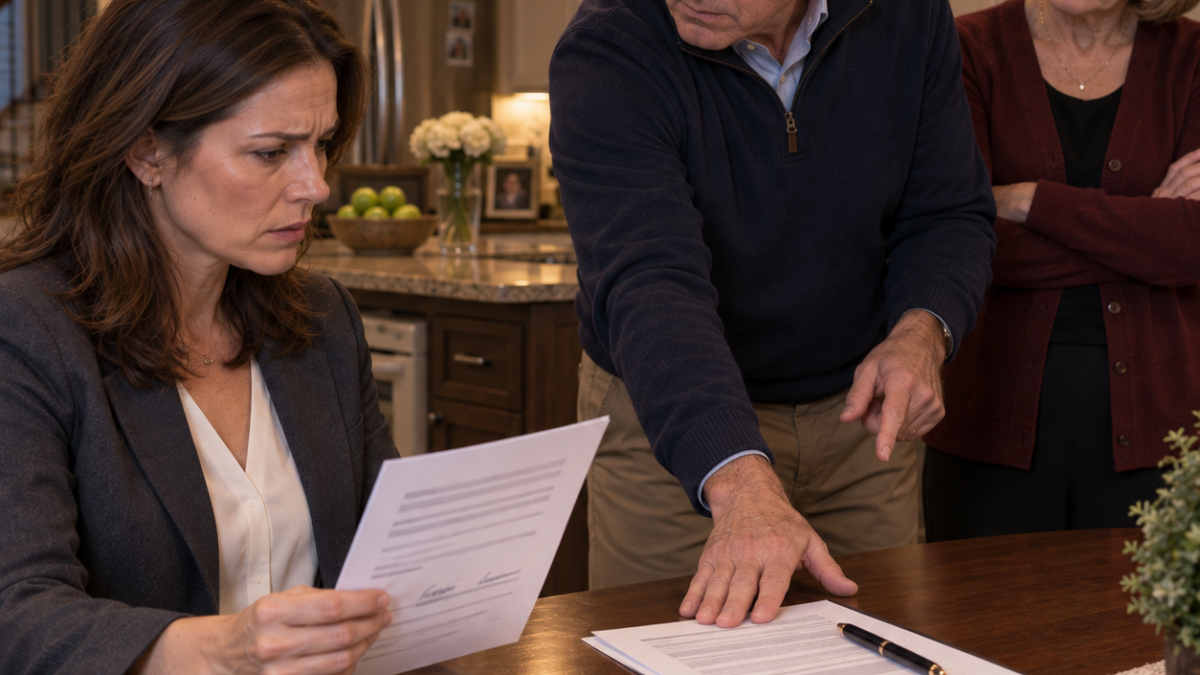
Dad already had the release waiting when I arrived. He pushed it across the kitchen table before I took off my coat. “It’s just clearing the title so Beth can close.” The affidavit said I acknowledged participating in the 2019 family agreement, confirmed the $96,000 obligation had been fully satisfied, and permanently released any claim against Hawthorne Glen. I looked at him. “When was I paid $96,000?” Dad’s jaw tightened. “It wasn’t literal debt. It documented what you’d done for us.” “Then why am I releasing it?” Mom stepped in. “Because the lawyers made everything sound more complicated than it was.” I turned to the attachment. The actual agreement wasn’t there. Only a reference number, date, and signature page copied from the old file. My name was at the bottom. Emily Rose Carter. It looked close. Too close. But I connect the E in Emily directly into the C when I sign quickly. This signature stopped between them. The capital C was slow and careful. Like someone drawing my signature instead of writing it. Dad tapped the release with one finger. “Beth needs the house. You don’t. Please don’t turn this into something ugly.” I looked at the copied signature again. Then at the date above it. October 11, 2019. “I was in Phoenix.” Mom’s eyes moved to Dad before she could stop herself.
Nobody spoke for several seconds.
Then Dad leaned back.
“You traveled all the time back then.”
“Yes.”
“You could have signed before you left.”
“The document says October eleventh.”
“Dates get entered later.”
“The title officer said the agreement itself is dated October eleventh.”
Mom folded her arms.
“Emily, you’re acting like someone robbed you.”
“I’m asking whether I signed a document.”
“You helped us financially.”
“That wasn’t my question.”
Dad pushed the release closer.
“This transfer has deadlines.”
“So does my job. I’m leaving.”
Beth came in through the garage as I stood.
She had clearly known I was coming.
“Seriously?”
I looked at her.
“Seriously what?”
“You’re going to stop the closing over paperwork from six years ago?”
“I’m not stopping anything. I’m not signing a statement saying something happened when I don’t remember it happening.”
“Mom and Dad are giving us the house.”
“I know. There was champagne.”
Her face flushed.
“I knew you were upset.”
“This has nothing to do with whether I get the house.”
“That’s easy to say when you’re the reason we can’t close.”
I picked up the copied signature page.
“This is the reason you can’t close.”
Beth looked at it.
She did not react the way I expected.
No confusion.
No surprise.
Just irritation.
“Dad said you helped them with the refinance.”
“I paid bills.”
“Same thing.”
“No. It really isn’t.”
Dad stood.
“We’re done for tonight.”
I took the release and signature copy with me.
He objected.
I reminded him my name was on both.
That ended the argument.
The next morning, I called an attorney.
Her name was Laura Kim.
She handled real-estate title disputes and financial fraud claims from an office downtown.
I knew her vaguely through work because our company had used her firm on a commercial matter, but we had never worked together directly.
She read the release first.
Then the recorded memorandum the title company had emailed me.
“This is unusual.”
“Good unusual?”
“No.”
The memorandum had been recorded in Warren County shortly before my parents’ 2019 refinance.
It referenced an unrecorded agreement between my parents and me.
According to the memo, I had contributed substantial amounts toward taxes, insurance, repairs, and household obligations from 2016 through 2019.
My parents acknowledged a repayment obligation of $96,000.
Payment became due if the home was sold, refinanced again, or transferred to an immediate family member for less than fair market value.
“So technically this document helps me.”
“Yes.”
“Why would someone forge my signature on an agreement that gives me money?”
Laura looked at me.
“That’s a useful question.”
The title company was trying to clear the claim because Beth’s proposed mortgage lender would not fund until the old agreement was released or satisfied.
Without my signature, the transfer stalled.
Laura told me not to contact the title company directly beyond confirming I disputed the signature.
She requested the full archived closing package from the 2019 refinance.
She also asked me to get proof of where I had been.
That part was easy.
My old employer still had travel records.
I had flown from Cincinnati to Phoenix on October 9, 2019.
Hotel check-in the same evening.
Conference badge scans October 10, 11, and 12.
Corporate-card charges.
An internal audit presentation with my name on the agenda at 2:00 p.m. on October 11.
The family agreement claimed I signed before a notary in Ohio at 3:35 that afternoon.
Unless I had developed private aviation without remembering it, both things could not be true.
I sent everything to Laura.
Then I did what she told me not to do.
I started building my own spreadsheet.
Not because I intended to investigate the case myself.
Because the numbers bothered me.
I went through eight years of bank records.
Parents.
Roof.
Furnace.
Insurance.
Property taxes.
Car repairs.
Medical deductibles.
Small things I had forgotten.
Big things I remembered instantly.
From 2016 through September 2019, I could document $71,430 in direct payments connected to my parents or the house.
Not ninety-six thousand.
The agreement had apparently included additional money I gave them after Dad lost his job.
Groceries.
Utilities.
Cash transfers.
Maybe the total really had reached ninety-six.
I had simply never added it.
That upset me more than the amount.
I had given so routinely that I no longer knew how much.
My family joked that I treated life like an audit.
Apparently I had exempted them.
The role started early.
Beth was four years younger.
I was the organized one.
She was the emotional one.
That is how my mother described us.
When Beth forgot lunch money, I shared mine.
When she crashed Mom’s car at seventeen, I drove her to work for a month.
When she failed chemistry, I tutored her.
When I got a scholarship to Ohio State, my parents told everyone how independent I was.
When Beth chose a small private college, they borrowed against the house to help pay tuition.
I noticed.
I told myself not everything had to be equal.
That became another family phrase.
Not equal.
Fair.
Fair meant the person who needed more received more.
The problem was nobody ever defined when need ended.
Beth married Aaron at twenty-six.
They had Lily two years later.
Aaron ran a small residential contracting business that had good years and terrifying years.
When they fell behind on rent during a slow winter, I paid the landlord directly.
Six thousand dollars.
Beth promised to repay me.
I told her not to worry about it.
She did not.
Dad’s layoff came the following year.
He had worked thirty-one years for a packaging-equipment manufacturer.
The plant consolidated.
At fifty-nine, he found himself job hunting for the first time since Reagan was president.
I understood why he panicked.
Their mortgage should have been manageable, but there were credit-card balances I did not know about, Beth’s remaining college loans my parents had quietly co-signed, and a home-equity line they had used for repairs.
Dad called me one evening and said they were “a little short” on property taxes.
A little short was $5,900.
I paid it.
Then insurance.
Then the furnace.
Then the roof.
The roof was the largest.
Dad told me the financing quote was terrible.
I wired the contractor.
That was how helping worked in my family.
No meeting.
No agreement.
No paperwork.
A phone call.
A problem.
Emily fixes it.
Laura called Thursday afternoon.
“The prior lender found the closing archive.”
I drove to her office.
The family reimbursement agreement was six pages.
My parents were listed as Thomas and Susan Carter.
I was listed as Emily Rose Carter.
The first three pages summarized money I had provided.
Several amounts were correct.
Some were close.
One was wrong.
It listed a $9,600 “2018 mortgage assistance payment.”
I had never made a mortgage payment for my parents.
Laura pointed to it.
“Remember that.”
Page four said the agreement was being created to document the nature of ongoing family support in connection with my parents’ refinance.
Page five created the $96,000 repayment obligation.
Page six contained three signatures.
Mom.
Dad.
Me.
My signature was not mine.
I knew it immediately.
A document examiner might need comparison samples.
I did not.
People know the movement of their own hands.
“What was the refinance amount?” I asked.
Laura turned to the closing statement.
The new loan was $314,000.
It paid off the old mortgage and home-equity line.
After fees and debts, my parents received $126,800 in cash.
I stared at the number.
“They told me they couldn’t finance the roof.”
“The roof was before this?”
“Five months before.”
I had paid $14,800.
Laura nodded.
“So the refinance came later.”
“What happened to the cash?”
“We don’t know yet.”
She had requested the settlement ledger.
Then she pointed to something else.
My 2018 W-2 was in the file.
So were two of my pay stubs.
And a photocopy of my driver’s license.
“How would they have this?”
The W-2, I knew.
Christmas 2018.
I was refinancing my own condo.
My printer died.
I printed tax documents at my parents’ house.
Dad joked that I was turning his den into a bank branch.
I had probably left copies behind.
The driver’s license could have come from any number of family paperwork situations.
I felt stupid.
Laura stopped me.
“Leaving a copy of identification in your parents’ house does not authorize its use.”
“I know.”
“You don’t sound like you know.”
She was right.
I was already moving responsibility around in my head.
If I had collected every page.
If I had asked more questions.
If I had stopped sending money.
All roads eventually reached the same fact.
Someone had put my name on a document.
Laura requested the notary journal.
The notary, a woman named Patricia Nolan, had retired to Florida.
Her commission records showed she notarized the agreement.
Finding her took a week.
During that week, my parents started calling relatives.
Not aggressively.
Strategically.
Aunt Carol called first.
“Your mother says there’s some title problem.”
“My signature appears on an agreement I didn’t sign.”
“Oh.”
That was not what Mom had told her.
Carol recovered.
“Well, I’m sure nobody meant anything.”
“Intent doesn’t change whether I signed.”
“Beth already enrolled Lily in the school district.”
“That was premature.”
“You know she’s always wanted that house.”
I nearly said so have I.
But that wasn’t true.
I wanted to matter in the conversation.
That is not the same as wanting the property.
My grandmother called next.
She was eighty-two and lived in an assisted-living apartment fifteen minutes from my parents.
She skipped small talk.
“How much have you given your parents?”
“I don’t know.”
“That means too much.”
I laughed.
She did not.
Then she told me something I had never heard.
In 2019, Dad asked her for $60,000.
“For what?”
“He said the house was in danger.”
“Did you give it to him?”
“No.”
“Why?”
“He wouldn’t show me the debt.”
“What happened?”
“He said you were going to help.”
My stomach tightened.
“He told you that?”
“Yes.”
“He never asked me for sixty thousand.”
Grandma was silent.
Then she said, “Maybe he found another way.”
The settlement ledger arrived the next day.
The $126,800 cash did not sit in my parents’ account for long.
$32,600 paid credit cards and past-due obligations.
$17,500 went into their savings.
$38,000 went by cashier’s check to an escrow company.
The memo line contained Aaron’s last name.
Lewis purchase escrow.
Beth and Aaron bought their first townhouse twenty-four days after my parents’ refinance.
I pulled the county record.
Purchase price: $238,000.
Mortgage: $188,000.
They had brought roughly fifty thousand dollars to closing after fees.
I stared at the screen.
Then I called Laura.
She already had the answer.
“The prior closing company confirmed the $38,000 was credited as a gift from your parents toward Beth and Aaron’s purchase.”
I sat down.
When Beth bought that townhouse, she told everyone they had “saved forever.”
Dad lectured me that Christmas about working too much.
He said Beth understood balance better than I did.
At the time, I was still writing checks when my parents said Hawthorne Glen needed something.
A month after the refinance, Mom asked me for $3,200 because their homeowner’s insurance escrow was short.
I sent it.
They had just given Beth thirty-eight thousand dollars from cash created by a refinance supported by paperwork carrying my forged signature.
I called Beth.
Laura had not told me not to.
That was my defense.
Beth answered carefully.
“Hi.”
“Did Mom and Dad give you thirty-eight thousand dollars for the townhouse?”
Silence.
“Yes.”
“Did you know it came from the Hawthorne Glen refinance?”
“Dad said they refinanced.”
“Did you know my name was involved?”
“What do you mean involved?”
“Answer the question.”
Another pause.
“He said you were helping.”
“How?”
“I don’t know.”
“Did he tell you I signed paperwork?”
“Emily, it was six years ago.”
“So?”
“Yes. I think he said you signed something showing how much you’d helped them.”
My eyes closed.
“Did you ever ask me?”
“Why would I?”
That answer hurt.
Not because it was cruel.
Because it was honest.
My family had trained Beth to treat my help as infrastructure.
Nobody calls the electric company to ask whether it consents to keeping the lights on.
“Did you know they used refinance money for your down payment?”
“Yes.”
“Did you know I supposedly had a ninety-six-thousand-dollar repayment claim against Hawthorne Glen?”
“No.”
That sounded genuine.
“Did you know they signed my name?”
“No.”
“I didn’t sign.”
She went quiet.
Finally:
“Dad said you did.”
“I was in Phoenix.”
She exhaled.
“You’re sure?”
I laughed despite myself.
“Yes, Beth. I’m sure where I was.”
Then her tone changed.
Defensive.
“So what happens now? You take the house?”
“I haven’t asked for the house.”
“You’re blocking the transfer.”
“The title company blocked the transfer because there is an unresolved agreement.”
“Same result.”
“No.”
“It feels the same to me.”
That sentence helped me understand something.
To Beth, consequences had always arrived from outside.
The landlord needed rent.
The car needed repairs.
Lily needed childcare.
Dad needed work.
The house transfer now needed my signature.
Each problem felt like something happening to her.
That did not make her selfish in every part of her life.
She was a good mother.
She had cared for Mom after knee surgery.
She remembered birthdays I forgot.
She brought food when I had COVID.
But money had always moved toward her from the family.
She had no practice seeing where it came from.
“I’m not signing anything false,” I said.
She started crying.
“I already gave notice on our rental.”
“I’m sorry.”
“That’s it?”
“What do you want me to say?”
“I want you to help.”
There it was.
The family reflex.
I ended the call before I said something I would regret.
Patricia Nolan called Laura from Florida two days later.
We joined by video.
She had her old notary journal.
She found the entry.
October 11, 2019.
Thomas Carter.
Susan Carter.
No Emily Carter.
In the notes column, she had written:
Third signature present prior to appointment. Signer traveling. Parents represent prior execution.
Laura asked, “Did you witness Emily sign?”
“No.”
“Did you speak with her?”
“No.”
“Did you notarize a certificate stating all three signers personally appeared?”
Patricia looked embarrassed.
“Yes.”
“Why?”
“They told me Emily had already signed and was traveling. I should have used a different acknowledgment process or refused. I handled it incorrectly.”
“Would you provide a sworn statement?”
“Yes.”
That was the first independent witness.
It still did not tell us who actually wrote my name.
Then another record appeared.
The attorney who had drafted the family agreement, Samuel Greene, still practiced in Dayton.
His file contained emails.
Dad had written him:
Emily has supported us financially for several years and has agreed that we can document the arrangement as part of the refinance. She travels frequently and may not be available for closing.
Samuel replied:
I need direct confirmation from Emily if she is taking contractual rights under the agreement.
Dad:
She understands the terms. I will have her call.
There was no record of my call.
Instead, three days later, Samuel received an email from Mom.
Attached: the signature page.
Mom wrote:
Emily signed before leaving for her conference. Please let us know if this satisfies your file.
I read that sentence in Laura’s office.
“So Mom sent it.”
“Yes.”
“Does that prove she signed my name?”
“No.”
But it placed her inside the process before the closing.
Mom had spent two weeks describing everything as Dad’s old paperwork problem.
She had sent the signature page herself.
I did not call her.
Laura was better at patience than I was, and I was starting to understand why it mattered.
We asked Samuel one more question.
Did anything happen after closing that concerned him?
He found a handwritten note.
About three weeks after the refinance, his office received a voicemail from a woman claiming to be me.
She asked why her name appeared in documents connected to Hawthorne Glen.
Samuel returned the call to the number provided.
My parents’ home number.
Dad answered.
According to Samuel’s note, Dad said I had become confused by the terminology but the family had resolved it.
Then Samuel wrote:
Do not rely on E. Carter consent for future property transaction without direct confirmation from E. Carter.
Dad had been warned in writing.
That changed everything.
Not because it identified the person who drew my signature.
Because it destroyed the idea that this was an innocent misunderstanding nobody noticed until now.
Dad knew there had been a question about my consent.
He used the agreement anyway when it benefited them.
Now, six years later, he wanted me to release it without reading.
Laura advised me to file a formal identity and signature dispute with the title insurer and my parents’ mortgage servicer.
I did.
That decision had a cost.
It suspended Beth’s closing completely.
Mom called within three hours.
“What did you do?”
“I disputed the signature.”
“You froze your sister’s house.”
“It isn’t her house yet.”
“You know what I mean.”
“Do you know Samuel Greene?”
Silence.
That was my answer.
“Mom?”
“Your father handled the refinance.”
“You emailed Samuel my signature page.”
She started crying.
“I was trying to save our house.”
“Did I sign it?”
“You were helping us.”
“That is not an answer.”
“We thought you would agree.”
“Did I?”
Long silence.
Then:
“You would have if we had explained it properly.”
That sentence made my skin go cold.
Not yes.
Not no.
A substitute.
“What did the thirty-eight thousand dollars for Beth have to do with saving your house?”
She stopped crying.
“Who told you that?”
“The closing ledger.”
“Emily, it was a gift to your sister.”
“From refinance proceeds.”
“We had the money once the loan closed.”
“Using my documents.”
“You weren’t responsible for the mortgage.”
I noticed the wording.
She knew exactly what role I had supposedly played.
Maybe not legal specifics.
Enough.
“Who signed my name?”
“Ask your father.”
She hung up.
Dad called that night.
He did not start with hello.
“You’re turning a family issue into a fraud case.”
“My signature is false.”
“You were never at financial risk.”
“That isn’t permission.”
“We were desperate.”
“Who signed my name?”
“We were losing the house.”
“Who signed it?”
He raised his voice.
“You’d already given us more than that amount. We were documenting reality.”
“My consent was part of reality.”
Silence.
Then he said, “You always said you’d help us.”
There are sentences that explain whole families.
That was ours.
You always help.
Therefore we can decide what help means.
“I’m not signing the release.”
“Then Beth loses the house.”
“No. Beth doesn’t receive this house.”
“You know what I mean.”
I was tired of people saying that too.
The family group chat lit up the following day.
Mom had told everyone the transfer was frozen because I was disputing “old paperwork.”
Aunt Carol asked whether we could resolve it privately.
A cousin wrote that Beth and Lily should not lose their home over technicalities.
Grandma replied:
It is not Lily’s home. It is Tom and Susan’s home.
Nobody responded to her.
Then Dad wrote:
Emily has every right to ask questions. We hope she remembers nobody intended to hurt her.
I stared at it.
Elegant.
He defended my right to ask while positioning my questions as emotional overreaction.
I did not respond.
Laura approved that decision.
The next development came from Beth.
She asked to meet without our parents.
We met at a bakery near her rental.
She looked terrible.
“I didn’t know the signature was fake.”
“I believe you.”
She seemed surprised.
“You do?”
“Yes.”
“But you think I knew something.”
“I think you knew Mom and Dad refinanced and gave you money.”
“Yes.”
“You knew Dad said I was helping.”
“Yes.”
“Did you ever wonder why I never mentioned it?”
She looked down.
“No.”
That was the first honest thing we had said to each other in weeks.
Then she pushed a folder toward me.
My entire family had apparently discovered folders.
Inside were old emails Dad had sent Beth during her 2019 home purchase.
One said:
Don’t worry about the source of funds. We have the Hawthorne Glen refinance handled and Emily’s assistance documented.
Another:
Your sister will be fine. She has always wanted to help the family, even if she complains about details.
Beth said, “I believed him.”
“I know.”
“He made it sound like you knew.”
“I know.”
She started crying.
“I should have asked you.”
“Yes.”
No instant reassurance.
I loved my sister.
That did not require me to erase the obvious sentence.
She wiped her face.
“Do you want the ninety-six thousand?”
“I want the truth first.”
“What happens to Mom and Dad?”
“That depends on the bank, title company, and whatever settlement we reach.”
“Are they going to be charged?”
“I don’t know.”
That scared her.
It scared me too.
The point where a family secret intersects with financial fraud is where emotional consequences stop being entirely yours to control.
I was not trying to have my parents arrested.
I was also done lying for them.
A week later, Laura received metadata from the scanned signature page.
The PDF had been created on my father’s old desktop computer.
That still did not prove who physically signed.
Then Samuel found one final email.
Dad to Mom.
The night before she sent the signature page.
I tried to make Emily’s signature match the copy on her tax return. Check it before you send.
There are moments when your body reacts before your thoughts do.
I felt heat travel up my neck.
Then nothing.
Laura said my name.
I looked at the screen again.
Dad had written it.
No metaphor.
No inference.
He had attempted to copy my signature.
Mom had reviewed it.
Mom had sent it.
Both knew.
The email continued.
Mom:
The C looks too neat.
Dad:
Good enough. She’s in Phoenix and the lender needs it tomorrow.
Mom:
I hate doing this.
Dad:
We’re not taking anything from her. She’ll get paid back if the house ever changes hands.
That was the logic.
They created a repayment right in my favor and used that fact to tell themselves the forgery was harmless.
In their minds, I would eventually receive money.
Therefore consent was a technical inconvenience.
Then Mom wrote:
What about Beth’s down payment?
Dad:
Emily cannot know that part. She’ll think we used her.
Mom:
We are using the refinance.
Dad:
Not her.
I read those lines until the words stopped looking like English.
They had built a moral distinction so narrow they could stand inside it.
Use my income history.
Use my financial support.
Use my identification.
Copy my signature.
But because the mortgage itself was theirs and the agreement technically owed me money, they told themselves they were not using me.
Laura asked what I wanted.
For weeks, I had not known.
Now I did.
“I want the bank and title company to have everything.”
She nodded.
“And the ninety-six thousand?”
“I want an independent accounting of what they actually owe under the agreement and what I actually contributed.”
“Even though the agreement is forged?”
“Yes.”
She understood.
I did not want to profit from fake paperwork.
I wanted the financial history reconstructed honestly.
Laura hired a forensic accountant.
That felt absurd given my profession, but it was necessary.
I needed someone who was not me.
He reviewed bank transfers, receipts, contractor payments, tax records, and the refinance proceeds.
My documented family and property support before October 2019 totaled $78,260.
Some of the ninety-six-thousand figure represented estimates and amounts I could not verify.
The forged agreement overstated my contribution by almost eighteen thousand.
That mattered.
If I demanded the full ninety-six simply because the forged document said so, I would be doing my own version of convenient accounting.
I chose seventy-eight thousand as the starting number.
Then we accounted for two payments my parents had made back to me over the years.
Final net claim: $71,800.
Laura proposed a settlement.
My parents would acknowledge that I had not signed or authorized the 2019 agreement.
They would pay $71,800 representing verified unreimbursed contributions.
I would release any civil claim against Hawthorne Glen after payment.
No statement that I had authorized the refinance.
No confidentiality provision requiring me to tell family members a different story.
No personal release for intentional identity misuse beyond the specific property dispute until the title and lender investigations were complete.
Dad rejected it.
He offered twenty thousand.
Then thirty-five.
Then forty-five if I agreed to tell the lender I had verbally approved the arrangement.
No.
That was the line.
Money could be negotiated.
Reality could not.
The decisive meeting happened at Laura’s office.
Not Hawthorne Glen.
Not in front of relatives.
Just Mom, Dad, their lawyer, Laura, me, and later Beth because she asked to attend.
Dad looked older.
Mom looked exhausted.
Their lawyer did most of the talking.
The bank’s investigator had reached a preliminary conclusion that my signature could not be authenticated and that my consent documentation had material irregularities.
The title insurer would not clear the transfer without resolving the reimbursement memorandum.
My parents’ current mortgage remained theirs.
I was not a borrower.
That was important.
My identity had been used to strengthen the original refinance file and create the support agreement, but I was not secretly liable for the loan.
Dad seemed to think that should end the problem.
“You were never on the hook for the mortgage.”
I looked at him.
“Do you still think that makes the signature irrelevant?”
“I think you’re treating us like criminals.”
“You copied my signature.”
His lawyer looked down.
Dad stopped.
Mom spoke.
“We were afraid.”
I had heard that before.
Then she said something new.
“We were afraid you’d say no.”
That was the first sentence that mattered.
Not because it excused anything.
Because it admitted consent was the obstacle.
If they truly believed I had already agreed, they would not have needed my signature while I was in Phoenix.
Mom continued.
“Your father had lost his job. We were behind. Beth and Aaron were trying to buy their first place. Everything felt like it was collapsing at once.”
Beth looked at her.
“So you gave us money you got by using Emily’s paperwork.”
Mom’s face crumpled.
“We thought we could help everybody.”
“You didn’t tell me.”
“We didn’t want you to feel guilty.”
Beth laughed once.
It sounded awful.
“You let me tell people Aaron and I had saved that down payment.”
“We didn’t ask you to say that.”
“No. You just let me.”
Dad snapped, “Enough.”
For once, Beth did not stop.
“No. Not enough.”
She turned to me.
“I’m not taking Hawthorne Glen.”
Dad stared.
“What?”
“We’re withdrawing the mortgage application.”
“You gave notice on your rental.”
“We’ll find another rental.”
“Lily is supposed to start school there.”
“We’ll drive her.”
“This whole thing was for you.”
Beth shook her head.
“No. You did it and then named me as the reason.”
That sentence changed the room.
Dad leaned back.
Nobody argued with it.
The transfer ended.
My parents kept Hawthorne Glen.
The title company closed its file on Beth’s transaction.
The lender finished reviewing the 2019 matter.
Because the original refinance had remained current and because I was not personally liable, the remedy focused on correcting records, documenting the disputed signatures, and notifying the relevant parties.
The lender also referred the irregularities through its internal fraud process.
I was not told every consequence.
That frustrated me.
Then I realized not every consequence belonged to me.
Three months later, my parents accepted the settlement.
$71,800.
Dad hated the number.
He said I was charging my own parents for years of help.
I told him I was accepting reimbursement for the exact help he once forged paperwork to claim he owed me.
That ended the conversation.
They paid from savings and a small investment account.
No new loan.
No use of my income.
No signature I had not written.
I deposited the money.
For a week, I hated seeing it in my account.
Then I reminded myself it was not prize money.
It was reimbursement.
I moved part into investments.
I used twelve thousand to replace my condo’s aging HVAC system.
Not emotionally meaningful.
Extremely satisfying.
My relationship with Dad nearly disappeared.
For months, his only texts were practical.
A tax form.
A question about the settlement.
A Christmas message that said:
Hope you’re well.
Mom tried harder.
At first, every apology had a tail attached.
I’m sorry, but we were desperate.
I’m sorry, but you always helped us.
I’m sorry, but we never thought you’d be hurt financially.
Eventually, I told her I would end every conversation the moment “but” appeared.
She thought I was being cruel.
I did it anyway.
Three weeks later, she called.
“I signed off on sending that page because asking you risked hearing no.”
I sat quietly.
No explanation followed.
No Dad made me.
No Beth needed help.
No family was under pressure.
Just the sentence.
“That’s true,” I said.
“I’m sorry.”
“I believe you.”
That was not forgiveness.
But it was the first conversation we had after the scandal that did not require me to correct the record.
Beth and I took longer.
Four months after the transfer collapsed, she sent me a picture.
Not of Lily.
Not of Mom.
A spreadsheet.
Monthly income.
Rent.
Business income from Aaron.
Childcare.
Savings target.
Emergency fund.
Her message said:
You created a monster.
I wrote back:
Your categories need work.
She replied:
There she is.
That was how we started talking again.
Carefully.
She and Aaron rented a townhouse for another year.
Aaron’s contracting business improved.
Beth took a billing-management job at a pediatric medical practice.
They saved.
Actually saved.
No secret gift.
No family refinance.
No champagne.
The following summer, they bought a modest three-bedroom house fifteen minutes from my parents.
Beth called after the closing.
“I have keys.”
“Congratulations.”
“No one is filming.”
“Even better.”
“I paid my own down payment.”
I smiled.
“I know.”
“Are you proud of me?”
That question irritated me for exactly two seconds.
Then I heard what she was really asking.
“Yes.”
She cried.
So did I.
Our parents stayed at Hawthorne Glen another eighteen months.
Then Dad developed arthritis badly enough that stairs became difficult.
They decided to sell.
This time, nobody made a family announcement.
No barbecue.
No keys.
Dad emailed Beth and me the listing before it went live.
The house sold to a young family with two boys.
My parents moved into a one-story condo.
They did not offer Hawthorne Glen to either daughter again.
The closing generated enough equity to make them comfortable.
I did not ask for another dollar.
The settlement had resolved my verified contributions.
That mattered to me.
I did not want every future family asset turned into a balance sheet.
I only wanted people to stop using “family” as the reason I was not allowed to see one.
Before the closing, Beth and I went through the house together.
Mom told us to take anything we wanted.
Beth took a china cabinet that had belonged to Grandma.
I took Dad’s old metal toolbox from the basement.
Not because it was valuable.
Because every time something broke at Hawthorne Glen, that toolbox appeared.
Dad fixing cabinet hinges.
Dad replacing outlets.
Dad teaching us how to shut off the water before touching a pipe.
The man who forged my signature was still the man who taught me to use a socket wrench.
I hated that both things were true.
Real families rarely give you the convenience of one version.
As we were leaving, Beth found the two brass keys Dad had given her at the original family lunch.
They were in a kitchen drawer.
She held them up.
“Remember these?”
“Unfortunately.”
She put them on the counter.
“I don’t want them.”
“Me neither.”
We left them for the buyers.
A few months later, Beth invited me to her new house for dinner.
Nothing ceremonial.
Pizza.
Lily doing homework at the table.
Aaron complaining about lumber prices.
Beth tossed me a spare key when I arrived.
“For emergencies.”
I caught it.
Then looked at her.
She froze.
“Oh.”
We both started laughing.
She reached for it.
“I can take it back.”
“No.”
I put it on my key ring.
“This one’s fine.”
That key meant something entirely different.
Not inheritance.
Not compensation.
Not proof somebody loved me more.
Access given openly.
No hidden paperwork attached.
Dad and I never returned to what we were before.
I’m not sure we should have.
He apologized once.
A real apology, eventually.
He said:
“I kept telling myself you would have helped because that was easier than admitting I didn’t give you the chance to choose.”
That was the sentence I needed.
Not because it restored trust.
Because it named what he took.
Choice.
For years, my family called me strong.
They meant it as praise.
Sometimes it was.
Sometimes it meant they expected me to absorb whatever hurt would be inconvenient for everyone else.
Beth needs help.
Mom and Dad are scared.
Emily can afford it.
Emily won’t make a scene.
Emily will understand later.
The forged signature was simply that family rule written in ink.
They had already announced my yes inside their heads.
The document only made it visible.
I don’t keep a spreadsheet of what I do for my family now.
That would be miserable.
I still help.
I bought Mom groceries after her knee replacement.
I watched Lily for an entire week when Beth and Aaron both got the flu.
I paid for Dad’s birthday dinner last year.
The difference is embarrassingly simple.
They ask.
I answer.
Sometimes yes.
Sometimes no.
Nobody signs for me anymore.
That turned out to be the boundary I should have had long before a title officer called me on a Tuesday morning.







