My Parents Came Back for Grandpa’s Boatyard—Then His Lawyer Opened a Twelve-Year-Old Agreement
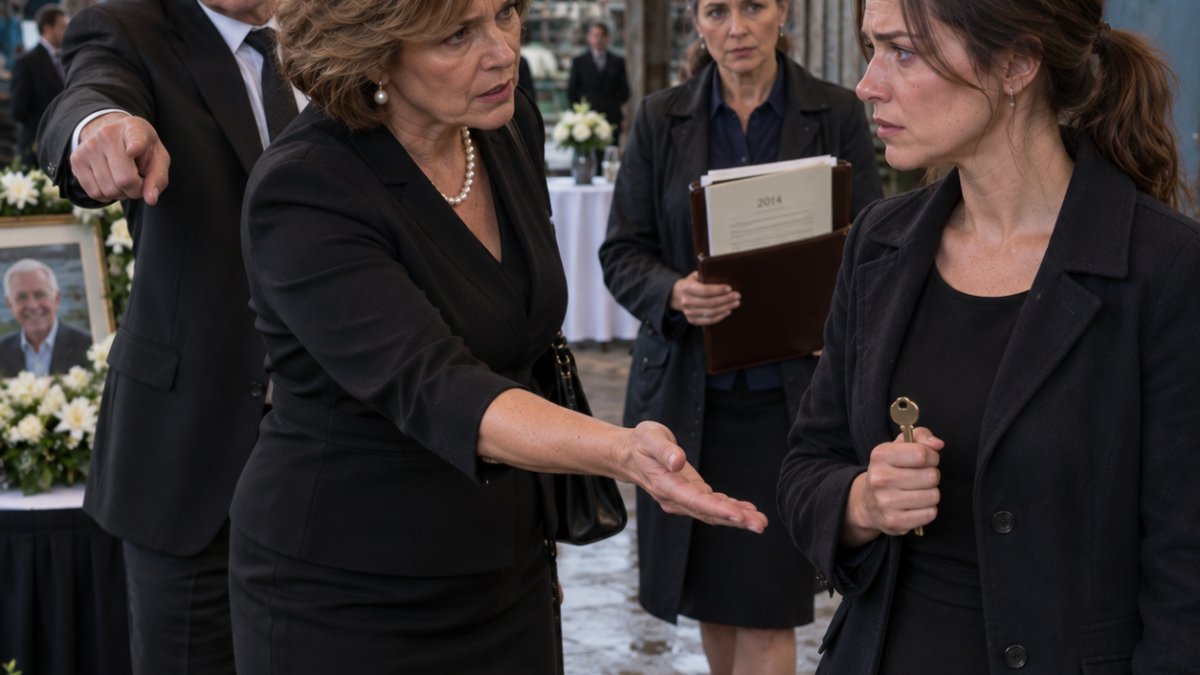
My mother held out her hand at my grandfather’s funeral reception and said, “Give me the office key. Your father has a broker coming Tuesday.”
I was still wearing the black dress I’d buried Grandpa Walter in.
Around us, people who had worked beside him for thirty years were eating barbecue from paper plates beneath the boatyard’s covered work shed.
My parents had been back in Beaufort, North Carolina, for less than twenty-four hours.
They were already trying to sell the place that had raised me.
“No.”
Mom blinked.
“What do you mean, no?”
“I mean you’re not getting the key.”
My father, Paul, stepped closer.
“Maya, don’t make this difficult.”
I almost laughed.
I was thirty-two years old, a mechanical engineer, and the founder of a small marine-sensor company that operated out of one of Grandpa’s old fabrication bays.
The last time my parents had lived with me, I was ten.
They moved to Arizona after Dad’s business collapsed and left me with Grandpa Walter “until things stabilized.”
They took my thirteen-year-old brother, Caleb, with them.
Things apparently needed twenty-two years to stabilize.
Grandpa became my legal guardian.
He taught me to rebuild a bilge pump before I learned algebra, let me sweep the machine shop for spending money, drove me to engineering camps, and sat through every parent-teacher conference my actual parents missed.
Now he was dead at seventy-nine, and Mom was standing inside Delaney Marine Works as if she had simply been away for the weekend.
Dad gestured toward the yard.
“Your grandfather’s gone. Somebody has to make decisions.”
“His attorney does.”
Mom’s face changed.
“Walter was my father.”
“That’s true.”
“I’m his only child.”
“Also true.”
“So stop acting like I’m a stranger here.”
I looked past her toward the travel lift Grandpa and I had rebuilt two winters earlier.
“You haven’t been here since I was sixteen.”
“That doesn’t change the fact that this is family property.”
Caleb stood several feet away, staring at the concrete.
He was thirty-five now.
I had seen him maybe six times since childhood.
Mom continued.
“We know what the waterfront parcel is worth. Your father talked to someone who handles marina sales.”
“You called a broker before the funeral?”
Dad cut in.
“We’re being practical.”
That word.
Practical.
The same word they had used when they left me.
Mom extended her hand again.
“The office key.”
The brass key was in my coat pocket.
Grandpa had carried it for almost forty years.
He gave it to me three nights before he died and said only, “Keep the books dry and the doors locked.”
I did not move.
Then a woman’s voice came from behind us.
“Joanne, I would strongly advise Maya not to hand you anything.”
Everyone turned.
Marian Blake, Grandpa’s estate attorney, stood at the edge of the shed carrying a leather portfolio.
Mom stiffened.
Dad said, “This is a family matter.”
Marian walked over.
“No. At this point, it’s a trust matter.”
She opened the portfolio.
Inside was a cream-colored file with an old date stamped across the top.
2014.
Mom stopped talking.
I noticed that before anything else.
Marian looked at me.
“Walter asked me to show you this before Monday’s trust meeting.”
Then she turned the file around.
Across the front were four words:
DELANEY FAMILY ASSET SETTLEMENT.
Below them were my parents’ signatures.
Dad reached for the file. Marian closed it before he touched it.
“You’ll receive your own copy Monday.”
Mom looked at me.
“This has nothing to do with you.”
Marian answered instead.
“It has quite a lot to do with why Walter structured his estate the way he did.”
I stared at the date.
2014.
I had been twenty.
By then, my parents had been living in Arizona for a decade.
Marian opened the file to the signature page.
Joanne Reed.
Paul Reed.
Both notarized.
Attached behind it was a bank confirmation showing a $240,000 wire from one of Grandpa’s investment accounts to Reed Hospitality Ventures LLC.
Dad’s failed company.
“I thought Grandpa refused to invest in that business.”
“He did,” Marian said.
Dad’s face tightened.
“It was temporary family assistance.”
Marian did not argue.
She turned one more page.
I caught only the heading before she closed the file again.
RELEASE OF FUTURE BUSINESS AND PROPERTY CLAIMS.
Mom’s voice sharpened.
“You have no idea what that document meant at the time.”
“That,” Marian said, “is exactly what Monday’s meeting will establish.”
Then she looked at the brass key still visible in my hand.
“Until then, Maya keeps control of the office, records, equipment bays, and secured files.”
My father stared at the key.
For the first time since arriving, neither of my parents looked like people expecting an inheritance.
They looked like people remembering something they hoped Grandpa had forgotten.
I slept in Grandpa’s house that night.
Calling it Grandpa’s house still felt natural even though the man himself was no longer there.
His boots were beside the mudroom door.
A half-finished crossword sat on the kitchen counter.
His reading glasses were folded on top of a marine-engineering magazine.
The house did not understand death yet.
Neither did I.
At eleven, Caleb knocked on the screen door.
He had refused my parents’ suggestion that we all stay together at a hotel.
I let him in.
He stood awkwardly in the kitchen.
“I didn’t know about the agreement.”
“Okay.”
“You believe me?”
“I don’t know you well enough to know whether I believe you.”
That hit him.
His shoulders dropped.
“Fair.”
I made coffee even though it was almost midnight.
Grandpa would have complained that coffee after six was “how fools volunteer for insomnia.”
I poured two cups anyway.
Caleb looked around.
“I remember this kitchen.”
“You were thirteen when we came here.”
“For Christmas.”
“You came once.”
He rubbed the back of his neck.
“I know.”
There were a hundred things I could have said.
Why didn’t you call?
Why didn’t you ask why your little sister never came home?
Why did you accept the story?
Instead I asked, “What did they tell you?”
Caleb took a long time to answer.
“That you wanted to stay.”
I actually laughed.
Not because it was funny.
“They told you ten-year-old me chose to stay with Grandpa?”
“They said you liked the marina. That school was better here. That Grandpa needed company.”
“And that sounded normal?”
“I was thirteen.”
That stopped me.
He had been a child too.
An older child, but still a child.
“Our parents were losing the house,” he said. “Dad’s business had gone under. Everything was chaos. I thought Grandpa was helping.”
“He was.”
“I mean helping all of us.”
I stared into my coffee.
That was how it started.
In the spring of 2004, my father owned three fast-casual restaurants around Raleigh.
By summer, two had closed.
By August, the third was behind on rent and taxes.
My parents sold the house.
Dad got an operations job in Scottsdale through a former business partner.
The plan, as explained to me, was that Caleb would start school in Arizona immediately while I stayed with Grandpa for one semester because moving me midyear would be “too disruptive.”
There were several problems with that story.
The biggest was that school had not started yet.
We arrived at Delaney Marine Works on a hot August afternoon with two suitcases.
Mine came out of the trunk.
Caleb’s did not.
I still remembered standing beside Grandpa’s workshop while Mom explained that my room had already been prepared.
I asked when they would come back.
“Christmas at the latest.”
They visited the following July.
Not Christmas.
Not spring break.
July.
For four days.
Then nothing for another two years.
Grandpa never told me they had abandoned me.
He didn’t need to.
Children understand repeated absence long before they understand the vocabulary adults use to excuse it.
Walter Delaney was seventy-eight when he died, but when I first came to live with him he was fifty-six and seemingly made of steel cable.
He had built Delaney Marine Works from a two-bay repair shed into a full-service boatyard with a travel lift, fabrication shop, dry storage, and a small production line for specialized dock hardware.
He was not affectionate in any conventional sense.
The first morning after my parents left, he put a broom in my hand.
“Bay three.”
I stared at him.
“What?”
“Sweep it.”
“Why?”
“Because metal shavings get in tires.”
“I’m ten.”
“Then it should take you less time than it takes me.”
That was Grandpa.
He did not tell me I was strong.
He gave me small jobs until strength became ordinary.
Sweep the floor.
Sort washers.
Hold the flashlight.
Write down measurements.
Check the fuel gauge.
By twelve, I could service an outboard motor with supervision.
By fourteen, I was learning CAD because Grandpa had finally accepted that computer drawings were not “a fad for engineers who hate pencils.”
By sixteen, I designed a better mounting bracket for dock-level sensors and spent three weekends proving the first version was terrible.
Grandpa framed the terrible version.
I asked why.
“First one teaches more than the pretty one.”
That bracket eventually became part of why I studied mechanical engineering.
Delaney Marine Works was not the enormous fortune my parents later imagined.
Not at first.
The money grew quietly.
Grandpa held nine patents related to storm-resistant mooring systems, modular dock joints, and water-level monitoring housings.
Several manufacturers licensed them.
The boatyard itself sat on eighteen waterfront acres outside Beaufort.
For most of my childhood, the land was valuable mainly because boats needed water.
Then development moved outward.
Marinas consolidated.
Waterfront prices climbed.
By the time I finished college, people had started calling Grandpa with offers.
He declined every one.
“Where would the boats go?”
I told him that was not how real-estate valuation worked.
He told me that was why he disliked real estate people.
After NC State, I spent four years working for a marine-controls manufacturer in Wilmington.
I returned to Beaufort at twenty-eight to start Tideframe Systems, building compact flood and dock-load sensors for marinas.
Grandpa rented me an unused fabrication bay.
Market rate.
No family discount.
I complained.
He said, “Then become profitable.”
I did.
That was the relationship.
He never handed me a company.
He handed me room to work and expected me to justify occupying it.
My parents knew almost none of that.
Our contact remained occasional.
Mom called on birthdays if Facebook reminded her.
Dad usually sent a message around Christmas.
Caleb and I exchanged polite texts a few times a year.
Then, in 2014, something happened that I had never understood.
Dad’s second business failed.
Reed Hospitality Ventures had invested in two boutique hotels in Arizona.
One construction delay became a lawsuit.
A lender called a note.
Dad called Grandpa.
I knew because Grandpa was furious for a week.
When I asked what happened, he said only, “Your father wants money attached to a story.”
“Are you giving it to him?”
“No.”
That was apparently not the full truth.
Marian showed me the rest Sunday morning.
She came to Grandpa’s kitchen with two binders and the 2014 settlement file.
Caleb was not present.
Neither were my parents.
Marian sat across from me.
“Before tomorrow, Walter wanted you to understand enough that you won’t be blindsided.”
“Did he give them $240,000?”
“Yes.”
“So Dad was right. It was assistance.”
“It was money. The legal structure matters.”
She opened the agreement.
My parents had not borrowed $240,000.
They had received it as an advance family distribution.
In exchange, Mom permanently released any claim to ownership of Delaney Marine Works, Grandpa’s patent portfolio, the waterfront property, and future appreciation of those assets.
Dad signed as her spouse.
Both had independent legal counsel.
I read the provision three times.
“Why would they agree to this for two hundred forty thousand dollars?”
“Because in 2014 the business and land were worth substantially less than they are now. And because they needed cash quickly.”
“How much less?”
“The operating business, real property, and licensed intellectual property were appraised around six million combined, depending on valuation method.”
“That still makes two-forty look ridiculous.”
“It wasn’t intended as a purchase of their expected inheritance.”
She pointed to another section.
“It settled years of disputes over advances your grandfather had already made to your mother.”
There were previous transfers.
College tuition.
A down payment.
Dad’s first restaurant.
Emergency tax payments.
Grandpa had kept records.
Of course he had.
Combined with the $240,000 payment, Mom had received a little over $600,000 from Grandpa between age twenty-one and forty-two.
I had never known.
Marian continued.
“Walter was tired of money damaging the relationship. He proposed a final advance and a clean separation between Joanne and the business assets.”
“They agreed.”
“Yes.”
“And now they’re pretending this never happened.”
“They may remember it differently.”
“That’s generous.”
“I’m an attorney.”
“Right.”
Then I asked the question that had been bothering me since the funeral.
“Did Grandpa structure the trust because of them?”
“Partly.”
“What’s the other part?”
“Employees.”
That surprised me.
Grandpa had thirty-one full-time employees when he died.
Several had worked there more than twenty years.
Darnell Price ran fabrication.
Luis Navarro managed the yard.
Martha Greene had done the books since before I arrived.
Grandpa knew their spouses.
Their kids.
Their bad knees.
Their mortgages.
He also knew waterfront developers had been circling for years.
If the business went to one individual outright, it could be sold.
Even if that individual was me.
“He didn’t want Delaney Marine Works becoming condos,” I said.
Marian smiled.
“He used almost those exact words.”
“Almost?”
“His phrase was less polite.”
That sounded right.
I asked what I was inheriting.
She shook her head.
“Tomorrow.”
I hated that.
Grandpa would have enjoyed it.
My parents spent Sunday behaving as though Monday were a negotiation.
Mom called three times.
I answered once.
“We should talk privately before tomorrow.”
“About what?”
“How we handle this.”
“There is no ‘we.’”
“Maya.”
“I’m not negotiating Grandpa’s documents in advance.”
“You have no idea what he promised me.”
“Then Monday should be educational for both of us.”
She inhaled sharply.
“Do you enjoy this?”
That question surprised me.
“Enjoy what?”
“Punishing us.”
I leaned against the machine-shop door.
“You’ve been here two days.”
“What does that mean?”
“It means Grandpa is dead and somehow you’ve made yourself the injured person before we even know what he left.”
She hung up.
Dad tried next.
He was more direct.
“We’re carrying significant debt.”
“That isn’t mine.”
“I’m explaining why this matters.”
“I know why it matters.”
“You don’t understand what happened in Arizona.”
“You can tell your attorney.”
“This doesn’t need attorneys.”
“You brought one.”
Silence.
Then, “Caleb needs help too.”
That got my attention.
“What kind of help?”
“His business isn’t doing well.”
I closed my eyes.
Of course.
Money had turned into the family language because nobody wanted to use the other words.
Regret.
Absence.
Responsibility.
Shame.
“Caleb is thirty-five,” I said.
“He’s still your brother.”
“Yes.”
“So think beyond yourself.”
That was almost impressive.
I was standing inside the boatyard that had fed, housed, educated, and employed me after they left.
And Dad was telling me to think beyond myself.
I ended the call.
Caleb came by that evening.
He found me in the machine shop cleaning Grandpa’s workbench.
“You do that when you’re nervous?”
“Clean?”
“Organize.”
“Yes.”
He leaned against a steel cabinet.
“Dad told you about my company.”
“He did.”
Caleb looked embarrassed.
“I didn’t ask him to.”
“What’s going on?”
He owned a residential remodeling business outside Phoenix.
Supply costs had hit him hard.
Two clients had delayed payment.
He had borrowed too much on a line of credit.
Not catastrophic.
Bad.
“I’m not here for Grandpa’s money,” he said.
“Why are you here?”
He considered that.
“Because Mom said he died.”
“That’s a low bar.”
“I know.”
For once, he did not defend himself.
He picked up a socket wrench.
“Do you remember me?”
The question caught me off guard.
“Of course.”
“No. I mean before.”
Before they left.
I remembered Caleb letting me sleep in his room during thunderstorms.
I remembered him teaching me to ride a bike.
I remembered him eating the marshmallows out of my cereal.
Then I remembered the car leaving.
“Yes.”
“They told me you didn’t want to come.”
“You said that.”
“I believed it for years.”
“When did you stop?”
His eyes moved around the shop.
“Probably yesterday.”
He left the wrench exactly where he found it.
That small gesture did more for me than a speech would have.
Monday’s trust meeting took place in Grandpa’s upstairs office overlooking the marina.
Not the house.
Not a law firm.
His office.
Martha set out coffee.
Darnell and Luis were there.
Marian sat at the head of the conference table.
My parents arrived with attorney Richard Sloan, a probate litigator from Raleigh.
Caleb came alone.
Mom looked irritated by the presence of employees.
“Why are they here?”
Marian answered.
“Because they are interested parties.”
Mom’s expression shifted.
That was the first clue that her imagined estate structure was wrong.
We sat.
The brass key rested beside my hand.
Marian opened the trust binder.
“Walter Delaney established the Delaney Stewardship Trust in 2016, amended in 2020, 2023, and most recently fourteen months before his death.”
Richard Sloan started taking notes.
Marian continued.
“The trust currently holds Delaney Marine Works LLC, associated real estate, the Delaney patent portfolio, licensing accounts, and certain investment assets.”
Dad asked the question everyone wanted answered.
“What is it worth?”
Richard turned toward him.
Dad ignored the look.
Marian answered anyway.
“The most recent independent consolidated valuation was approximately thirty-four point eight million dollars.”
Mom’s lips parted.
She had known it was substantial.
I don’t think she expected that number.
Neither had I.
Thirty-four point eight million sounded absurd inside the office where Grandpa had kept instant oatmeal in a desk drawer because he refused to pay marina café prices.
Marian raised one hand.
“That is not thirty-four point eight million dollars in cash.”
Dad frowned.
“It’s assets.”
“Yes.”
“Assets can be sold.”
“Some can. Some cannot.”
There it was.
Marian began with the boatyard.
Fifty-five percent of the beneficial interest in Delaney Marine Works had been transferred to an employee stewardship trust.
No employee could sell an individual share.
The trust received distributions from operating profits and would eventually fund retirement benefits for long-term staff.
Darnell looked at Luis.
Neither spoke.
Twenty percent of the beneficial interest and certain licensing proceeds were assigned to the Delaney Technical Apprenticeship Foundation, a nonprofit Walter had incorporated quietly two years earlier.
The program would fund paid apprenticeships in marine trades, welding, machining, and technical maintenance.
Then Marian looked at me.
“The remaining twenty-five percent beneficial interest is distributed to Maya Reed.”
Mom turned toward me.
I did not feel rich.
I felt like someone had just placed a heavy machine on my chest.
Marian continued.
“Maya is also appointed managing steward of the operating trust for an initial ten-year term, subject to the board provisions Walter established.”
I finally spoke.
“What does that mean?”
“It means you do not own Delaney Marine Works outright.”
“Good.”
My mother made a sound somewhere between disbelief and anger.
Marian ignored it.
“You will hold management authority alongside a five-member board: you, one employee-elected representative, one independent marine-industry member, one foundation representative, and one financial trustee.”
Grandpa had built checks on me too.
That realization steadied me.
He trusted me.
He had not made the business dependent on my virtue.
He designed a system.
Exactly like him.
“What about the land?” Dad asked.
“Held by the operating trust under a continuity covenant.”
Richard Sloan stopped writing.
“What restrictions?”
Marian looked at him.
“No sale of the core waterfront parcel for twenty years unless continued marine-industrial use becomes economically impossible and four of five trustees approve, including the employee representative and independent trustee.”
Dad leaned back.
“So nobody can monetize it.”
“Delaney Marine Works can operate it.”
“That’s not what I asked.”
“I know.”
Mom turned to Marian.
“And me?”
The room changed.
Marian opened the cream-colored 2014 file.
“The trust identifies Joanne Reed separately.”
Mom’s attorney sat straighter.
“As previously documented, Joanne received a final lifetime family distribution in 2014 under the Delaney Family Asset Settlement.”
Mom said, “That was not inheritance.”
Marian did not raise her voice.
“The agreement does not use the word inheritance. It uses ‘full settlement of future claims to Delaney business and real-property interests.’”
“That agreement was signed under pressure.”
Richard Sloan finally spoke.
“Joanne.”
She turned toward him.
“We’ll discuss that.”
Marian continued.
“The agreement was negotiated over eleven weeks. Joanne and Paul were represented by separate counsel from Walter. The signing was notarized. Walter’s payment was transmitted three business days later.”
Dad said, “We needed the money.”
“No one disputes that.”
“You’re making it sound like we sold something.”
Marian looked at him evenly.
“You settled a potential future claim in exchange for immediate consideration.”
That was lawyer language for yes.
Mom’s face reddened.
“You can’t tell me my father meant to leave me nothing.”
Marian turned another page.
“I don’t have to infer his intent.”
She read from Grandpa’s final amendment.
He wrote that Mom had already received substantial financial support during his lifetime and had voluntarily executed a settlement concerning business and real estate.
He wrote that he loved his daughter.
That surprised me.
Mom too.
Then the next sentence landed.
Love does not require repeated financial rescue, nor does kinship create ownership in work one did not perform.
The room went completely quiet.
That sounded like Grandpa.
Not polished.
Not sentimental.
Clear.
Mom stared at the table.
Marian continued.
There was no additional distribution to Mom or Dad.
Not even a token amount designed to discourage a contest.
Grandpa had relied on the earlier settlement instead.
Richard Sloan asked whether Walter had undergone capacity evaluations.
Marian had those too.
One at the 2020 amendment.
Another fourteen months before death.
Both found him competent.
Two independent attorneys witnessed the last amendment.
Martha and Luis were not legal witnesses, which mattered because Grandpa had deliberately kept employees out of that role to avoid questions about influence.
He had thought of everything my parents’ lawyer might ask.
Then Marian turned to Caleb.
“This is separate.”
Caleb looked startled.
Grandpa left him a $175,000 trust.
Not because Caleb had worked at Delaney Marine.
He hadn’t.
The trust letter said something else.
Caleb had been a child when his parents moved.
Walter would not treat a child’s absence as an adult decision.
The money was restricted for housing, business debt reduction, education, or retirement.
Caleb covered his mouth with one hand.
Mom immediately said, “That should be part of the family settlement.”
Caleb looked at her.
It was the first time I saw something break between them.
“Mom.”
“We have debt too.”
“It’s Grandpa’s decision.”
“You wouldn’t have that without us.”
He stared at her.
Then at me.
Then back at her.
“Apparently none of us would.”
Dad pushed his chair back.
“This is ridiculous.”
Richard put a hand on his arm.
“Paul.”
“No. We came across the country for this.”
The sentence escaped before he could stop it.
Nobody said anything.
Dad heard himself.
“So that’s why you came?” I asked.
He looked away.
Mom stood.
“We came because my father died.”
“You walked the property before you came inside.”
She went still.
I had seen them through the kitchen window the morning before the funeral.
Dad photographing the travel lift.
Mom pointing toward the dry-storage building.
Caleb had told me later they were talking about values.
Mom picked up her purse.
“This isn’t over.”
Richard Sloan closed his pad.
“Joanne, we should review everything privately.”
“Are you saying we can’t challenge it?”
“I’m saying I need to review the documents.”
“But can we?”
“You can challenge almost anything.”
Dad leaned toward him.
“And win?”
Richard did not answer immediately.
That was answer enough.
They left.
Caleb stayed.
Darnell still had not said anything.
Luis stared at the trust summary.
Finally Darnell looked at Marian.
“Walter did this for us?”
“Partly.”
Darnell’s eyes turned red.
He looked away immediately.
“That old bastard.”
Everyone laughed.
It was the first good sound in that office since Grandpa died.
Afterward, Marian asked me to stay.
She gave me a smaller envelope.
Grandpa’s handwriting.
Maya.
I opened it alone after everyone left.
The letter was one page.
No grand speech.
He wrote that Delaney Marine Works was a business, not a shrine.
If it stopped serving workers, customers, and the watermen who depended on it, I should change it.
If it became economically impossible to operate, I should not destroy my life preserving his.
If I hated running it after five years, I should step down.
Then:
The key opens the office. It does not make you right.
I laughed.
Even dead, he was correcting me.
The next paragraph was harder.
I kept you because you needed somewhere to stay. You stayed because you made a life here. Those are different things. Never confuse being left with being chosen by the place that caught you.
I read that sentence three times.
Then I cried.
Not elegantly.
Not quietly.
I sat on Grandpa’s office floor with his letter in my lap and cried hard enough that my chest hurt.
For weeks I had been practical.
Hospice.
Funeral home.
Payroll.
Insurance.
Trust meetings.
My parents.
The boatyard.
That letter finally gave grief somewhere to go.
I had spent twenty-two years turning abandonment into competence.
Grandpa knew.
He loved that I could fix things.
He also knew why I needed to.
My parents retained Richard Sloan for another month.
He requested copies.
Marian provided them.
He asked questions about trust formation, valuations, board restrictions, and the 2014 settlement.
Then nothing happened.
No lawsuit.
No dramatic courtroom contest.
Dad called Caleb repeatedly.
Caleb stopped answering.
Mom sent me one email.
You manipulated him against his family.
I read it once.
Then forwarded it to Marian.
Marian replied:
No response necessary.
I followed that advice.
Three weeks later, Richard sent a letter stating that his clients were “evaluating available remedies.”
Marian sent back twelve pages of referenced provisions, counsel certifications, valuation reports, and the settlement release.
No second letter arrived.
I later learned why through Caleb.
Their lawyer had told them a challenge would be expensive, uncertain, and potentially expose financial records around the 2014 settlement that they did not want examined in public.
Dad’s current debt was worse than I realized.
The Scottsdale hospitality company was gone.
Their home had been refinanced twice.
They owed money on tax liens and business guarantees.
Grandpa’s estate had looked less like inheritance and more like rescue.
That explained their urgency.
It did not create an obligation.
Understanding someone’s desperation is not the same as volunteering to finance it.
Caleb stayed in North Carolina for another week.
We had dinner twice.
The first was terrible.
Too many pauses.
Too many missing years.
The second was easier.
He asked to see the machine shop.
I showed him the old bracket Grandpa had framed.
“This was yours?”
“My first design.”
“It’s ugly.”
“Thank you.”
He laughed.
Then he became serious.
“I should have called.”
“Yes.”
“I believed them too long.”
“Yes.”
“I don’t know how to fix that.”
I looked around the shop.
For once, I did not reach for Grandpa’s favorite philosophy about fixing things.
“Maybe you don’t.”
Caleb nodded.
“Can we start with something smaller?”
“Like?”
“Dinner next time I’m in North Carolina.”
“That I can do.”
We did.
Not often.
But enough.
His trust paid down his business line.
He did not take all of it.
That surprised me.
He used about $70,000 to stabilize his remodeling company, then left the rest invested.
He sent me a photo six months later of a job site in Phoenix.
New framing.
Straight walls.
Caption:
Still standing.
I replied:
For now. Check your shear bracing.
He called me an engineer in the insulting way contractors do.
That was probably the first normal sibling interaction we ever had as adults.
My parents did not reconcile with me.
I want to be clear about that because stories like this often turn money into a truth serum that magically reforms everyone.
It didn’t.
Mom believed Grandpa had punished her.
Dad believed I had benefited from years of “access.”
Neither seemed able to accept that Grandpa’s estate was not a competition between me and them.
Most of it did not go to me.
That fact actually made them angrier.
They understood losing to a favorite granddaughter.
They could not understand losing to employees.
To apprentices.
To a system.
Mom said exactly that during our final phone call.
“He gave more to strangers than his own daughter.”
“They weren’t strangers.”
“They were employees.”
“Some worked with him for thirty years.”
“I was his child.”
“And he helped you for decades.”
“That isn’t the same.”
“No.”
It wasn’t.
I waited.
Mom said, “You think you earned this.”
“I earned my job here.”
“The trust.”
“No.”
That stopped her.
“What?”
“I didn’t earn being left property. Grandpa made a decision.”
“You always act so morally superior.”
“I’m telling you the opposite.”
She said nothing.
“I don’t think I’m entitled to it because I stayed. Grandpa did what he wanted with what he built.”
That was the part she could not accept.
If inheritance was not proof of virtue, then disinheritance was not automatically proof of victimhood.
It was simply Walter’s property plan.
She ended the call.
We have not spoken since.
The employee trust took almost a year to implement fully.
It was messy.
Valuations.
Tax structures.
New governance rules.
Training the board.
Explaining profit distributions to mechanics who had spent their careers thinking ownership belonged to people in offices.
Darnell hated meetings.
Luis hated Darnell hating meetings.
Martha loved bylaws so much that I became concerned about her recreational choices.
I made mistakes.
On one early board vote, I pushed too hard for a new automated inventory system because I assumed efficiency would sell itself.
It didn’t.
The yard crew hated the interface.
Darnell told me, “Your granddad would’ve made you use it for a month before buying it.”
He was right.
We changed systems.
I paid the cancellation fee.
That mattered too.
Grandpa had not left me authority so I could become the next person everyone was afraid to challenge.
Tideframe Systems grew.
Slowly.
We moved from one fabrication bay into two.
Then rented a small office over the parts room.
We hired four engineers and six technicians.
Our flood-monitoring system started selling to marinas up the East Coast.
The patent royalties Grandpa left in the stewardship trust helped stabilize the yard during two bad hurricane seasons.
Nobody bought a yacht.
Nobody became an overnight millionaire.
People got retirement contributions.
We replaced the failing roof over fabrication.
We upgraded the stormwater system.
The apprenticeship foundation launched the following summer.
Eight students in the first class.
Four recent high-school graduates.
Two young adults coming out of foster care.
One Navy veteran changing careers.
One twenty-six-year-old single mother who wanted welding certification because the shipyard paid better than her warehouse job.
I taught the basic CAD module.
Darnell taught welding.
Luis taught marina systems.
On the first morning, I handed every apprentice safety glasses, gloves, a notebook, and a cheap brass key tag.
Not a key.
A tag.
Each had the number of their tool locker.
One student asked why the tags were brass instead of plastic.
I almost told them about Grandpa.
I didn’t.
Not yet.
“Because plastic breaks.”
That was enough.
Two years after the funeral, Marian retired.
She came to the boatyard for lunch.
We ate outside near the haul-out slip.
She asked whether I still had the office key.
I pulled it from my pocket.
Same brass.
More scratches.
“She told me you’d lose it.”
“Who?”
“Your mother.”
I laughed.
“When?”
“2014.”
That caught me.
“What happened in 2014, exactly?”
Marian looked toward the water.
“You know the legal version.”
“I know the agreement.”
“You’re asking why.”
“Yes.”
She considered whether the story was hers to tell.
Then she gave me the part she could.
My parents had approached Grandpa asking for $400,000.
Not $240,000.
Dad’s investors were threatening suit.
The hotel project was collapsing.
They wanted Grandpa to invest as an equity partner.
He refused after reviewing the financials.
They argued for weeks.
Mom told him that if he would not help “his own family,” they would cut contact completely.
Grandpa responded badly.
Of course he did.
He told her their contact had already been mostly requests for money.
That fight led to the settlement.
Grandpa offered a final fixed amount if Mom wanted to sever any expectation of future business ownership.
She negotiated.
Her lawyer negotiated.
They landed on $240,000 plus cancellation of an older $65,000 family note.
She signed.
Dad signed.
They took the money.
“What did she say about me?”
Marian looked at me.
“That part is why I hesitated.”
“Tell me.”
“She said Walter could afford to help because he didn’t have normal expenses.”
I waited.
Marian continued.
“Walter said raising you was a normal expense.”
I looked down at the brass key.
There are sentences that arrive twenty years late and still know exactly where to land.
I had always wondered whether Grandpa felt trapped by me.
He never said he did.
He also never said he didn’t.
That sentence answered something I had stopped asking.
Marian touched my arm.
“He never viewed you as the price of helping your parents.”
I nodded.
“Thank you.”
That evening, I walked through the shop after everyone left.
The travel lift was parked.
The water was flat.
A half-finished aluminum bracket sat on one bench.
Somebody had left a radio playing quietly in fabrication.
I turned it off.
Then I went upstairs and opened Grandpa’s old desk.
His drawers were still mostly the way he had left them.
Pencils.
Receipts.
A tide chart from three years earlier.
A box of stainless-steel screws he had no reason to keep in an office desk.
At the back was a photograph.
Me at eleven.
Standing beside Grandpa.
Both of us filthy.
I was holding a wrench almost as long as my arm.
On the back he had written:
Maya finally stopped over-tightening everything.
That was it.
No “love.”
No “proud.”
No sentiment.
Perfect.
I framed it.
It sits in my office now.
Not because the boatyard belongs to me.
It doesn’t.
That may be the most important thing Grandpa built into the trust.
I cannot wake up one morning, sell eighteen acres of waterfront, and disappear with a check.
Neither can Darnell.
Neither can the foundation.
Neither can an investor.
The place belongs, in an intentionally inconvenient legal way, to its purpose.
That frustrates people.
Sometimes it frustrates me.
It also means the next Maya who needs a place to land may find one.
Last summer, one of our apprentices, a nineteen-year-old named Janelle, stayed late in the shop.
I found her staring at a broken hydraulic control valve she had already disassembled twice.
“You going home?”
“I’m fixing this.”
“You’ve been fixing it for three hours.”
“I’m close.”
“You’re angry.”
“I am not.”
“You installed the seal backward.”
She stared at it.
Then at me.
Then she said a word I will not repeat.
I laughed.
She flipped the seal.
Five minutes later, the valve held pressure.
She looked at me like she had personally defeated the laws of fluid dynamics.
“That’s it?”
“That’s it.”
She wiped her hands.
“My foster dad used to throw stuff when repairs didn’t work.”
I did not know what to say.
So I gave her the thing Grandpa would have given me.
A rag.
“Clean the bench.”
She laughed.
“Yes, ma’am.”
I hate “ma’am,” but I let it go.
When she left, I locked the shop.
The brass key turned the same way it had thousands of times.
Click.
Secure.
I stood there with my hand on the door.
Twenty-four years earlier, my parents left me at that yard because their lives had become too expensive and complicated to hold everything at once.
For years, I thought the lesson was that people leave.
Grandpa taught me something less dramatic.
Some people stay.
Some systems hold.
Some promises are worth designing so they do not depend entirely on somebody being good forever.
My parents came back for an inheritance.
What they found instead was an agreement they had signed, money they had already taken, and a business that had been deliberately designed not to become anybody’s rescue fund.
I did receive something.
A quarter interest.
A house.
The right to serve as steward.
Responsibilities that will probably outlive my patience on certain Mondays.
But the thing I keep closest is still the least valuable object in the estate.
A scratched brass key.
It opens one office.
That’s all.
Grandpa understood the difference between access and ownership.
It took the rest of us much longer.
The last line of his letter is taped inside my desk.
Not framed.
Not displayed.
Just there when I need it.
Make sure the place still works after you’re gone.
So far, it does.







