My Family Disowned Me for Marrying Him—Then Needed My Signature to Save Their Business
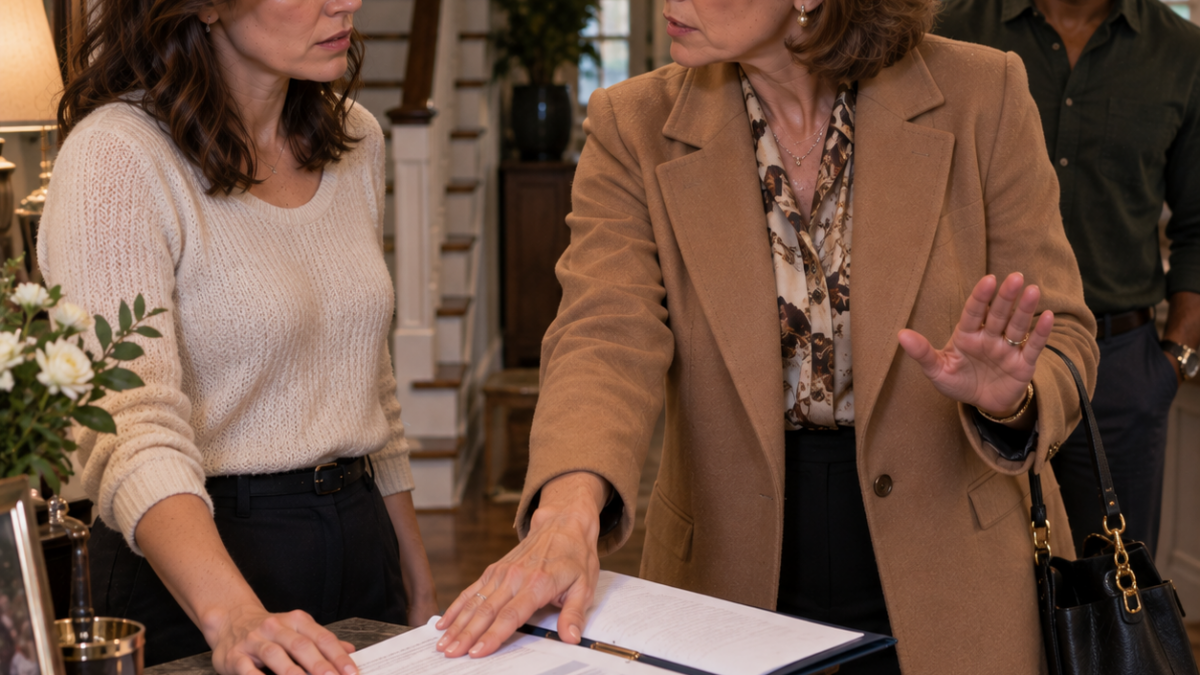
Eight years after my mother told me not to come home if I married Malik, she showed up at my front door with a bank folder and asked me to guarantee $1.1 million for my brother.
She called it “a family emergency.”
I called it impressive timing.
Three days earlier, the company Malik and I built had announced a majority acquisition. A business publication ran our photo beside a headline estimating that the deal put our combined holdings somewhere around $34 million.
The number was misleading. Most of it wasn’t cash.
My mother didn’t know that.
She also hadn’t called on my birthday in eight years.
I’m Claire Morgan. I was thirty-five, a CPA and CFO of a healthcare-logistics software company in Raleigh, North Carolina.
Malik is my husband.
He’s also Black.
That mattered to my family more than anything else when I was twenty-seven.
My parents had spent my whole life caring about appearances, church committees, the family business, and what people in Greensboro might say.
When I told them I was marrying Malik, my mother, Marianne, asked if I had considered “what kind of life that would create for our family.”
My father said less, which somehow hurt more.
My older brother Grant told me I was throwing away everything I had been given.
I married Malik anyway.
My parents skipped the wedding.
They ignored the announcement when our daughter Ava was born.
My father died three years later, and I learned about the funeral from a cousin after it was over.
So when Marianne appeared on my porch holding a leather handbag and a thick white bank folder, I didn’t hug her.
She looked past me into the house.
Malik was in the kitchen helping Ava with homework.
My mother didn’t ask to see either of them.
Instead she said, “Grant is in trouble.”
Apparently my brother’s commercial-interiors company had overexpanded. A development project had stalled, the bank was tightening its credit line, and my mother said the family house could be next.
Then she opened the folder.
“We don’t need a gift,” she said. “We just need your signature.”
The first page was a personal guaranty for $1.1 million.
I laughed once.
She frowned.
“This isn’t funny.”
“No. It really isn’t.”
She tapped the paperwork.
“With the position you’re in now, this is nothing. You won’t even feel it.”
Eight years of silence, and somehow she already knew what I could afford.
I turned the page.
There was a mortgage consent tied to a warehouse property in Greensboro.
Then another page.
Member Consent — Whitaker Property Holdings, LLC.
I stopped.
My name appeared beneath my mother’s and Grant’s.
Claire Whitaker Morgan.
Twenty percent membership interest.
I looked up.
“You told me I was out of the family.”
Her expression changed.
Only slightly.
“That was personal.”
I looked back at the page.
“This looks financial.”
She reached for the folder.
“It’s a technicality. Your father never cleaned up the old ownership paperwork.”
But the bank hadn’t treated it like a technicality.
There was a yellow signature tab beside my name.
After eight years of being told I had no family, no inheritance, and no place in anything the Whitakers owned, somebody suddenly needed me to sign as an owner.
I closed the folder.
My mother held out her hand.
“Claire, don’t make this about the past.”
I kept the documents.
“I’m not.”
Then I looked at the membership page again.
“I’m trying to figure out why my name is still on your future.”
My mother wanted the folder back.
I told her my attorney would return it after I had reviewed everything.
She said lawyers would only make the situation uglier.
That was enough reason for me to call one.
The next morning, my attorney, Dana Cho, pulled the North Carolina business records and the original operating agreement for Whitaker Property Holdings.
My mother had been wrong about one thing immediately.
My ownership wasn’t old paperwork.
It was active.
Twenty percent.
The agreement required unanimous member approval before the company could mortgage its primary warehouse.
Dana turned to the signature page.
“Your father amended this after you got married.”
My stomach tightened.
Attached was a member resolution signed six months after my wedding.
It did not remove me.
It specifically confirmed that my interest could not be canceled, transferred, or redeemed without my written consent and an independent valuation.
I read my father’s signature three times.
The man who never called me again had made sure they couldn’t take my ownership away.
Then Dana found something else in the bank packet.
The proposed loan wasn’t described as money to prevent foreclosure on my mother’s home.
Its stated purpose was to cure a covenant default connected to Grant Whitaker Development LLC.
I looked at Dana.
“That isn’t the family business.”
“No,” she said.
“It’s your brother’s real-estate company.”
The emergency my mother brought to my door had already changed shape twice.
I went home with copies.
Malik was making pasta.
Ava sat at the island drawing animals that looked like they had survived industrial accidents.
She was seven and believed every horse required at least six legs.
I waited until she went upstairs.
Then I put the documents on the counter.
Malik read quietly.
He had learned long ago not to react to my family before I did.
That was one of the many things I loved about him.
Finally he said, “Your father protected your shares?”
“Apparently.”
“How do you feel about that?”
“I don’t know.”
That was true.
I had spent years knowing exactly how I felt about my father.
Angry.
Abandoned.
Finished.
Now a legal document had inserted one additional fact.
Not an apology.
Not a birthday call.
Not an invitation to his funeral.
One signature protecting property I didn’t even know I still owned.
Malik turned the page.
“This loan is for Grant?”
“His development company.”
“Your mother said it was the house.”
“Yes.”
He looked at me.
“You’re not signing.”
“I know.”
That answer came easily.
The harder question was what I was going to do with the twenty percent.
I had grown up around Whitaker Commercial Interiors.
My grandfather started it as an office-furniture dealership.
My father expanded into commercial interiors, warehouse systems, and large institutional installations.
The business was not glamorous, but it had been profitable for decades.
The family property company owned the warehouse, a small office building beside it, and several acres of land.
My grandmother had given Grant and me each twenty percent when we were young adults.
My parents kept the remaining sixty.
I remembered signing something at twenty-one.
I did not remember caring.
Back then I was finishing college and more interested in getting into public accounting.
I assumed it was estate planning.
Apparently that was exactly what it was.
Then I fell in love with Malik.
We met at a hospital-operations conference in Atlanta.
I was twenty-five and working for a consulting firm that helped healthcare systems analyze costs.
Malik was twenty-six, a software engineer presenting a prototype he had built for tracking critical medical supplies between hospitals and regional warehouses.
His demo broke.
Completely.
Halfway through.
He stood in front of forty people staring at an error message and said, “Well, at least now you know the system detects shortages.”
I laughed louder than everyone else.
He found me afterward.
“What was so funny?”
“The confidence.”
“I was dying.”
“You hid it well.”
“That’s because I’m very brave around projectors.”
We had coffee.
Then dinner.
Then another dinner when we were both back in North Carolina.
Malik grew up outside Durham.
His mother taught chemistry at a public high school.
His father repaired elevators.
Nothing about him fit the version of a Black man my parents had apparently assembled from fear, social prejudice, and people they already agreed with.
I thought meeting him would change their minds.
That was naive.
The first time Malik came to my parents’ house, my mother was polite.
Too polite.
She asked what his parents did.
Where they lived.
Where he went to college.
Whether he had student loans.
Questions that sounded normal one at a time.
Together, they were an assessment.
My father barely spoke.
Grant was friendlier.
Later, alone, he asked whether I was “serious.”
“Yes.”
He whistled.
“Mom’s going to lose her mind.”
“Why?”
He looked at me like I was insulting him by making him say it.
“You know why.”
I did.
I just wanted somebody else to own the sentence.
When Malik proposed two years later, I told my family at Sunday dinner.
My mother put down her fork.
“No.”
Not congratulations.
No.
I remember Malik asking later what that word meant.
At the time, I couldn’t explain it.
It meant she believed permission still existed.
The argument lasted almost an hour.
My father said marriage tied families together, not just individuals.
My mother said I was making a choice that would “change how people see all of us.”
Grant told them to calm down, then turned to me and asked why I needed to make everything harder than it had to be.
Eventually Malik’s name stopped appearing.
He became that man.
Your decision.
This situation.
My mother never used a slur.
She didn’t need to.
Prejudice becomes sophisticated when people care about manners.
The final conversation happened two weeks before our wedding.
My mother told me that if I went through with it, I should not expect the family to pretend everything was normal afterward.
I asked what that meant.
She said, “It means you can build the life you’ve chosen without us.”
My father sat in his chair and said nothing.
That silence decided more than her words did.
I married Malik at a small garden venue outside Durham.
His parents came.
His sister came.
My college roommate stood beside me.
There were forty-eight guests.
None had my last name.
Malik’s father walked me halfway down the aisle after asking if that would feel strange.
It did.
In a good way and a terrible way at once.
Afterward, I mailed my parents a wedding announcement.
Returned unopened.
Three months later, my company transferred me to Raleigh.
Malik quit his job and began building the healthcare logistics platform full-time.
We lived in a two-bedroom apartment.
I worked.
He coded.
For the first eighteen months, Northline Health Systems—then called M-Line Logistics because Malik was terrible at naming companies—made almost nothing.
I paid rent.
Malik picked up contract work.
We ate a lot of rice.
Nothing heroic.
Nothing cinematic.
Just two adults trying to make payroll and remember whose turn it was to buy detergent.
When Ava was born, I called my mother from the hospital.
Straight to voicemail.
I left a message.
“She’s healthy. Her name is Ava. Seven pounds, two ounces.”
No response.
I tried my father.
Nothing.
Grant sent one text four days later.
Glad baby is healthy.
That was the total contribution from my family to the first year of their granddaughter’s life.
I stopped calling.
Not because I stopped caring.
Because every unanswered call made Malik watch me get rejected again.
Eventually I realized continuing to offer my family opportunities to hurt me was not the same thing as keeping a door open.
Northline grew slowly.
Our first serious customer was a regional hospital system that had spent months losing track of emergency respiratory equipment between facilities.
Malik’s software cut the transfers they could not account for by almost half.
I was still working full-time then.
At night, I built financial models and contracts.
When the second health system signed, I left consulting.
I became CFO.
Malik hated budgets.
I loved them.
He saw possibilities.
I saw runway.
That combination worked.
By year five, we had eighty employees.
By year seven, almost two hundred.
We brought in outside investors only after we could negotiate from strength.
The acquisition came in our eighth year of marriage.
A public enterprise-software company wanted sixty-two percent of Northline.
Malik would remain CEO.
I would remain CFO for at least three years.
We kept meaningful equity.
There was cash in the transaction, yes.
More money than either of us imagined having when we lived above a noisy student apartment.
But the financial article took the total estimated value of our retained stock, transaction proceeds, and options and printed $34 million beside our photograph like somebody had deposited the entire amount into checking.
The morning after publication, old acquaintances appeared.
A college classmate I had not spoken to since graduation.
A former neighbor.
Two cousins.
Grant sent:
Hell of a headline. Congrats.
No apology.
No mention of eight years.
Then my mother arrived.
After Dana found the LLC documents, I asked her to get the complete bank file.
Because I was a member whose consent was required, the lender agreed to provide the relevant loan package through counsel.
It took four days.
My mother called twice during that time.
I did not answer.
Grant called once.
I let it go to voicemail.
His message was brief.
“Claire, Mom probably explained badly. Nobody’s asking you to rescue me. Call me.”
I sent it to Dana.
Not because it was threatening.
Because I had learned documentation is easier than memory.
The full loan package arrived Friday.
Dana and I went through it page by page.
The warehouse was appraised at $4.8 million.
The adjoining office building at $1.1 million.
The LLC carried approximately $1.6 million in existing debt.
Plenty of equity.
The lender was willing to extend another $1.1 million if every member consented to the warehouse mortgage and someone with outside liquidity provided a limited personal guaranty.
That someone was me.
But the money was not primarily going to Whitaker Commercial Interiors.
Grant had created a separate development company three years earlier.
He bought an old textile property outside Greensboro to convert into retail space, offices, and apartments.
Briarstone Commons.
The project ran over budget.
Interest rates moved.
One anchor tenant backed out.
Grant borrowed from the family operating company to keep the project moving.
Then he borrowed more.
Whitaker Commercial Interiors violated its bank covenant because too much cash had moved to an affiliate.
My mother and Grant had already pledged my mother’s investment account and part of the equity in her home to support earlier borrowings.
The new loan would consolidate part of that exposure.
My mother’s house was not scheduled for foreclosure.
There had been no notice of sale.
There was risk.
Real risk.
But not the emergency she described.
Dana slid the bank credit memo toward me.
“This is the part you need to read.”
Under repayment source, the bank listed three possibilities.
Operating cash flow from Whitaker Commercial Interiors.
Sale or refinancing of Briarstone Commons.
Additional support from family members.
Then:
Proposed guarantor Claire W. Morgan, reported recent liquidity event.
I stared at the wording.
“They told the bank about our acquisition.”
“Looks like it.”
“Before asking me.”
“Yes.”
Another paragraph said Grant and Marianne believed I would cooperate because of my historical ownership in the family property entity.
Historical.
A convenient word.
My ownership was current when they needed my signature.
Historical when describing why I had not participated.
I called Grant.
Dana was present.
I told him she was there.
“Fine,” he said.
He sounded exhausted rather than angry.
“What happened to Briarstone?”
A pause.
“You read the file.”
“I want your version.”
“The project got ahead of us.”
“Us?”
“My company.”
“Whitaker Commercial Interiors funded it.”
“Temporarily.”
“How much?”
“About seven hundred thousand.”
The bank records showed closer to eight hundred twenty.
“Grant.”
“Okay. More.”
“Did Mom know?”
“Yes.”
“Did Dad?”
“Dad was dead before I started it.”
I looked at Dana.
“Why did Mom tell me the house was about to be foreclosed?”
“Because she’s scared.”
“That’s not an answer.”
“It’s the answer I have.”
“And why the personal guaranty?”
“The bank asked.”
“Why did you give them my name?”
“Because you’re a member of the property company.”
“That’s not why they want my guaranty.”
He went quiet.
I said, “You told them about the acquisition.”
“Claire, we’re talking about paper risk. Nobody expects you to write a check.”
I almost laughed.
That was exactly how people sell guaranties.
Nobody expects the guarantor to pay until the moment they do.
“I’m not signing.”
He exhaled.
“Can we not do this over the phone?”
“There’s nothing else to discuss.”
“Yes, there is.”
“What?”
“The property company.”
I waited.
“If you won’t help with the loan, we need to figure out your interest.”
That interested me.
“What does that mean?”
“It means we should have dealt with it years ago.”
“Yes.”
“We can buy you out.”
“At independent market value?”
Another pause.
“Claire.”
“The operating agreement says independent market value.”
“You never contributed anything.”
“My grandmother gave me the interest.”
“You walked away.”
“I walked away from people. I didn’t sign away property.”
His voice hardened.
“Do you hear yourself?”
“Yes.”
“You have thirty-four million dollars and you’re arguing over a warehouse share you forgot existed.”
That was the moment my sympathy for him changed.
Not disappeared.
Changed.
“You called me for the first time in years after the article.”
“That’s not fair.”
“No. It’s chronological.”
He hung up.
Malik found me sitting at the dining table afterward.
“You okay?”
“My brother thinks having money means ownership stops mattering.”
“People get creative about other people’s money.”
I looked at him.
“You know what the worst part is?”
“What?”
“I feel greedy.”
“For not guaranteeing a million-dollar loan?”
“For caring about twenty percent of something I didn’t remember owning.”
Malik sat across from me.
“Would you feel greedy if the asset were worth fifty thousand?”
“No.”
“So the discomfort is about the size.”
“Probably.”
“That’s not morality. That’s scale.”
Malik was annoyingly useful that way.
The next week, Dana ordered an independent valuation of Whitaker Property Holdings.
My mother objected.
Grant objected.
The operating agreement allowed any member to request one in connection with a proposed transfer or major financing.
So we did.
While that was happening, I learned more about my father.
Not from family.
From the corporate minutes.
There were folders of annual resolutions going back twenty years.
Most were boring.
Lease renewals.
Manager appointments.
Tax elections.
Then the year after my wedding.
My mother and Grant had signed a proposed resolution authorizing the company to redeem my interest for the original transfer value.
Twenty thousand dollars.
My father had refused.
His handwritten note was scanned into the records.
Claire owns twenty percent. Personal disagreement is not a redemption event. If the company wants her units, pay fair value like any other member.
I sat in Dana’s office with my hand over my mouth.
“He defended me.”
Dana waited.
“No,” I said.
I corrected myself.
“He defended my ownership.”
That distinction mattered.
My father did not call me.
He did not meet Malik.
He did not know Ava.
He let my mother remove me from the family.
One principled corporate decision could not rewrite that.
But I had spent years believing he agreed with everything my mother said.
Apparently, even in his silence, there had been a line he would not cross.
I did not know what to do with that.
Two days later, my aunt Susan called.
My father’s younger sister.
We had exchanged Christmas cards for a while after the estrangement, then even that faded.
“I heard Marianne came to see you.”
“Of course you did.”
“She’s telling everyone you’re trying to take the warehouse.”
“I already own part of it.”
Aunt Susan sighed.
“I know.”
That irritated me.
“You knew?”
“Your father told me.”
“When?”
“Years ago.”
“And nobody thought I should know?”
“I assumed you did.”
The phrase families use when nobody wants responsibility.
I asked about the redemption resolution.
She went quiet.
“Your mother wanted you out of everything after the wedding.”
“And Dad?”
“He was angry too.”
“Because Malik is Black.”
“Yes.”
She did not soften it.
I appreciated that.
“But your dad was old-fashioned about property. He said if he gave you something, it was yours.”
“That sounds less noble when you say it like that.”
“It probably is.”
I smiled despite myself.
Susan continued.
“Claire, your father was wrong about Malik. Completely wrong. He knew that before he died.”
My chest tightened.
“How?”
“He watched the company website.”
“What?”
“Your company. When it started growing. He followed it.”
“That doesn’t mean anything.”
“No.”
She paused.
“But after Ava was born, he asked me if I had seen pictures.”
I stopped breathing for a second.
“You had pictures?”
“You sent me a Christmas card.”
I had.
Ava in a red dress.
Malik holding her.
Me looking exhausted.
“I showed him.”
“What did he say?”
Susan waited too long.
Finally:
“He said she had your eyes.”
That was it.
Not redemption.
Not enough.
More than I had before.
“Why didn’t he call?”
“I asked him that.”
“And?”
“He said he didn’t know how to come back from what he had done.”
I looked out my office window.
“Phones work both directions.”
“I told him.”
After we hung up, I cried in the bathroom at work.
Not because my father secretly loved me.
That story would have been too easy.
I cried because human beings are capable of regretting something deeply and still not doing the one uncomfortable thing required to repair it.
My father had protected my property because paperwork was easier than apology.
He had looked at a photograph of my daughter because curiosity was easier than knocking on my door.
I inherited twenty percent of a real-estate company and absolutely none of the conversation I actually wanted.
The appraisal came back at $5.35 million for the properties combined.
Net of existing debt, my twenty percent interest had meaningful value even after minority and liquidity adjustments.
The appraiser estimated a fair buyout range between $660,000 and $780,000.
Grant offered $150,000.
Dana read the email.
“Creative.”
I did not respond.
My mother called that evening.
I answered.
“Claire, this has gone far enough.”
“Which part?”
“You know exactly what I mean.”
“I’m not sure I do.”
“You’re forcing your brother to pay you three-quarters of a million dollars for something you abandoned.”
“I didn’t abandon it.”
“You left.”
“You told me to leave.”
“You chose Malik.”
There it was.
Eight years disappeared in one sentence.
Not my husband.
Malik.
The choice that caused everything.
I said, “Yes.”
She seemed surprised I didn’t defend it.
“Yes, Marianne. I chose Malik.”
“You chose him over your family.”
“No. I chose to marry him. You made that a competition.”
Silence.
Then:
“We were trying to protect you.”
“From what?”
She did not answer.
I pushed.
“What exactly were you protecting me from?”
“Claire.”
“No. Say it.”
“I am not having this conversation.”
“You drove to Raleigh asking me to guarantee a million-dollar loan. You can have this conversation.”
Her voice became colder.
“We were raised differently.”
That phrase.
The museum label for prejudice.
I said, “You were raised to think marrying a Black man made your daughter unfit to remain in the family.”
“That is not fair.”
“It’s accurate.”
“He was not from our world.”
I almost laughed.
“Which world?”
“You know what I mean.”
“I do. That’s the problem.”
She changed direction.
“What do you want?”
Not an apology.
A transaction.
“What do you mean?”
“For the warehouse. What number?”
I looked at the appraisal.
“I don’t want to be bought out cheaply just to make Grant’s loan possible.”
“Then what?”
I had been thinking about that.
“I’ll consent to an orderly sale of the warehouse if the lender agrees.”
Silence.
“You want to sell the family business.”
“No. The operating company can lease somewhere else. I want to sell the property rather than mortgage it again to finance Grant’s development.”
“You know what that building means.”
“Yes.”
My grandfather bought it.
My father expanded it.
I had spent summers there stuffing folders and counting chair components because my father believed child labor built character.
I knew exactly what it meant.
Marianne said, “Your father would never agree to this.”
I looked at his handwritten note on my desk.
“Dad believed ownership mattered.”
She hung up.
The bank meeting happened two weeks later.
Neutral conference room.
Greensboro.
Dana came with me.
Malik came too.
That was my condition.
Not because I needed my husband to protect me.
Because I was done attending family meetings where everybody pretended the reason for our estrangement was vague.
When Marianne arrived and saw Malik, she stopped.
Grant came behind her.
He looked at me.
“You brought him?”
Malik answered before I could.
“I’m Claire’s husband.”
Grant’s face tightened.
“Obviously.”
Dana said, “Why don’t we sit down?”
The lender was a man named Thomas Reeves.
Mid-fifties.
Patient.
He did not care about our family history.
He cared about collateral.
That was useful.
Thomas explained the bank’s position.
Whitaker Commercial Interiors remained viable but overleveraged.
Briarstone Commons was not producing enough cash to service its debt.
The family had moved money between entities in ways the bank had previously allowed but would no longer tolerate.
The proposed $1.1 million loan would cure the operating-company covenant breach and provide time to restructure Grant’s development debt.
The bank wanted my property-company consent because the warehouse would secure part of the loan.
It wanted my limited guaranty because the recent acquisition suggested I had liquidity.
I said no.
Not dramatically.
“No.”
Thomas nodded.
He had heard borrowers say no before.
My mother had not.
“Claire.”
I kept looking at the banker.
“I will not personally guarantee Grant’s development debt.”
Grant leaned forward.
“It’s not just my debt.”
“The credit memo says otherwise.”
“The family company supported the project.”
“Because you moved money into it.”
“With Mom’s approval.”
“That doesn’t turn it into my obligation.”
My mother said, “You benefit from the family company.”
“I receive no income from it.”
“You own part of the property.”
“Yes. That is why I’m here.”
Dana slid our proposal forward.
We would approve marketing the warehouse for sale.
The operating company could negotiate a leaseback with a buyer or relocate.
Sale proceeds would pay secured property debt first.
The remaining proceeds would be distributed under the operating agreement unless all members agreed to another lawful allocation.
I was also willing to consider selling my interest to the family at appraised fair value if they could finance the purchase without my guaranty.
Grant read the first page.
“You want us to sell Grandpa’s building.”
“I want you to stop borrowing against it to fund Briarstone.”
“You can afford the risk.”
“That doesn’t make it mine.”
He looked at Malik.
“This is about him.”
I felt Malik beside me go still.
Grant continued.
“If she had married someone from home, none of this would have happened.”
Dana said, “Mr. Whitaker.”
I held up one hand.
“No. Let him finish.”
Grant’s face was red.
“You left everybody. Now you come back with lawyers and valuations and act like we owe you.”
Malik finally spoke.
“Claire didn’t come back.”
Everyone looked at him.
He leaned forward slightly.
“Your mother came to our house.”
The room went silent.
Not because it was clever.
Because it was true.
Grant looked away first.
My mother said, “This is exactly why we never accepted this.”
“Accepted what?” I asked.
She looked at Malik.
Then at me.
No answer.
For the first time, the banker understood there was another conversation inside the financial one.
He closed his folder.
“Perhaps counsel should continue discussing the collateral options.”
The meeting ended without a deal.
In the hallway, my mother caught my arm.
Not hard.
Just enough to stop me.
I looked down at her hand.
She let go.
“You would let everything your father built disappear over this.”
“No.”
I kept my voice low.
“I’m trying to keep Grant’s project from taking the rest of it with him.”
“You always thought you were smarter than everybody.”
“I’m a CFO. You came to me because you wanted that skill attached to my money.”
She flinched.
Good.
Not because I wanted to hurt her.
Because accuracy finally had somewhere to land.
Then she said the sentence that became the end of that version of our relationship.
“If you do this, don’t expect there to be anything left to come back to.”
I looked at Malik.
Then at Dana.
Then at the woman who had said essentially the same thing eight years earlier.
“I stopped waiting to come back a long time ago.”
We left.
The warehouse went on the market six weeks later.
Not because I forced it.
Because the bank refused additional credit without my consent and the family could not find another lender willing to take the same risk on acceptable terms.
Grant listed Briarstone too.
No buyer wanted to pay what he owed.
Eventually the project entered a negotiated restructuring and the primary lender took control.
Grant did not go to prison.
He did not become homeless.
He lost money.
A lot.
He closed his development company.
Whitaker Commercial Interiors survived by shrinking.
They moved into a smaller leased warehouse twenty minutes away.
About twenty employees were laid off over several months.
That part bothered me.
Those people had not made any racist decisions about my marriage.
They simply worked for a company whose owners had taken too much risk.
I called the new company president after Grant stepped back and offered to fund a limited outplacement program for laid-off workers.
Not through the family.
Through an outside employment firm.
Malik asked if I was sure.
“Yes.”
“Your mother may interpret that as weakness.”
“I don’t care what she interprets anymore.”
That was new.
The warehouse sold for $4.92 million.
After debt, transaction costs, and reserves, Whitaker Property Holdings distributed the remaining proceeds according to ownership percentages.
My share was a little over $630,000.
The money hit an account one Tuesday morning.
I stared at it longer than I stared at our acquisition proceeds.
Not because it was larger.
Because it came from a family asset I had been told eight years earlier no longer had anything to do with me.
I moved twenty-five thousand dollars into the outplacement fund.
The rest went into our normal investment structure.
No vacation.
No car.
No victory purchase.
It was money.
Not an apology.
My mother used part of her distribution to pay down the debt secured by her house.
She kept the house.
That mattered.
The emergency had never required me to save her home with a personal guarantee.
Selling an overleveraged family asset solved the actual problem.
Grant hated me for it.
He sent one email.
Dad built something meant to stay in this family. You cashed out the second it became inconvenient.
I started writing a response.
Deleted it.
Dana had taught me the usefulness of not litigating emotion by email.
I never replied.
Three months later, Aunt Susan mailed me a box.
Inside were photographs from my father’s office.
One showed him and my grandfather in front of the original warehouse.
Another showed Grant and me as kids sitting on stacks of boxed office chairs.
Then there was a sealed envelope with my name in my father’s handwriting.
Susan included a note.
Found this in his desk after Marianne moved offices. I don’t know if he meant to send it.
I waited until Malik came home.
“You want me here?”
“Yes.”
I opened it.
The letter was dated eleven months before my father died.
Claire,
I have rewritten this enough times to know rewriting is another form of avoiding the thing itself.
I was wrong about Malik.
That sentence alone made me stop.
Malik’s hand closed around mine.
I kept reading.
My father wrote that he had let fear of other people’s judgment disguise itself as principle.
He wrote that silence had been cowardice.
He had watched interviews with Malik.
Read articles about Northline.
Seen one picture of Ava that Susan showed him.
He said he wanted to call.
Then:
I do not know whether calling because I feel guilty would be another selfish thing. You built a life after I told you not to bring it near mine. I have no right to ask you to make my regret easier.
The last paragraph was worse.
If I find the courage, you will hear from me. If I don’t, know that the failure will be mine, not yours.
He never found the courage.
I sat at the kitchen table and cried until my head hurt.
Malik did not tell me the letter made anything better.
He knew it didn’t.
Ava came downstairs because she heard me.
She climbed onto my lap.
“What happened?”
I looked at Malik.
We had always told Ava that my parents and I were not close.
Not why.
Not yet.
I wiped my face.
“I found a letter from your grandpa.”
“The one who died?”
“Yes.”
“Was it nice?”
Children ask impossible questions cleanly.
“Parts of it.”
She accepted that.
Then she asked for cereal.
Life is useful that way.
My mother remained silent for another four months.
Then a letter came.
Actual paper.
No bank folder.
No attorney copied.
I recognized her handwriting immediately.
I almost threw it away.
Malik said, “You don’t have to read it.”
“I know.”
I opened it anyway.
The first paragraph was an apology.
The second explained.
Too much.
How she was raised.
What people said.
What she feared.
How my marriage had felt like rejection of everything she taught me.
I nearly stopped.
Then I reached a sentence that was different.
I have spent years calling what I did “disapproval” because the word racism makes me ashamed. It was racism.
I read that line three times.
She wrote that losing the warehouse had forced her to go through old records.
She had found my father’s resolution.
Then learned Susan had sent me his letter.
She did not ask for money.
She did not ask me to forgive Grant.
She asked whether I would meet her once.
I showed Malik.
“What do you want?” he asked.
“I don’t know.”
“You can say no.”
“I know.”
“Do you want me there?”
“Yes.”
That answer I knew.
My mother suggested a restaurant in Greensboro.
I chose Raleigh instead.
Neutral ground, maybe.
But also mine.
She drove down.
Malik and I arrived together.
When Marianne saw him, she stood.
For eight years, I had imagined the scene where she finally apologized.
In some versions, I made her suffer first.
In others, she cried and I felt nothing.
Reality was smaller.
She looked old.
Not broken.
Just older than the woman who had stood in my parents’ dining room and told me my marriage would embarrass the family.
She looked at Malik.
“I owe you an apology.”
He nodded.
“Yes.”
My mother’s eyes filled.
She did not seem prepared for him to agree so plainly.
“I judged you without knowing you.”
“Yes.”
“I treated your marriage to my daughter like something done to me.”
Malik waited.
Marianne continued.
“And I ignored your child.”
“Our child,” he said.
She closed her eyes for a second.
“Yes. Your child.”
I watched.
This was the part I had not understood when I was younger.
An apology is not a speech somebody performs while the injured person reassures them.
Sometimes the correct response to “I hurt you” is simply “yes.”
My mother turned to me.
“I am sorry.”
I said, “I believe you are sorry.”
Her face changed.
Not enough, apparently.
“Is that all?”
“For today.”
She nodded slowly.
Then she asked about Ava.
There it was.
The decision I knew was coming.
“I want to meet her.”
“No.”
My mother looked stunned.
I kept going.
“Not yet.”
“Claire—”
“You had eight years to wonder what she looked like.”
She lowered her eyes.
“I know.”
“You don’t go from refusing to acknowledge her existence to grandmother because you wrote one honest letter.”
“I understand.”
Maybe she did.
Maybe she simply knew arguing would end the meeting.
Either way, she accepted it.
I told her we could meet again.
Adults first.
No Ava.
No holidays.
No pretending eight years had been a misunderstanding.
If a relationship developed, it would develop from what happened next.
Not from biology demanding an instant reset.
She agreed.
We met three more times over the next year.
Always with Malik at first.
Then once just her and me.
Grant did not participate.
He believed I had chosen money over family.
I believed he had mistaken access to my signature for family.
We were not close to resolving that.
My mother eventually met Ava.
Not at Christmas.
Not at our house.
At a public garden in Raleigh on a Saturday afternoon.
Ava knew she was my mother.
Nothing more complicated than that.
Marianne brought no expensive gift.
I had specifically asked her not to.
She brought a children’s book about astronomy because Ava liked planets.
They walked around the garden for an hour.
Ava asked why Marianne had never met her before.
Of course she did.
My mother looked at me.
I did not rescue her.
She crouched so she was level with Ava.
“Because I made some very bad choices when your parents got married.”
Ava considered that.
“Were you grounded?”
Malik laughed so suddenly he had to turn away.
Marianne smiled through tears.
“Something like that.”
That was the beginning.
Not forgiveness.
Not restoration.
A beginning.
Two years after the acquisition, Northline moved into a larger office.
We had a family day before the official opening.
Employees brought spouses and kids.
Ava ran around giving tours of rooms she had never seen before as if she had designed them herself.
My mother came.
She stood near the back during Malik’s remarks.
No special introduction.
No symbolic front-row chair.
Afterward she came over while I was talking to one of our early investors.
He asked how Marianne knew me.
There was a moment when I watched her decide what story to tell.
“I’m Claire’s mother,” she said.
Then she looked at Malik.
“And Malik’s mother-in-law. I’m still learning how to deserve both titles.”
The investor had no idea what that meant.
I did.
Later, Malik and I were cleaning up.
Ava had fallen asleep in a conference-room chair.
My mother had already left.
Malik found me staring out the window.
“What?”
“Nothing.”
“That’s never true.”
I smiled.
“I used to think the ending I wanted was Mom showing up because we were successful and me getting to tell her she couldn’t have any of it.”
“And?”
“I got that ending.”
“Kind of.”
“And it didn’t actually finish anything.”
Malik leaned against the wall.
“Money usually disappoints people who hire it to do emotional work.”
“Did you just invent that?”
“Yes.”
“It sounded suspiciously polished.”
“I’m CEO now. We get phrases.”
I laughed.
The truth was simpler.
My mother did come back after the headline.
Money opened the door.
There was no pretending otherwise.
If Northline had failed quietly, I don’t know whether she ever would have driven to Raleigh.
Maybe not.
That fact remains part of our relationship.
So does the fact that when the financial problem was gone, she kept writing.
Kept driving.
Kept apologizing even when no money was on the table.
People are allowed to begin for bad reasons and make better choices afterward.
They are not entitled to forgiveness because they do.
That distinction matters to me.
Grant and I remain mostly estranged.
He rebuilt Whitaker Commercial Interiors on a smaller scale.
The company is profitable again.
I know because public filings exist and because Aunt Susan tells me things whether I ask or not.
Grant sent Ava a birthday card last year.
No money.
Just a card.
I let her open it.
She asked who Uncle Grant was.
I said, “My brother.”
“Why haven’t I met him?”
“We’re not close.”
She accepted that answer for now.
Someday she’ll want the longer version.
When she does, I’ll give it to her.
That may be the biggest thing I learned from all of this.
Malik and I are not raising Ava around our net worth.
She doesn’t know what our shares are worth.
She doesn’t need to.
But we do not invent poverty either.
When she asks why we can afford something, we explain.
When we say no, we tell her whether it is because we cannot afford it or because we do not think it is a good use of money.
I refuse to make secrecy sound like virtue just because secrecy once protected me.
A few months ago, Ava asked why my last name used to be Whitaker.
I told her.
Then she asked whether being a Morgan meant I stopped being a Whitaker.
I thought about the warehouse.
My father’s resolution.
My mother at the bank meeting.
Grant.
The $630,000 distribution.
The letter in my father’s handwriting.
“No,” I said.
“You can be part of where you came from without letting it decide where you’re going.”
She frowned.
“That sounds like a grown-up answer.”
“It is.”
“Can I have ice cream?”
“Yes.”
That answer was easier.
The bank folder my mother brought to our house is still in my office.
Dana told me years ago I could shred it.
I never did.
Not as a trophy.
As a reminder.
The first page asked me to guarantee $1.1 million.
The page behind it listed me as a twenty-percent owner of something my family had spent eight years pretending had nothing to do with me.
For a while, I thought that contradiction was the whole story.
It wasn’t.
The real contradiction was that my family believed they could erase me emotionally while preserving whatever legal or financial version of me might someday become useful.
I stopped cooperating with that arrangement.
I did not guarantee Grant’s debt.
I did not surrender my ownership because I had become wealthy elsewhere.
I did not use my wealth to destroy them either.
I let the numbers become what they were.
Ownership.
Debt.
Risk.
Value.
Then I made the family questions stand on their own.
Who apologized?
Who didn’t?
Who changed?
Who still believed blood was a bill that came due whenever they needed something?
Those questions took longer.
Some still do.
My father once wrote that if he never found the courage to call, the failure was his.
For years I thought silence meant the person on the other end had all the power.
Now I know silence can also be a choice you stop chasing.
My mother eventually spoke.
My brother has not.
I no longer build my life around either possibility.
The company Malik and I built is doing well.
Ava is eight.
My mother knows her.
Carefully.
Slowly.
With boundaries.
There is no key to our house on her ring.
No family account she can access.
No promise that one honest letter erased eight years.
But there is a Saturday next month when she is driving to Raleigh for lunch.
Ava requested the planet book again.
Malik will be there.
So will I.
Not because blood comes first.
Because behavior comes next.
For now, that is enough.







