My Family Called Me “Fine” After the Attack—Then Tried to Control My Trust
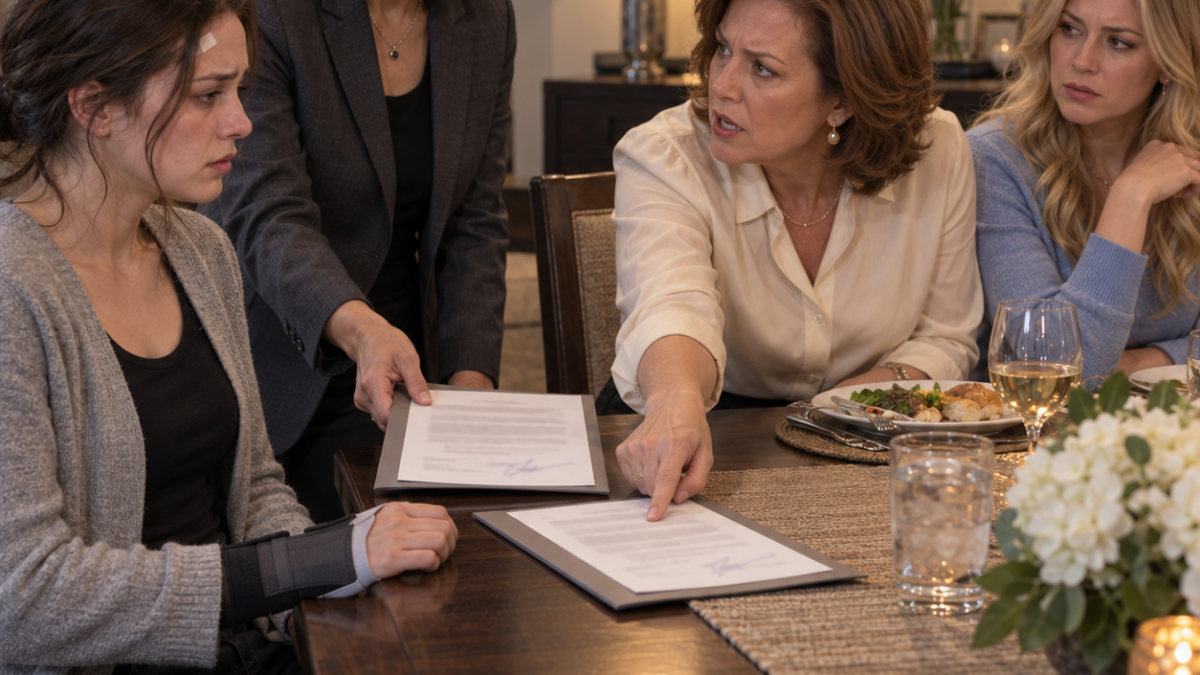
My mother told me to sign a “temporary family management form” six days after I was attacked by a man who had mistaken me for my younger sister. I was 29, newly discharged from a Phoenix hospital with a wrist brace and stitches hidden under my hair, and nobody in my family had visited because Brooke was “too traumatized by knowing it should have been her.” When I reached the gated townhouse my parents had moved into while I was hospitalized, my room wasn’t ready, Brooke’s favorite dinner covered the table, and Mom asked me not to discuss the attack because it triggered her nightmares. Then Dad pushed a legal packet toward me. It would let him manage the trust my grandparents left me “until I felt normal again.” I almost signed—until our family attorney walked in holding another copy with my signature already on it.
The attack itself had happened outside a hotel in Scottsdale.
Brooke and I had attended a charity dinner with our parents.
She left early after arguing with her ex-boyfriend.
I stayed behind to help Mom gather auction items.
When I finally walked toward the parking garage, a man approached me from behind and called Brooke’s name.
I turned.
That mistake was enough.
Police later told me he had been looking for my sister over a financial dispute involving her former boyfriend.
He realized quickly that he had the wrong woman.
That didn’t prevent me from spending three days in the hospital.
No one from my family came.
Dad called once.
Mom sent flowers from the hospital gift shop.
Brooke texted:
I’m sorry. I can’t handle hospitals right now.
When I was discharged, I asked my mother to pick me up.
She said they had “a lot happening” and ordered a car instead.
The driver took me to our old house.
It was empty.
Not quiet.
Empty.
Furniture gone.
Closets cleared.
Even the family photographs had been removed.
I called Mom.
“We moved,” she said.
“You moved while I was in the hospital?”
“Brooke couldn’t sleep there anymore.”
I stared at the vacant living room.
“Why didn’t anyone tell me?”
“Because you had enough to deal with.”
That sentence almost sounded considerate.
Then she gave me the new address.
Forty minutes later, I stood inside a furnished townhouse in Paradise Valley while my parents and Brooke sat around a dining table eating lemon chicken, roasted potatoes, and the chocolate tart Brooke had loved since childhood.
My place had not been set.
Mom noticed me standing there with my hospital bag.
“Oh. We weren’t sure what time you’d arrive.”
Brooke looked at my wrist brace and immediately looked away.
“I’ve been having nightmares,” she said.
Dad nodded as if she had explained something important.
Mom pulled out a chair.
“Sit. But let’s not talk about what happened tonight.”
I stared at her.
“Why?”
“It upsets Brooke.”
Brooke’s eyes filled instantly.
“I already feel guilty.”
I hadn’t accused her of anything.
Dad gave me the warning look I knew from childhood.
“Don’t make this harder.”
So I sat down.
There was shellfish in the salad.
I’m allergic.
Mom had forgotten.
That wasn’t dramatic.
It was almost worse because it was ordinary.
I moved the bowl away.
Brooke talked about how frightened she was to leave the house.
Dad told her she could take as much time off work as she needed.
Mom offered to stay with her during appointments.
Nobody asked whether I could sleep.
Nobody asked what the doctor had said.
Nobody asked why my hands still shook whenever someone walked behind me.
Halfway through dinner, Dad disappeared into his office.
He returned carrying a gray folder.
“We should handle this while you’re here.”
He placed it in front of me.
Temporary Family Asset Management Authorization.
I looked up.
“What is this?”
“Nothing permanent.”
Dad sat beside me.
“Your grandparents left several assets in trust for you. Given everything that’s happened, it makes sense for me to handle the administrative side for a while.”
“I already handle it.”
“Not right now.”
Mom reached across the table and pointed at the signature line.
“This is exactly the kind of thing you shouldn’t have to think about while you’re recovering.”
Brooke quietly added, “Dad’s just trying to protect you.”
I flipped through the packet.
Property interests.
Investment accounts.
Voting rights in a family LLC.
Words I recognized but hadn’t expected to see at dinner.
“How long is temporary?”
Dad’s mouth tightened.
“Why are you interrogating us?”
Before I could answer, the doorbell rang.
Mom frowned.
“Who is that?”
Dad went still.
A minute later, the housekeeper led in Margaret Chen, the attorney who had handled my grandparents’ estate.
She carried a leather portfolio.
When she saw the gray folder in front of me, her expression changed.
“Avery,” she said, “have you signed anything tonight?”
“No.”
“Good.”
Dad stood.
“Margaret, this isn’t necessary.”
She ignored him.
Instead, she placed a second copy of the same authorization beside mine.
There was already a signature at the bottom.
My name.
Avery Collins.
I stared at it.
Margaret looked directly at me.
“This version was submitted to my office two days ago.”
I looked from the signature to my father. He didn’t meet my eyes. Mom immediately said it had to be an administrative mistake. Margaret asked everyone except me to stop talking. The submitted version wasn’t only a temporary management form. Attached to it was a physician’s statement saying I was temporarily unable to make complex financial decisions. I had never met the physician whose name appeared on the page. Margaret had refused to process anything because the signature didn’t match the specimen she kept from my grandparents’ trust documents.
Then she showed me an email that had accompanied the packet. It came from Brooke. She had written that the family needed the authorization completed before Friday because a financing deadline was approaching.
“What financing?” I asked.
Nobody answered.
Margaret turned to Dad.
He told her it was family business and had nothing to do with my recovery.
That was when Margaret pulled out a collateral schedule. My trust owned a minority interest in Collins Ridge Lodge, a mountain property my grandparents had bought decades earlier. The document proposed pledging that interest toward a new $1.8 million credit facility.
I had never agreed to that.
Brooke stood so quickly her chair scraped the floor.
“We’re trying to protect the company.”
Margaret placed one final email in front of me.
The sender was Brooke.
The message had been written while I was still in the hospital.
Its subject line was:
Avery authorization — she won’t fight this right now.
The room went silent.
There are moments when your understanding of people doesn’t explode.
It narrows.
All the vague excuses, small slights, old disappointments, and family habits suddenly fit inside one clean outline.
Brooke believed I wouldn’t fight because I was injured.
Dad believed he could manage my property because he had always managed the family’s version of me.
Mom believed the right paperwork could be explained later if everyone acted as though the decision had already been made.
And I had spent most of my life teaching them that if they pushed hard enough, I eventually stopped resisting.
Margaret closed the portfolio.
“We’re leaving.”
Mom stood.
“Avery doesn’t need to go anywhere.”
Margaret looked at her.
“She does if she wants independent legal advice.”
Dad’s face reddened.
“I am her father.”
“You are also an officer of the company seeking access to an asset she controls.”
That shut him up.
Brooke pointed toward me.
“You don’t even know what the loan is for.”
Margaret stepped between the table and my chair.
“Then she can learn without signing anything.”
Brooke’s voice rose.
“If she blocks this, people could lose jobs.”
That sentence did exactly what it was designed to do.
It made refusal sound like harm.
I looked at her.
“How many people?”
“What?”
“How many jobs?”
She faltered.
“I don’t have the exact number.”
“What is the loan for?”
“Expansion.”
“Where?”
Dad cut in.
“Enough.”
Margaret gathered both copies of the authorization.
Dad put his hand over the unsigned one.
“That stays here.”
“No,” she said.
“It is company paperwork.”
“It contains Avery’s personal trust information.”
“I’ll make a copy.”
“No.”
I watched two adults argue over a document that apparently existed to protect me.
Then something inside me simply ran out.
“Give it to her, Dad.”
He looked at me.
“Avery, you’re exhausted.”
“Give it to her.”
“You don’t understand the consequences.”
“Then explain them tomorrow.”
Mom shook her head.
“Why are you being so difficult?”
Margaret looked at me before I could answer.
She didn’t speak.
She didn’t need to.
That was the first time anyone in the room treated my no as information rather than an obstacle.
Dad released the folder.
I stood.
My hospital bag was still beside the front door.
Brooke crossed her arms.
“You’re seriously leaving?”
“Yes.”
“Where?”
“A hotel.”
Mom looked offended.
“You have family.”
I glanced around the dining room.
My sister’s favorite food.
No place setting for me.
A forged signature.
A doctor I had never met declaring me incapable.
“Yes,” I said. “Apparently I do.”
I left with Margaret.
Outside, my hands started shaking again.
Not dramatically.
I could still walk.
Still think.
Still answer questions.
My body just hadn’t learned that being outside a parking garage meant I was safe.
Margaret noticed.
“We don’t have to discuss anything tonight.”
“I want to.”
“You don’t have to.”
That sentence almost broke me.
Not because it was kind.
Because it gave me something my family rarely did.
Choice.
We drove to a hotel near Camelback.
Margaret waited in the lobby while I checked in.
Then we sat in a corner with two cups of tea I didn’t drink.
She started with the trust.
My maternal grandparents, Ruth and Samuel Harris, had raised me for large stretches of my childhood.
That wasn’t part of some dramatic family exile.
The truth was quieter.
My parents were building Collins Hospitality when Brooke and I were young.
They traveled constantly.
Brooke hated leaving them.
I adapted more easily.
So I spent summers, school breaks, and eventually almost two full school years with my grandparents in Flagstaff.
My parents called it practical.
Grandma called it unfair.
She never said that in front of them.
Only to me once, when I was sixteen.
“You’re easy to send away because you make being left look easy.”
I didn’t understand the sentence then.
I did now.
When my grandparents died, they divided their estate.
Some money went to charities.
Some to Mom.
Brooke received a smaller education account.
I received the trust.
At the time, Mom told me Grandma had done it because I was “the responsible one.”
The trust held cash, market investments, and a 31 percent non-controlling interest in Collins Ridge Lodge LLC.
The lodge had once belonged mostly to my grandparents.
My parents’ company operated it under management agreements.
I had never been involved operationally.
Distributions arrived quarterly.
Margaret’s office sent reports.
I signed annual consents when appropriate.
That was it.
“What does Dad need my interest for?”
“The lodge is being proposed as part of a collateral pool.”
“For the $1.8 million?”
“Yes.”
“Why?”
“Collins Hospitality is opening a wellness property outside Sedona.”
I stared at her.
“Brooke’s project.”
Margaret hesitated.
“You know about it?”
Brooke had talked about nothing else for a year.
She worked in marketing for my parents’ company.
Her “desert wellness concept” appeared constantly on social media.
Renderings.
Mood boards.
Stone tubs.
Meditation decks.
She called it her first major development.
I had congratulated her.
Bought her a bottle of champagne.
Never once had anyone mentioned my trust was expected to help finance it.
“How much cash has the family company put in already?”
“I don’t know.”
“You know something.”
Margaret sighed.
“I know the lender became concerned after cost estimates increased.”
“By how much?”
“Enough that they requested additional collateral.”
“And my interest fills the gap.”
“Partly.”
I leaned back.
The hotel lobby seemed too bright.
“How long have they been discussing this?”
“Your father asked me generally about trust authority three months ago.”
“What did you tell him?”
“That he has none over your trust unless you grant it or a court determines you lack capacity.”
“So they tried incapacity.”
“I don’t know who decided that.”
“You saw the doctor’s statement.”
“Yes.”
“Is it real?”
“The doctor exists.”
“Have I ever met him?”
“Not according to what you’ve told me.”
I rubbed my wrist beneath the brace.
My family had not visited me in the hospital.
Yet somehow a physician connected to them had certified that I couldn’t manage money.
Margaret leaned forward.
“We are not going to guess tonight.”
She took out a notebook.
“Tomorrow we verify.”
Technical facts.
That helped.
I had spent my career designing exhibits for a science museum in Denver.
My job was to take complicated information and make it understandable to people moving through a space.
Dinosaurs.
Climate systems.
Astronomy.
Medical technology.
A good exhibit does not tell visitors what to feel.
It gives them enough structure to understand what they are seeing.
That night, I needed the same thing.
Not:
My family doesn’t love me.
Not:
Brooke is evil.
Not:
Dad wants to steal my trust.
Facts.
A document was submitted.
The signature wasn’t mine.
A physician statement questioned my capacity.
My trust interest appeared on a collateral schedule.
Brooke’s email assumed I would not fight.
That was enough.
The next morning Margaret arranged a call with an independent trust attorney named Daniel Reyes.
I signed a limited engagement.
For the first time in my life, someone represented me in a family conflict who had no interest in family harmony.
It was refreshing.
Daniel asked one question repeatedly.
“Did you authorize that?”
No.
“Did you ask for that?”
No.
“Did you receive notice?”
No.
It became almost comical.
By noon, we had learned that the physician statement came from Dr. Malcolm Pierce, a concierge doctor my parents used.
He had never examined me.
He had spoken to my father.
His statement did not say I was legally incompetent.
It said that “based on reported symptoms following recent trauma, temporary assistance with complex decision-making may be medically reasonable.”
That was bad enough.
But someone had attached it to the authorization as if it established incapacity.
Dr. Pierce, once contacted by Daniel, immediately clarified in writing that he had never intended his letter to support transferring legal control of my assets.
One piece collapsed.
Then the signature.
The electronic version contained an image copied from a museum vendor contract I had signed two years earlier.
Same signature.
Pixel for pixel.
That was worse.
“Who downloaded that?”
Daniel asked.
The contract was public.
Anyone could have.
That meant we couldn’t prove from the signature alone who had placed it on the form.
The email trail mattered more.
Brooke had sent the final packet.
Dad had reviewed earlier drafts.
Mom had participated in messages about timing.
Nobody had written:
Forge Avery’s name.
Real misconduct rarely arrives labeled.
Instead, Brooke wrote:
She’s on medication and not dealing with details.
Dad responded:
Get Margaret what she needs.
Mom wrote:
Please don’t bother Avery until she’s home.
Then Brooke:
I can handle the signature page.
I read that sentence three times.
Daniel tapped the printout.
“This is where we stop speculating and ask.”
I didn’t want to ask Brooke.
Not yet.
I asked a different question.
“What happens if I refuse the collateral?”
Margaret answered.
“The lender either restructures the deal, asks for different security, reduces the facility, or walks away.”
“Does the family company collapse?”
“No.”
“Do people lose jobs immediately?”
“No.”
“Then Brooke lied.”
“She exaggerated.”
That distinction mattered.
Collins Hospitality was not on the edge of bankruptcy.
The Sedona project was.
More precisely, the project was on the edge of becoming smaller than Brooke wanted.
Without the extra credit line, they could still proceed if the family injected more equity, sold another asset, brought in an outside investor, or reduced scope.
My trust was the easiest solution.
Which explained why everyone had treated it as inevitable.
I flew home to Denver two days later.
I did not return to the Paradise Valley townhouse.
My parents called.
I sent everything to voicemail.
Brooke sent:
You are making a business issue into a personal attack.
I didn’t answer.
Then:
Hundreds of people worked on this.
Still nothing.
Then:
Grandma left you that interest because you’re family. Using it to help the family is literally the point.
That one I forwarded to Daniel.
His reply:
Useful.
I smiled for the first time in days.
Back in Denver, I tried to return to work.
I lasted forty minutes.
A delivery cart rolled behind me in a service corridor.
I dropped a model panel.
My heart raced so hard I couldn’t speak.
My coworker Lena found me sitting on the floor.
“Do you want me to call somebody?”
“No.”
“Do you want me to sit?”
That question.
Again.
Choice.
“Yes.”
She sat.
No touching.
No questions.
Eventually the panic passed.
I had spent the previous week telling myself I felt strangely calm.
I wasn’t calm.
I was functioning.
There is a difference.
I booked an appointment with a trauma therapist.
Dr. Maya Holloway told me during our first session that numbness wasn’t evidence I had become cold.
It was my nervous system reducing the amount of information it couldn’t process.
“You may feel more later.”
“I don’t know if I want to.”
“That’s okay.”
“Everyone keeps telling me how I should feel.”
“Then we won’t.”
I almost laughed.
Apparently my entire recovery would involve professionals refusing to order me around.
The family conflict escalated while I was learning to sleep again.
Dad called my office.
I had reception route him to voicemail.
Mom emailed my personal address.
Subject:
Please think of Brooke.
The message was three pages.
Brooke had worked hard.
Brooke had finally found something she believed in.
Brooke had been traumatized by nearly becoming the victim of the attack.
Brooke’s project gave her something positive to focus on.
The financing delay was worsening her anxiety.
I reached the end.
Not one sentence asked how I was recovering.
I forwarded it to Dr. Holloway.
Not because she needed evidence.
Because I wanted to know whether I was reading it unfairly.
She asked:
“What part feels most important to you?”
“That she thinks Brooke’s anxiety is connected to my signature.”
“Is it?”
“No.”
“Then maybe that’s enough.”
I stopped trying to decode my mother.
Three weeks after the dinner, the lender suspended the $1.8 million facility.
Not canceled.
Suspended.
The company had thirty days to produce alternative collateral.
Dad finally came to Denver.
He didn’t tell me first.
He waited outside the museum after work.
I almost turned around when I saw him.
Then I remembered something Daniel had said.
You can talk without agreeing.
So I stopped ten feet away.
“What are you doing here?”
“We need to settle this.”
“No. You want to settle it.”
His face tightened.
“You always used to be more reasonable.”
That almost made me laugh.
“Did you know my signature wasn’t real?”
He looked toward the parking lot.
“Brooke said you had signed earlier paperwork.”
“That isn’t what I asked.”
“I knew you hadn’t personally signed that version in front of me.”
“Did you think I had authorized it?”
Silence.
“Dad.”
“I thought you would.”
There it was.
The family philosophy in four words.
I thought you would.
I had spent my whole life being retroactively volunteered.
Grandma needs help.
Avery will stay.
Brooke is upset.
Avery will understand.
The family needs collateral.
Avery will sign.
“How is that different from knowing I didn’t?”
He became angry.
“Because you are making this sound criminal when we were trying to keep a project moving.”
“You used my signature.”
“I didn’t.”
“You accepted a document carrying it.”
“I assumed Brooke had spoken to you.”
“She hadn’t.”
“I know that now.”
“No. You knew she hadn’t before I came home. You told her not to bother me.”
His face changed.
I had the emails.
There was nowhere for the conversation to hide.
Dad lowered his voice.
“I made a mistake.”
“That is not the whole mistake.”
“What do you want me to say?”
I wanted an answer to a question older than the loan.
“Why is Brooke always the emergency?”
He stared at me.
“What?”
“She doesn’t sleep, we move houses.”
“Avery—”
“She feels guilty, nobody visits me.”
“You told us you were stable.”
“I was in the hospital.”
He looked away.
“Brooke thought she was the intended victim.”
“I know.”
“She was terrified.”
“So was I.”
“You’ve always handled things differently.”
“Because nobody handles them for me.”
That landed.
His face softened for a second.
Then the business problem returned.
“If you don’t approve the trust pledge, we may lose the Sedona property.”
There it was.
A choice.
Finally stated correctly.
“If I don’t approve.”
“Yes.”
“What happens then?”
“We lose part of the deposit.”
“How much?”
“About two hundred eighty thousand.”
Family money.
A lot.
But not ruin.
“Brooke said jobs would disappear.”
“The project would create jobs.”
“That’s not the same thing.”
Dad closed his eyes.
“No.”
I nodded.
Facts.
“Then don’t tell me refusing is hurting employees.”
“I didn’t.”
“She did.”
“I can’t control everything Brooke says.”
“No. Apparently only what I sign.”
He flinched.
I almost apologized.
Old habit.
I didn’t.
Dad asked whether I would at least meet with the company board.
I agreed.
Not because I was moving toward yes.
Because I owned 31 percent of Collins Ridge Lodge LLC and had ignored that fact for years.
If my asset was significant enough to finance Brooke’s project, I should understand it.
The board meeting changed the story again.
It took place over video.
The Collins Ridge Lodge itself was profitable.
Very profitable.
The LLC distributed cash every year after reserves and capital expenses.
My parents’ hospitality company received a management fee.
I knew that.
What I had not understood was how important the lodge had become as collateral for the broader family business.
Grandma had designed my trust to prevent exactly this.
Margaret found the old estate memorandum.
My grandparents had watched my parents borrow aggressively during earlier expansions.
They intentionally placed my lodge interest behind an independent trustee structure so nobody could casually leverage it for other projects.
Grandma wrote:
Avery is likely to defer to the family even when doing so is not in her own interest.
I had to stop reading.
She had known.
Before I did.
My grandmother had built a legal boundary around the adult I would become because she knew I might never build one emotionally.
That was the main reveal.
The trust wasn’t evidence Grandma loved me more than Brooke.
It was evidence she knew how my family used me.
Mom had always described the trust as a reward for being responsible.
It wasn’t.
It was protection from being too responsible.
The difference changed everything.
At the board meeting, Brooke presented the Sedona expansion.
It was good.
That annoyed me.
I wanted the project to be ridiculous.
It wasn’t.
The design made sense.
The market analysis was credible.
The location had potential.
Brooke had done real work.
The problem was not that she was incompetent.
The problem was that she had decided the strength of her project entitled her to my asset.
When she finished, Dad asked whether I had questions.
I had one.
“If the lender didn’t have access to Collins Ridge, what would you do?”
The CFO answered.
“Reduce phase one by roughly thirty percent or bring in outside equity.”
Brooke cut in.
“Which gives away ownership.”
“So instead I give away control of my collateral.”
“It’s temporary.”
I smiled despite myself.
“Everyone loves that word.”
Mom, who was sitting beside Dad, looked down.
The CFO cleared his throat.
“There is another possibility.”
Everyone turned.
The family owned a vacation property in La Jolla through a separate holding company.
It could be sold.
Brooke’s face changed immediately.
“No.”
Interesting.
The La Jolla property was where my parents spent summers.
Brooke used it constantly.
Suddenly preserving sentimental family property mattered more than the Sedona project.
I asked:
“What is it worth?”
“Approximately two point one million.”
Dad frowned.
“We are not selling La Jolla.”
“Why not?”
“It belongs to the family.”
“So does my lodge interest, apparently.”
Nobody answered.
There it was in full daylight.
My assets were family resources.
Their assets were family heritage.
Brooke became angry.
“You barely even go to Collins Ridge.”
“I receive the distributions.”
“That’s not the same.”
“As what?”
“Actually caring about it.”
I leaned toward the camera.
“Paying attention to an asset is not a prerequisite for owning it.”
“You sound like a lawyer.”
“I hired several.”
The meeting ended without agreement.
The next day, Daniel sent formal notices revoking any implied authority my parents might claim over the trust.
Margaret confirmed that no collateral pledge could proceed without valid approval.
I instructed the independent trustee to reject the current proposal.
That was my decision.
Not revenge.
Not emotional indifference.
A financial decision about my property.
The immediate consequence was simple.
The lender withdrew the $1.8 million facility.
The Sedona project did not collapse.
It shrank.
Collins Hospitality renegotiated the land purchase.
They lost $90,000 of their original deposit but preserved the rest by extending closing.
An outside investor bought a minority position.
Brooke hated that.
She called it giving strangers part of the family’s future.
I did not point out the irony.
I wanted to.
Growth.
A month later, the physician who wrote the letter sent me a formal apology.
Dr. Pierce admitted he should have refused to provide any statement about my decision-making without examining me.
He also wrote that my father had framed the request as temporary help with bill management.
That matched Dad’s style.
Never ask directly for the thing that sounds bad.
Ask for something adjacent.
Let everyone else connect the pieces.
I filed the apology with the other documents.
I did not sue him.
Daniel said we had options.
I didn’t want a second war.
The forged signature issue was harder.
No one admitted placing the signature image on the form.
Brooke said a project coordinator prepared the packet.
The coordinator said Brooke gave her the materials.
Dad said he assumed authorization existed.
Mom claimed she had nothing to do with document preparation.
There was enough ambiguity that a criminal accusation would have turned into a long fight.
I made a different choice.
Brooke signed a written acknowledgment that she had no authority to submit documents on my behalf.
The family company agreed to notify my trustee directly for any future request involving Collins Ridge.
My parents paid my legal fees related to the dispute.
Not because money fixed it.
Because consequences needed to land somewhere other than me.
Brooke and I stopped speaking.
Mom called twice a week at first.
I answered once.
She cried.
“I don’t understand how we got here.”
I did.
But explaining it again felt like returning to a job I had resigned from.
“You asked me to leave the house because Brooke couldn’t sleep.”
“She was struggling.”
“I know.”
“And you were so calm.”
“I was injured.”
“We thought you needed space.”
“You moved without telling me.”
Mom went silent.
“We didn’t mean to hurt you.”
That sentence used to matter enormously.
Intent had been my family’s universal solvent.
They didn’t mean to exclude me.
Didn’t mean to favor Brooke.
Didn’t mean to use me.
Didn’t mean to sign for me.
The problem was that consequences existed after intent left the room.
“I believe you,” I said.
She sounded relieved.
Then I added:
“It still happened.”
The relief disappeared.
That became our boundary.
I stopped debating whether they were good people.
Good people can create bad systems.
My parents loved me.
They also treated Brooke’s discomfort as urgent and mine as manageable.
Both were true.
I stayed in therapy.
Months passed.
My emotional numbness faded unevenly.
The first feeling that came back strongly was anger.
Dr. Holloway called that useful.
I disagreed.
Anger made grocery stores exhausting.
Made family emails feel like sparks.
Made me want to rewrite history out loud to people who weren’t listening.
Then grief arrived.
Not just about the attack.
About Grandma.
About the years I spent believing being easy to manage was a virtue.
About the fact that she had understood my family well enough to build legal protection into her estate.
I cried in Dr. Holloway’s office until my face hurt.
She handed me tissues.
“Better?” she asked eventually.
“No.”
“Fair.”
I liked her.
The first genuinely good feeling returned at work.
We opened an exhibit I had led for eighteen months.
It was about desert water systems.
Children moved through interactive displays I had helped design.
One little boy figured out a groundwater model and shouted:
“I did it!”
His mother high-fived him.
I laughed.
Not politely.
Actually laughed.
For a moment, I noticed it happening.
Then stopped noticing.
That felt like recovery.
My parents eventually sold the La Jolla property.
Not because I forced them.
Because the outside investor demanded more equity than Dad wanted to give away.
The sale financed part of Sedona and reduced company debt.
The project opened a year later at a smaller scale.
Brooke’s concept received good reviews.
I saw an article.
I sent nothing.
Not congratulations.
Not criticism.
Her success no longer needed to threaten me.
That was new.
Dad called after the opening.
“We did it.”
“Congratulations.”
“You could come see it.”
“Maybe someday.”
He paused.
“I miss you.”
I didn’t know what to do with that.
So I told the truth.
“I don’t miss how things were.”
“Neither do I.”
That surprised me.
A few months later, we met for lunch when he came to Denver.
No Mom.
No Brooke.
No business documents.
Dad looked older.
I probably did too.
He asked about therapy.
I almost told him it was none of his business.
Then answered anyway.
“Helping.”
He nodded.
“I’ve been seeing someone too.”
That might have been the most unexpected sentence of the year.
“For what?”
He smiled sadly.
“Apparently my daughters aren’t the only people I avoid difficult conversations with.”
We ate quietly.
Then he said:
“I knew Brooke sent the authorization before talking to you.”
I put down my fork.
“I know.”
“No. I mean I knew she hadn’t asked.”
I looked at him.
“I told myself we’d explain once you were feeling stronger.”
“Why?”
“Because if we asked first, you might say no.”
There it was.
No ambiguity.
No project coordinator.
No mistake.
He had not forged the signature.
But he had accepted bypassing my consent because consent might interfere with his plan.
“That is the part I can’t forgive yet.”
He nodded.
“I understand.”
“Do you?”
“I think so.”
I looked at him.
He looked miserable.
Old Avery would have rescued him from that feeling.
I let him have it.
Then I asked the question that had been waiting since the hospital.
“Why didn’t you visit me?”
Dad’s eyes filled.
“Brooke was falling apart.”
“I was in the hospital.”
“I know.”
“You could have left her for an hour.”
“Yes.”
“Why didn’t you?”
He wiped one eye.
“Because you always seemed like the one who would be okay.”
There it was again.
Competence as abandonment permission.
“I wasn’t okay.”
“I know that now.”
I nodded.
“That’s all I wanted you to say.”
We did not hug at the restaurant.
I wasn’t ready.
But we met again six months later.
Then again.
Mom took longer because every conversation eventually returned to Brooke.
Brooke is having a hard year.
Brooke feels ashamed.
Brooke wants to apologize but doesn’t know how.
Finally I told Mom:
“Stop bringing me reports from a person who has my number.”
She did.
Brooke didn’t call.
That was her choice.
I respected it more than another apology delivered through Mom.
Two years after the forged authorization, Margaret retired.
She invited me to lunch.
At the end, she handed me a slim archival box.
“What is this?”
“Your grandparents’ original trust correspondence.”
I had digital copies.
These were handwritten notes.
Grandma’s handwriting filled yellow legal pads.
Most of it was boring.
Tax questions.
Property valuations.
Distribution language.
Then I found a note about me.
Avery will say yes because saying no makes her feel selfish.
Please structure this so she does not have to be the bad person in order to protect herself.
I cried in the restaurant.
Margaret pretended not to notice until I recovered.
“Did she ever say that to you?”
“No.”
“She should have.”
“Maybe.”
I folded the note carefully.
Grandma had given me property.
More importantly, she had given me a boundary before I knew how to create one.
I changed the trust after that.
Not the beneficiary.
The governance.
I added an independent investment adviser.
Any transaction involving a family-affiliated company required third-party valuation and written conflict review.
No emergency authorizations without direct verification.
No family member could accept my signature by image.
Boring.
Specific.
Beautiful.
Brooke and I finally spoke three years later.
Not because Mom arranged it.
Brooke emailed me directly.
Subject:
No excuses.
I almost deleted it.
Instead I read.
She wrote:
I knew you hadn’t signed.
I told myself you would.
Dad told me you’d understand once the financing closed.
I was scared the project would disappear and angry that one signature from you could decide something I had spent years building.
I made your recovery convenient for me.
I am sorry.
No mention of nightmares.
No mention of the attack.
No argument that she had suffered too.
Just the thing she did.
I waited two weeks.
Then replied:
Thank you for saying it clearly.
She asked if we could meet.
I said not yet.
A year later, we did.
Coffee.
Public place.
Ninety minutes.
She looked different.
Not physically.
Less certain.
“I used to think you got everything from Grandma,” she said.
“I thought you got everything from Mom and Dad.”
She smiled without humor.
“We were both keeping score.”
“Probably.”
“But what I did wasn’t about fairness.”
“No.”
“I wanted what you controlled.”
“Yes.”
She looked at me.
“You always looked like you didn’t care.”
“I cared too much.”
That surprised her.
We did not become close.
We stopped being enemies.
Sometimes that is enough.
My family never returned to what it had been.
I am grateful.
The old version required one daughter to be fragile and one to be durable.
Brooke needed saving.
Avery could adjust.
Once I refused the role, everyone had to become more complicated.
Brooke learned to survive disappointment.
Dad learned that asking was different from informing.
Mom learned that my silence did not mean consent.
I learned that independence isn’t the same as emotional invulnerability.
The attack left me with scars that faded.
The family conflict left different ones.
I still dislike parking garages.
I still notice footsteps behind me.
I still read every document before I sign it.
That last one might be permanent.
I don’t mind.
Collins Ridge Lodge remains in my trust.
I visit now.
Once or twice a year.
The first trip was alone.
I drove from Denver through the mountains in October.
Aspens had turned yellow.
The lodge sat above a reservoir, timber and stone against cold blue water.
I had seen financial statements for years.
I had never really seen the place as mine.
Not mine alone.
But mine in the legal, adult sense my family had always blurred.
I checked into a normal guest room.
Paid the restaurant bill.
Walked the property.
No ceremony.
At sunset, I sat on the terrace and opened Grandma’s note on my phone.
Avery will say yes because saying no makes her feel selfish.
I laughed.
She had been right.
For years.
Not anymore.
The waitress asked whether I wanted another glass of wine.
I looked at the mountains.
“No, thank you.”
She nodded and walked away.
No persuasion.
No guilt.
No emergency.
Just a no that remained a no.
It shouldn’t have felt revolutionary.
It did.
The biggest change in my life after the attack wasn’t that I became emotionally numb.
It was realizing how many people had benefited from me confusing numbness, patience, and compliance.
I used to believe strength meant tolerating what other people couldn’t.
Now I think strength can look much smaller.
Reading the form.
Asking what it does.
Refusing to sign.
Leaving the room.
Letting someone else be disappointed.
And trusting that their disappointment is not automatically your responsibility.
My family once believed I would always say yes because I had always survived the consequences.
They finally learned something my grandparents understood first.
Surviving without protection does not mean you never deserved it.
And loving your family does not require handing them the pen.







