My Brother Hid My Wheelchair at His Wedding—Then the Bride Found the Planner’s Email
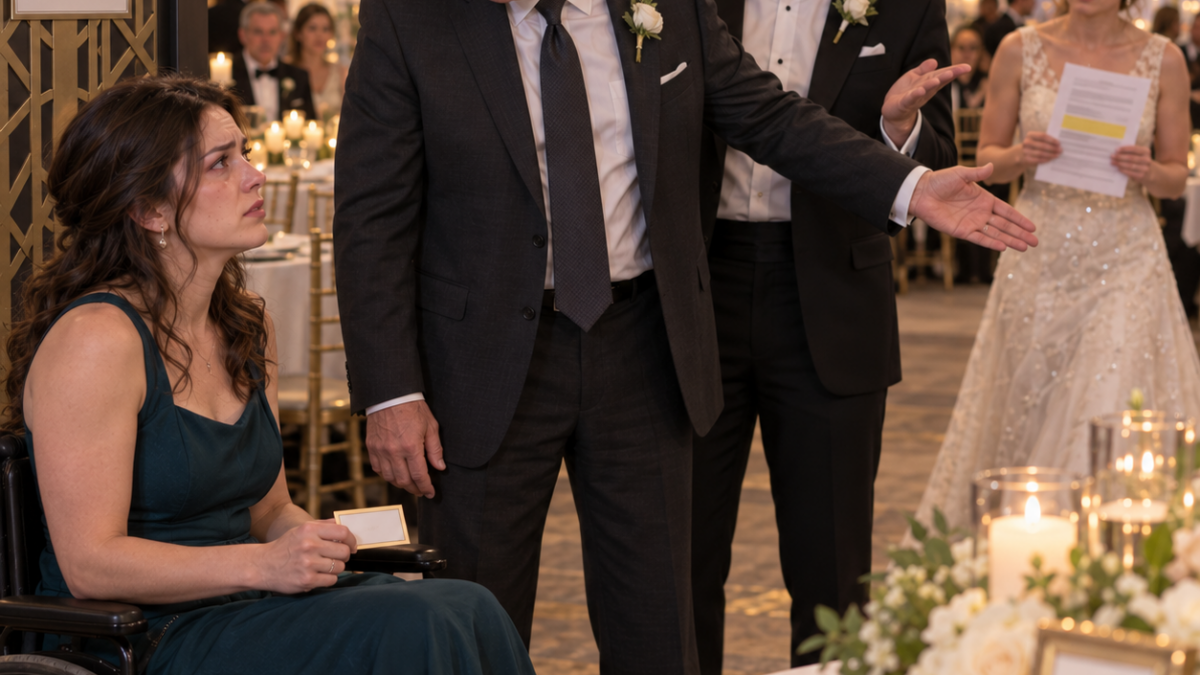
My brother Noah spent nine months telling me I was essential to his wedding, then seated me behind a decorative divider because he didn’t want my wheelchair in the primary reception photos. I had negotiated vendor schedules, paid $21,400 in deposits as my wedding gift, and agreed to be a backup payer for several optional upgrades if the budget held. At the ballroom, my father pointed toward Table 18 near the service corridor and told me not to create a scene. Noah’s bride, Emily, looked horrified when she saw where I was. I stayed long enough to realize the placement was deliberate. Then Emily crossed the dance floor holding a printed planner email. The first line mentioned my name. The second mentioned my chair.
My name is Hannah Price. I’m 31, and I work in operations risk consulting in Milwaukee, Wisconsin.
I use a wheelchair.
That became part of my life after a car accident when I was 24.
It changed plenty of practical things.
It did not turn me into a different person.
My family, however, developed a strange habit of treating my chair as something that needed to be managed whenever appearances mattered.
My older brother Noah was 34.
He had always been good at presentation.
Good clothes.
Good photographs.
Good job titles.
He could walk into a room full of strangers and leave with three invitations and a new business contact.
Our parents loved that about him.
My father, Mark, called Noah “the natural people person.”
My mother, Diane, called him “effortlessly polished.”
I was the useful one.
When something became complicated, people called me.
That was how I became involved in Noah and Emily’s wedding.
Their original budget had started reasonable.
Then the guest list grew.
The venue package changed.
The photographer upgraded.
The band needed a longer performance window.
A late-night lounge appeared.
Transportation became more complicated.
Three months before the wedding, Noah called me.
“We need your spreadsheet brain.”
I helped because he was my brother.
I reviewed contracts.
Built a payment calendar.
Tracked cancellation deadlines.
Caught a duplicate catering charge.
Negotiated a transportation change that saved them almost $4,000.
Then I offered to pay several deposits as my wedding gift.
By the final month, I had paid $21,400.
Emily knew.
She thanked me every time.
Noah rarely mentioned it.
That should have bothered me more.
Six days before the wedding, I was at my parents’ house reviewing the final transportation schedule when I heard Noah speaking in the kitchen.
“Put Hannah somewhere accessible toward the back.”
Emily answered immediately.
“Accessible doesn’t mean hidden.”
I stopped in the hallway.
Noah lowered his voice.
I could still hear him.
“The photographers are already working around enough. I don’t want every family shot built around the chair.”
For several seconds, I did not move.
Emily said:
“She’s your sister.”
“I know.”
“She paid for half the things you keep adding.”
“That doesn’t mean the wedding has to revolve around her.”
I rolled backward before they saw me.
That evening, Mom came into the guest room where I was staying and told me seating had become “extremely complicated.”
I asked where I was sitting.
She said the planner was still finalizing it.
I already had access to the working seating chart.
Table 18.
Far side of the reception hall.
Behind a tall decorative divider.
Near the service corridor.
My parents were at Table 2.
Immediate family was at Tables 1 through 4.
I said:
“Why am I at 18?”
Mom gave me a careful smile.
“It gives you more room.”
“I didn’t ask for more room.”
“Hannah, please don’t turn this into something ugly right before the wedding.”
That sentence told me exactly whose comfort mattered.
I said nothing.
On the wedding day, I wore a deep teal dress I had bought months earlier.
I styled my hair.
I showed up.
During family photographs, the photographer’s assistant asked me to wait while they did a “clean standing composition.”
I looked at Noah.
He heard her.
He said nothing.
They took another photograph later with me at the edge.
Then we entered the reception.
Table 18 was exactly where the chart said it would be.
My place card sat beside a decorative screen tall enough to block most of the table from the center of the room.
I had barely stopped beside my chair when Dad approached.
“Just enjoy the evening.”
“Did you approve this?”
His jaw tightened.
“Hannah, don’t create a scene.”
Across the ballroom, Emily had reached the seating display.
She found my name.
Then she looked toward Table 18.
Her face changed.
She spoke sharply to Noah.
He brushed her off.
Then Emily turned away from him and walked toward me carrying a sheet of paper from the planner’s station.
She placed it on the table between us.
“Hannah,” she said quietly, “I think you need to read this.”
Emily turned the page so I could see the email chain. The first message was from the wedding planner. She had asked whether immediate family should remain together even if extra clearance was needed around my wheelchair.
Noah’s reply was underneath it.
Keep Hannah toward the rear tables where there’s more room.
Dad responded twelve minutes later.
Agreed. Main family area should stay visually clean.
My hand went still on the edge of the paper.
Emily pointed to another message.
“I never saw this.”
The planner had asked whether I knew about the change.
Noah answered:
She’ll understand. She’s helping with logistics anyway.
Emily looked sick.
“He told me you requested a quieter table because you didn’t like crowds.”
“I never said that.”
“I know.”
She sat beside me.
Then she asked a question I wasn’t expecting.
“How much of this wedding did you actually pay for?”
I told her about the $21,400 in completed deposits.
Her face went blank.
“Noah told me your gift was the transportation deposit.”
“That was one of them.”
Emily looked across the ballroom at her new husband.
Then she unfolded one final email thread.
“This came from your dad to the venue coordinator yesterday.”
I could only see the subject line.
Final payment backup.
Emily lowered her voice.
“I think they were planning to put more charges on you tonight.”
I read the email.
Dad had written it at 4:26 the previous afternoon.
If Noah’s card hits the limit during reception settlement, Hannah Price’s payment method is already on file. Use that for approved upgrades. She knows we may need flexibility.
I read it again.
Then I looked at Emily.
“I did not approve that.”
Her face tightened.
“I thought so.”
There was more.
The venue coordinator had replied:
Please confirm Hannah has authorized charges above the remaining $12,000 backup cap and whether her approval is required before each transaction.
Dad responded:
She’s family. We don’t need to bother her during the event.
I almost laughed.
Not because it was funny.
Because I had spent months building controls for multimillion-dollar operations at work, only to watch my father explain to a hotel why basic authorization should not apply to his daughter.
I had agreed weeks earlier to one narrow thing.
If the wedding budget remained within the version I had reviewed, I would allow up to $12,000 of specific optional charges to use my card after I approved them in writing.
That was not a blank check.
It was not permission for Dad to tell vendors I had “flexibility.”
And after the upgrades kept growing, I had approved nothing.
Emily asked:
“What exactly is still unpaid?”
“I need the vendor sheet.”
She handed it to me.
The outstanding items were almost entirely optional.
Two extra hours for the premium bar.
Band overtime.
A late-night dessert station.
An expanded afterparty lounge.
Additional shuttle vehicles.
Photographer overtime.
Decor rental that extended beyond the contracted pickup time.
Nothing that would stop the wedding.
Nothing that would leave a caterer unpaid for food already served.
Nothing that would strand the bride and groom without the reception they had contracted.
Just extras.
Expensive extras.
I added them mentally.
Roughly $15,700.
Dad had assumed my card would absorb the overflow.
While seating me behind a divider.
Emily watched my face.
“What are you going to do?”
I looked toward Noah.
He was laughing with two groomsmen.
My father stood nearby.
Mom was talking to relatives.
Nobody looked worried.
Why would they?
Hannah always handled it.
That was the family system.
I opened my phone.
Not to cancel the wedding.
Not to dispute the deposits I had already paid.
Those were gifts.
I meant them when I paid them.
I wrote one email to every vendor with my card authorization.
Effective immediately, please remove my payment method from all pending, optional, overtime, extension, and post-event charges. All previously completed payments and deposits remain valid. Any new or unpaid balance should be invoiced directly to the contract holder unless I provide separate written authorization.
I copied Emily.
Then I sent it.
She read the message.
“You’re sure?”
“Yes.”
“I’m sorry.”
I looked at her.
“You didn’t do this.”
“I married the person who did.”
“That is your problem to decide what to do with.”
Her eyes filled.
“I didn’t know he lied about the table.”
“I believe you.”
She nodded once.
I returned to Table 18.
I stayed through dinner because I did not want my departure to become the reason people remembered the reception.
That sounds ridiculous now.
Even then, I was protecting them.
I ate half my meal.
Spoke with a retired teacher seated beside me.
Watched Noah and Emily cut the cake.
Watched Dad give a toast about family loyalty.
That part nearly sent me out immediately.
Then the venue coordinator approached me.
Her name was Marisol.
She looked uncomfortable.
“Ms. Price?”
“Yes.”
“I received your email.”
“Good.”
“I want to confirm something directly because I was given conflicting instructions.”
“Ask.”
“Should your card be removed completely from tonight’s unpaid items?”
“Yes.”
“Even if Mr. Price requests otherwise?”
“Yes.”
She nodded.
“Thank you.”
Then she said:
“I’m sorry about your table.”
I looked at her.
“What?”
She lowered her voice.
“I recommended placing you with immediate family. We could have adjusted the layout.”
That mattered.
Not because I needed a stranger’s sympathy.
Because it removed the final practical excuse.
There had been no accessibility problem requiring Table 18.
The planner had offered a solution.
My family had rejected it.
“Thank you for telling me.”
Marisol walked away.
I stayed another fifteen minutes.
Then I found Emily.
She was standing near the hallway leading to the bridal suite.
“I’m leaving.”
Her face fell.
“You don’t have to.”
“I do.”
She hugged me carefully.
“Can I call you tomorrow?”
“Yes.”
Noah saw us.
He walked over.
“You’re leaving already?”
“Yes.”
“Why?”
For one second, I wondered whether Emily had told him.
Apparently not.
“I’m tired.”
He glanced toward Table 18.
“You could’ve just said you wanted to move.”
I stared at him.
“Emily told you to move me six days ago.”
His expression changed.
That was enough.
I rolled toward the exit.
He did not follow.
I had been home for less than ninety minutes when my phone began vibrating.
First Noah.
Then Dad.
Then Mom.
Then Noah again.
I let it ring until a text appeared.
CALL ME NOW.
Then another.
YOUR CARD IS DECLINING.
That was inaccurate.
The card was not declining.
The vendors no longer had authorization to charge it.
I waited.
The next call came from Dad.
I answered.
“What?”
His voice was low and furious.
“Did you remove your card from the venue?”
“Yes.”
“You cannot do that in the middle of the reception.”
“I just did.”
“We have charges due.”
“Then pay them.”
“Hannah, this is not the time.”
“It’s exactly the time the charges are due.”
He exhaled hard.
“You agreed to help.”
“I agreed to approve specific overages up to a cap.”
“Same thing.”
“No.”
“They are asking for another payment method.”
“Give them one.”
“You know Noah’s card is near the limit.”
“That sounds like information Noah should have considered before ordering upgrades.”
Dad went silent.
Then:
“You’re punishing your brother because of a seating issue.”
“No.”
“What would you call it?”
“I stopped authorizing my money.”
“You know what I mean.”
“Yes.”
I did.
He wanted me to admit that money and respect were unrelated.
They were not unrelated.
Not because financial help should buy affection.
It should not.
But access to my money was voluntary.
My family had confused consistent generosity with permanent entitlement.
“I paid every gift I promised,” I said. “I’m not reversing anything.”
“You are leaving him exposed.”
“He signed the contracts.”
“Hannah.”
“Dad.”
He lowered his voice.
“Guests are noticing.”
There it was.
Not the money.
Not me.
People noticing.
“I thought that was what you were trying to prevent all day.”
He hung up.
The reception did not collapse.
That distinction matters.
Nobody lost dinner.
Nobody was thrown out.
The cake remained.
The band finished its contracted set.
Guests danced.
What disappeared were the additions Noah had assumed somebody else would absorb.
The premium bar extension did not happen.
The band did not play the extra ninety minutes.
The photographers finished at the contracted time.
The late-night dessert wall never opened.
The additional luxury shuttles were not dispatched.
The afterparty lounge setup was collected instead of extended.
Dad eventually put $6,200 of additional charges on one of his own cards.
Noah covered another portion.
They declined the rest.
For a normal wedding, none of that would have mattered.
For Noah, whose entire identity that year had become producing a flawless event, every missing extra felt visible.
Guests asked whether the schedule had changed.
A groomsman joked that the afterparty had vanished.
A cousin ordered a rideshare because the extra shuttle never arrived.
The world continued.
That was the lesson.
The thing my family had treated as a catastrophe was simply them receiving the event they had actually funded.
The next morning, Emily called.
Her voice was exhausted.
“Can I come over?”
“Yes.”
She arrived around noon carrying a folder.
She had removed her wedding jewelry except for the ring.
She sat at my kitchen table.
“I didn’t go on the honeymoon.”
I stared at her.
“What?”
“Our flight was this morning.”
“Emily.”
“I know.”
“This is not because the bar closed early.”
“No.”
She pushed the folder toward me.
Inside were printed messages between Noah and the planner.
More than I had seen at the reception.
One message from the planner:
We can widen the main family aisle and place Hannah at Table 3. No additional charge.
Noah:
Keep current layout.
Planner:
Bride asked again that Hannah remain with immediate family.
Noah:
I’ll handle Emily.
Then the photograph instructions.
Photographer:
Confirm whether Hannah should be included in primary sibling and immediate-family sets.
Noah:
One full family shot is enough. Keep standing compositions cleaner.
The phrase made me nauseous.
Cleaner.
As if my wheelchair were clutter.
Then Dad:
Agreed.
I closed the folder.
Emily said:
“I asked him last night why he lied.”
“What did he say?”
“He said he was trying to avoid making every photograph complicated.”
I stared at her.
“What else?”
She looked ashamed.
“He told me your deposits were smaller than they were.”
“How much did he say?”
“About six thousand.”
I almost laughed.
“He knew.”
“I know.”
She put both hands around her coffee cup.
“I asked him how much he expected you to cover after the wedding.”
“And?”
“He didn’t know.”
“That sounds right.”
“He said your family always helps each other.”
I looked at her.
“Did he tell you how much he has helped me?”
Emily closed her eyes.
“No.”
Neither of us spoke.
Then she said something that changed how I understood Noah.
“I think he needed to believe he was independent.”
I understood immediately.
Noah loved being the person who had everything under control.
The beautiful wedding.
Successful career.
Apartment downtown.
Travel.
Perfect photographs.
My money disrupted the story.
So he made my contribution invisible.
Then he tried to make me less visible too.
That was not embarrassment about disability by itself.
It was embarrassment about dependence.
My chair was simply the easiest visual excuse.
Emily told me she was staying with her sister for several days.
Not because she had decided to end the marriage.
Because she had learned, less than twenty-four hours after the ceremony, that her husband had lied about money, seating, and instructions given in her name.
“I need to know what else he edits before telling me,” she said.
I did not advise her.
That relationship belonged to her.
After she left, Noah finally called again.
This time I answered.
He started immediately.
“Was it worth it?”
“What?”
“Humiliating me at my own wedding.”
I looked around my apartment.
The room was quiet.
“Did you hear yourself?”
“Hannah, don’t.”
“No. You put me behind a screen.”
“It was one table.”
“You told the photographer to minimize me.”
“I said simplify the compositions.”
“You lied to Emily.”
“I was under pressure.”
“You expected me to pay another fifteen thousand dollars without asking.”
“I knew you would help.”
That sentence stopped me.
“Why?”
He went quiet.
“Why did you know?”
“Because you always do.”
There it was.
The same assumption Dad had made.
The same assumption Mom had made.
I was dependable.
Therefore available.
I asked:
“If I had stayed at Table 18, paid every overage, and never said anything, would you have decided tomorrow that you treated me badly?”
He did not answer.
“Noah?”
“I don’t know.”
“That’s the first honest thing you’ve said.”
He became angry.
“You want an apology? Fine. I’m sorry about the table.”
“No.”
“What?”
“I don’t want an apology you’re offering because you lost your extras.”
“You’re impossible.”
“And I’m done funding you.”
Silence.
“What does that mean?”
“It means the wedding deposits were gifts. They stay gifts. I won’t ask for them back.”
He exhaled.
“But?”
“But I’m not paying your future bills. I’m not managing your contracts. I’m not fixing your budgets. If you ask me to attend something, I attend as your sister.”
“You’re really going to make this about money.”
“Noah, you made it about money when you expected mine without asking.”
I ended the call.
My parents arrived the next evening.
Unannounced.
I almost did not let them in.
Mom looked like she had not slept.
Dad looked irritated in the specific way he always did when a problem could no longer be controlled privately.
“We need to resolve this,” he said.
I moved backward from the doorway.
“You can come in for thirty minutes.”
Dad noticed the time limit.
He disliked it immediately.
They sat on my couch.
Mom started.
“Your brother’s marriage is in trouble.”
“That is not mine to fix.”
“Hannah.”
“It’s been one day.”
“Emily left.”
“She went to her sister’s.”
“You knew?”
“She told me.”
Dad leaned forward.
“You inserted yourself between them.”
I actually laughed.
“She came to me because Noah lied to both of us.”
“You removed payment in the middle of a wedding.”
“I removed authorization for new charges.”
“That distinction is ridiculous.”
“It is the distinction between my bill and somebody else’s.”
Dad stared at me.
I opened my laptop.
I had photographed the planner emails.
Emily had given me permission to keep copies.
I placed the screen in front of Dad.
His own message was there.
Main family area should stay visually clean.
Dad’s face changed.
Mom leaned closer.
“What is that?”
“Dad approving Table 18.”
Mom looked at him.
“You told me the planner recommended the back table.”
Dad shifted.
“It had more space.”
“The planner offered Table 3.”
I opened the next email.
Mom covered her mouth.
Dad said:
“You are taking language out of context.”
So I scrolled up.
The full context was worse.
The planner explicitly offered to reconfigure Table 3.
Dad rejected it.
Then I showed Mom the photography instructions.
One full family shot is enough.
Keep standing compositions cleaner.
Mom stared at Noah’s message.
“He said the photographer decided that.”
“No.”
Her eyes filled.
I did not feel victorious.
That surprised me.
I had imagined evidence would feel satisfying.
Mostly it felt sad.
Dad asked:
“Who else has these?”
“Emily. The planner. Probably the venue’s records.”
“Did you send them to relatives?”
“No.”
He relaxed visibly.
That told me what mattered.
“Do not,” he said.
I stared at him.
“Why?”
“This family has already been embarrassed enough.”
There it was again.
I closed the laptop.
“Dad, you still think the problem is who finds out.”
“What do you want me to say?”
“I want you to understand why it was wrong.”
“I understand.”
“No, you understand that it looks bad.”
Mom started crying.
“I should have stopped it.”
I looked at her.
She continued.
“I knew you were far back.”
“Did you know why?”
“I knew your father said the photographs would be easier.”
“And that didn’t bother you?”
She looked down.
“I told myself you wouldn’t care.”
“Why?”
“You’re not sensitive about the chair.”
I felt something inside me go cold.
“That is not the same as being okay with being hidden.”
She nodded.
“I know.”
“No. You know now.”
Dad stood.
“This is getting us nowhere.”
I looked at him.
“That’s fine.”
“What?”
“You can leave.”
His expression hardened.
“Hannah.”
“You came here to make the consequences stop. I can’t do that.”
Mom remained seated.
Dad stared at her.
“Diane.”
She did not stand.
“Mark, sit down.”
I had never heard my mother use that tone with him.
He stared at her.
She repeated:
“Sit down.”
He did.
Mom wiped her face.
Then she looked at me.
“I’m sorry.”
It was the first apology I received that did not contain the word but.
I did not say it was okay.
Because it wasn’t.
I said:
“Thank you.”
Dad said nothing.
Before they left, I gave them one boundary.
For sixty days, I did not want surprise visits.
I did not want requests for money.
I did not want anyone asking me to manage Noah.
If relatives had questions, my parents could answer them themselves.
Dad called sixty days excessive.
Mom said:
“Okay.”
That quiet agreement mattered more than Dad’s argument.
The family story spread anyway.
Not from me.
One of Noah’s cousins, Trevor, had been seated at Table 18.
He found out from Emily that the placement was deliberate.
He was furious.
Not because he cared about wedding politics.
Because he realized several people at that table had been used as camouflage.
If Table 18 contained only me, the exclusion would have been obvious.
So distant acquaintances and miscellaneous guests had been assigned around me.
Trevor posted one question in the family group chat.
Why was the groom’s sister behind the divider if the planner offered a family-table option?
Nobody answered immediately.
Then another relative mentioned hearing Dad tell me not to make a scene.
Someone else remembered the family photographs.
The story stopped being controllable.
Dad called me.
“Can you tell them to drop it?”
“No.”
“You have the planner emails.”
“I’m not sending them.”
“Then tell everyone there was a misunderstanding.”
“That would be a lie.”
“Hannah.”
“I didn’t start the conversation.”
“You could stop it.”
“Yes.”
“Then stop it.”
“No.”
He hung up.
For decades, Dad had equated authority with the ability to end a discussion.
For once, the discussion no longer belonged to him.
Meanwhile, Noah and Emily did not take their honeymoon.
They canceled it and used the refundable portion to cover remaining wedding expenses and reduce the card balance Dad had taken on.
Emily returned home after nine days.
She required complete financial transparency.
All accounts.
Credit cards.
Wedding balances.
Personal debt.
Noah agreed.
Then they started counseling.
I learned this from Emily, not Noah.
She told me she had not decided whether the marriage would survive.
She wanted to know whether Noah could stop managing appearances long enough to become honest.
That seemed fair.
Noah’s first apology arrived by email three weeks later.
It was terrible.
He explained stress.
Photography.
Crowds.
Venue limitations.
Family expectations.
I stopped reading halfway through.
The second apology was shorter and slightly better.
Still too much explanation.
The third arrived two months after the wedding.
This one was different.
Hannah,
I put you in the back because I did not want your wheelchair in the photographs I imagined showing people for the rest of my life.
I hate writing that sentence, but softening it would be another lie.
I also let Emily think the seating issue had been solved when it had not.
I let you pay for things while telling people I had the wedding financially under control.
I treated your help as private and your presence as inconvenient.
I am sorry.
I read it three times.
Then one final paragraph.
I wanted everyone to see the life I had built. The truth is, you were quietly supporting part of it while I was trying to keep you outside the picture.
That was the first time he named the real thing.
I replied:
I received this. Thank you for saying it clearly.
Nothing more.
An accurate apology does not instantly rebuild trust.
It simply gives rebuilding somewhere honest to start.
The sixty days with my parents changed me more than I expected.
My phone was quieter.
Nobody asked me to review a lease.
Nobody asked for emergency transfers.
Nobody needed me to compare insurance options.
At first, I felt useless.
That scared me.
I had built so much of my family identity around solving problems that I did not know how to interpret silence.
Then I began noticing how much time I had.
I worked fewer evenings.
I returned to a ceramics class I had abandoned.
I went out with friends without checking my phone every fifteen minutes.
I spent money on a weekend trip with two college friends and did not calculate which family expense I might need that money for later.
That was when I realized usefulness had become my price of admission.
I was the competent daughter.
The organized sister.
The one who covered gaps.
The one who did not need much.
Once I stopped performing that role, I had to discover whether anyone wanted a relationship with me when I was not solving something.
Mom did.
She waited the sixty days.
Then she asked whether I would meet her for coffee.
Not Dad.
Just her.
I agreed.
She did not ask about Noah.
She asked about work.
Then my ceramics class.
Then she said:
“I have been thinking about why I told myself you wouldn’t care about the seat.”
I waited.
“You made the accident look easier for us than it was.”
I frowned.
“What do you mean?”
“You came home from rehab and started solving everything immediately. Transportation. Work. Your apartment. Insurance. You hated when people hovered.”
“That’s true.”
“So I started telling myself you didn’t need protection.”
“I don’t need protection from my chair.”
She nodded.
“You needed protection from your family deciding your comfort mattered less.”
That sentence surprised me.
“Yes.”
“I didn’t do that.”
“No.”
She cried.
This time I reached across the table.
Not because her tears erased anything.
Because the conversation was finally about the right thing.
Dad took longer.
He apologized four months after the wedding.
Not at my apartment.
At my aunt’s anniversary dinner.
Before he sat down, he walked over to me.
“Where are you sitting?”
I pointed to a table near the center.
He nodded.
Then he chose a seat at the same table.
That small action hit harder than I expected.
Later, he said:
“I kept calling it practical because practical sounded better than admitting I cared about how photographs looked.”
I said nothing.
He continued.
“I was ashamed of the wrong thing.”
“What do you mean?”
“I should have been ashamed of what I was asking you to accept.”
That was enough for that night.
Noah and Emily stayed married.
Their first year was difficult.
Emily later told me counseling uncovered more than the wedding.
Noah was not secretly evil.
He was deeply afraid of looking unsuccessful.
He hid debt.
Minimized mistakes.
Avoided asking for help honestly.
Managed photographs because images felt controllable.
The wedding had been the largest version of a pattern already there.
He worked on it.
Slowly.
He and I did not become close immediately.
For almost a year, we saw each other only at larger family events.
He never asked me for money.
That became almost funny.
The first time he asked me for advice about a car lease, he started by saying:
“I am not asking you to pay for anything.”
I laughed.
“That is growth.”
He laughed too.
Eventually we found a different sibling relationship.
One with fewer transactions.
More directness.
He invited me to dinner because he wanted to see me, not because something needed fixing.
I learned to say no without preparing a legal brief explaining why.
He learned not to ask twice.
The $21,400 I spent on wedding deposits remained a gift.
People sometimes questioned that.
Why not demand it back?
Because I meant it when I gave it.
My brother’s later behavior did not turn my generosity into stupidity.
I refused to let him rewrite my motives too.
I gave that money because I loved him.
Then I stopped giving more because I respected myself.
Both decisions belonged to me.
What changed permanently was the role money played in my family.
I no longer served as automatic backup financing.
If someone invited me to an event, I attended as family.
If they wanted a consultant, we could discuss that separately.
If they needed a lender, there were banks.
Mom once joked that I had become “very corporate.”
I told her:
“No. I finally started using the same boundaries at home that everyone respects at work.”
She admitted that was fair.
The wedding photographs arrived months later.
Emily sent me the full gallery link herself.
The standing family photograph Noah had been so worried about was there.
I was on the far edge.
A floral arrangement partially blocked one wheel.
I expected the image to hurt.
It didn’t.
Then I reached a candid photograph the photographer had taken later.
Emily was kneeling beside me near Table 18.
The planner email was on the table.
My face looked stunned.
Emily looked furious.
Behind us, slightly out of focus, Noah was watching.
That photograph told the truth better than the polished family portrait ever could.
I saved it.
Not because I wanted to remember being humiliated.
Because it captured the exact moment I stopped confusing inclusion with belonging.
I had technically been invited.
Technically photographed.
Technically inside the ballroom.
Technically family.
None of those things mattered if the people closest to me believed my presence should be managed so their image remained comfortable.
Belonging is different.
Belonging means nobody needs you smaller before they can enjoy having you there.
A year after the wedding, Emily and Noah hosted a small anniversary dinner.
Nothing extravagant.
Twenty people at a neighborhood restaurant.
When I arrived, Noah met me near the host stand.
“Table’s through there.”
He pointed toward the main room.
Then stopped.
“I checked the spacing.”
I raised an eyebrow.
“Congratulations.”
He laughed nervously.
“I deserved that.”
My place was beside Emily.
No screen.
No service corridor.
No speech about accessibility.
Just a chair removed from the table so my wheelchair fit naturally.
Exactly how it should have been the first time.
During dinner, Noah made a toast.
Short.
No performance.
He thanked everyone for coming.
Then he said:
“This year taught me that a perfect-looking life and an honest life are not the same thing.”
He did not mention me.
I appreciated that.
My experience did not need to become material for his redemption speech.
After dinner, he approached me.
“Was that okay?”
“Yes.”
“You sure?”
“Yes, Noah.”
He smiled.
Then he walked away.
That may sound like a small ending after everything.
It was.
Small was good.
The wedding had been built around spectacle.
The repair happened through ordinary choices.
A better seat.
An honest bill.
A direct apology.
A question asked once instead of pressure repeated five times.
Parents who stopped treating embarrassment as the worst possible outcome.
A brother who finally learned that photographs do not become cleaner when you remove the person who helped make the celebration possible.
And me learning the part that mattered most.
I had spent years thinking generosity guaranteed belonging.
It does not.
You can pay.
Plan.
Fix.
Organize.
Rescue.
Show up.
And people can still decide you are inconvenient when the cameras come out.
The answer is not to give more.
The answer is to stop purchasing access to rooms where respect should have been free.
I did not ruin Noah’s wedding.
I did not cancel contracts.
I did not reverse gifts.
I did not demand that guests take sides.
I simply removed my payment method from expenses I had never agreed to own.
The wedding adjusted to the resources its actual contract holders had.
The family adjusted to a version of me they could no longer use automatically.
Noah adjusted to consequences he had always assumed somebody else would absorb.
And eventually, all of us adjusted to something healthier.
My wheelchair was never the thing making that ballroom complicated.
The complicated thing was a family willing to accept everything I contributed while treating my visible presence as something that needed to be softened, moved, or hidden.
Once I understood that, leaving Table 18 became the easiest decision I made all night.







